


Page 1 - D. Cancer biology
P. 1
Understanding functional roles of FAM86A

      in NF-κB mediated gastric tumorigenic responses


                           2
                                                                                   1
              1
                                         1
                                                          1
                                                 1
                                                                                           1
                                                                       1
   Yo Han Hong , Jae Gwang Park , Han Gyung Kim , Nur Aziz , Long You , Chaoran Song , Wooram Choi , Jieun Oh and Jae Youl Cho 1
                           1 Integrative biotechnology, Sungkyunkwan University, Suwon 16419, Korea
                            2 Colorectal Cancer Branch, National Cancer Center, Goyang 10408, Korea
                   BACKGROUND                                                  AIM
   Gastric cancer is the one of the most lethal and third  In this study, we investigated functional roles of
   cause of cancer related mortality. Gastric cancer is   FAM86A on the gastric tumorigenic responses.
   involved  in  various  oncogenic  signaling  pathways.
   FGFR1-PI3K-AKT-NF-κB signaling pathway affects the                      METHODS
   expression of various genes that regulate tumorigenic
   responses. These responses are known to be regulated   Clinical impact of FAM86A was assessed in total 426
                                                          patients with gastric cancer. Immunoblot and realtime PCR
   by post-translational modifications. Methylation as one of  were used to detect FAM86A expression in cell lines and
   the  post-translational  modifications  change  protein  patient samples. QunatSeq 3’ mRNA-Seq was used to
   structure, activity, and localization. FAM86A as a non-  screen the target genes of FAM86A. Biological functions of
   histone protein lysine methyltransferase has novelty and  FAM86A  were  examined  in  vitro  and  in  vivo.
   conserved sequence in the various species. However,    Immunoprecipitation  and  mass  spectrometry  were
   biological functions of FAM86A remain unclear.         conducted to identify the specific binding partners.
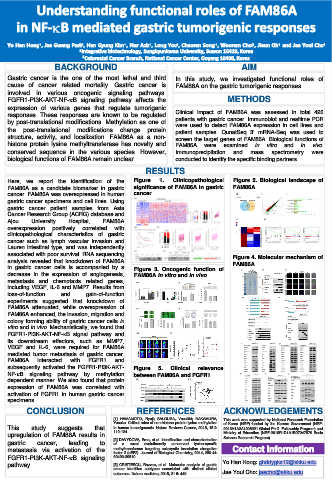
                                                RESULTS
   Here, we report the identification of the  Figure  1.  Clinicopathological  Figure 2. Biological landscape of
   FAM86A as a candidate biomarker in gastric  significance of FAM86A in gastric  FAM86A
   cancer. FAM86A was overexpressed in human  cancer
   gastric cancer specimens and cell lines. Using
   gastric cancer patient samples from Asia
   Cancer Research Group (ACRG) database and
   Ajou    University  Hospital,  FAM86A
   overexpression  positively  correlated  with
   clinicopathological characteristics of gastric
   cancer such as lymph vascular invasion and
   Lauren intestinal type, and was independently
   associated with poor survival. RNA sequencing
   analysis revealed that knockdown of FAM86A                                Figure 4. Molecular mechanism of
   in gastric cancer cells is accompanied by a  Figure 3. Oncogenic function of  FAM86A
   decrease in the expression of angiogenesis,  FAM86A in vitro and in vivo
   metastasis and chemotaxis related genes,
   including VEGF, IL-6 and MMP7. Results from
   loss-of-function  and     gain-of-function
   experiments suggested that knockdown of
   FAM86A attenuated, while overexpression of
   FAM86A enhanced, the invasion, migration and
   colony forming ability of gastric cancer cells in
   vitro and in vivo. Mechanistically, we found that
   FGFR1-PI3K-AKT-NF-κB signal pathway and
   its downstream effectors, such as MMP7,
   VEGF and IL-6, were required for FAM86A
   mediated tumor metastasis of gastric cancer.
   FAM86A    interacted  with  FGFR1  and
   subsequently activated the FGFR1-PI3K-AKT-  Figure  5.  Clinical  relevance
   NF-κB  signaling  pathway  by  methylation  between FAM86A and FGFR1
   dependent manner. We also found that protein
   expression of FAM86A was correlated with
   activation of FGFR1 in human gastric cancer
   specimens.
          CONCLUSION                         REFERENCES                   ACKNOWLEDGEMENTS

                                      [1] HAMAMOTO, Ryuji; SALOURA, Vassiliki; NAKAMURA,  This work was supported by National Research Foundation
                                      Yusuke. Critical roles of non-histone protein lysine methylation  of Korea (NRF) funded by the Korean Government (NRF-
   This    study    suggests    that  in human tumorigenesis. Nature Reviews Cancer, 2015, 15.2:  2016H1A2A1908921 Global Ph.D. Fellowship Program) and
   upregulation of FAM86A results in  110-124.                            Ministry of Education (NRF-2018R1D1A1B07047970 Basic
                                                                          Science Research Program)
   gastric   cancer,   leading   to   [2] DAVYDOVA, Erna, et al. Identification and characterization
                                                                lysine-specific
                                                         conserved
                                        a
                                      of
                                                evolutionarily
                                           novel
   metastasis via activation of the   methyltransferase targeting eukaryotic translation elongation  Contact information
                                      factor 2 (eEF2). Journal of Biological Chemistry, 2014, 289.44:
   FGFR1-PI3K-AKT-NF-κB signaling     30499-30510.
   pathway.                           [3] CRISTESCU, Razvan, et al. Molecular analysis of gastric  Yo Han Hong: ghddygks12@skku.edu
                                      cancer identifies subtypes associated with distinct clinical  Jae Youl Cho: jaecho@skku.edu
                                      outcomes. Nature medicine, 2015, 21.5: 449.

