


Page 5 - C. Biotechnology and molecular imaging
P. 5
Antibiotic-free system for phytoene production from recombinant E. coli
                                    Seung-Hye Lee , Seon-Won Kim *
                                                                        1
                                                     1
  1  Division of Applied Life Science (BK21 plus Program), PMBBRC, Gyeongsang National University, Jinju 52828,
  Republic of Korea
  *Corresponding author: Prof. Seon-Won Kim, Tel.: 82-55-772-1362; Fax: 82-55-759-9363; E-mail address: swkim@gnu.ac.kr
                   BACKGROUND                                                  AIM

   Phytoene is colorless and absorbs UV-B light from 260 to  In this study, for the improved production of phytoene,
   320 nm which can be used as a photo-protective material  we applied an antibiotic-free expression system. The
   to prevent urban skin aging. In order to synthesize    system is based on the isoprenoid pathway such as
   phytoene in E. coli, the phytoene biosynthesis pathway is  the MEP pathway and the MVA pathway. These
   introduced by expression vectors. Expression vectors are  pathways are required for the production of IPP and
   maintained by antibiotics. However, when antibiotics are  DMAPP which are essential metabolites for microbial
   used in the fermentation process, it causes increase in  growth. The genes consisting of the pathways are
   production costs. Moreover, as the culture progresses for  used instead of the antibiotic marker gene applying
   a long time, the antibiotics are decomposing and the   selection pressure to maintain the plasmids..
   plasmid disappears, leading to a decrease in production.
                                                METHODS

   Culture was  carried out for 72 hours in 2YT medium containing 3.0%(w/v) glycerol, 0.2%(w/v) arabinose at 30℃,
   +with antibiotics, - without antibiotics. Ampicillin and chloramphenicol were added as needed as antibiotics used, and
   were used at concentrations of 100µg/mL and 50µg/mL respectively. Phytoene was extracted using acetone. The
   extract was centrifuged at 14,000 rpm for 10 minutes, and only the top solution was taken to conduct a quantitative
   HPLC analysis.
                                                RESULTS

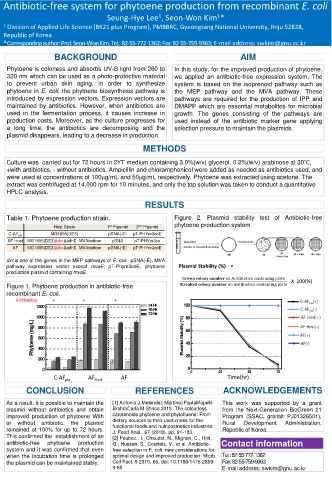
   Table 1. Phytoene production strain.                   Figure 2. Plasmid stability test of Antibiotic-free

                   Host Strain      1 Plasmid  2 nd  Plasmid  phytoene production system.
                                     st
                  MG1655(DE3)       pSNA(-E)  pT-PHYm3coE
    C-AF pla
    AF Host MG1655(DE3)ΔdxrΔadhE::MVAbottom  pSNA  pT-PHYm3co
     AF   MG1655(DE3)ΔdxrΔadhE::MVAbottom  pSNA(-E)  pT-PHYm3coE
   dxr is one of the genes in the MEP pathways of E. coli.. pSNA(-E), MVA
   pathway expression vector except mvaE; pT-Phym3coE, phytoene  Plasmid Stability (%)    =
   production plasmid containing mvaE.
                                                                                                                                   on Antibiotics containing plate  X  100(%)
   Figure 1. Phytoene production in antibiotic-free                                                                                            on Antibiotics containing plate
   recombinant E. coli.
      Antibiotics  +   -    +    -    +    -
             1200                                  24 Hr     100
                                                   48 Hr
                                                   72 Hr
             1000                                            80
            Phytoene (mg/L)  600                             Plasmid Stability (%)  60
             800
                                                             40
             400
             200                                             20
               0                                              0 0       24        48       72
                   C-AF pla   AF Host   AF                                 Time(hr)
          CONCLUSION                         REFERENCES                   ACKNOWLEDGEMENTS

   As a result, it is possible to maintain the  [1] Antonio J.Meléndez-MartínezPaulaMapelli-  This work was supported by a grant
   plasmid without antibiotics and obtain  BrahmCarla M.Stinco 2018. The colourless  from the Next-Generation BioGreen 21
   improved production of phytoene With  carotenoids phytoene and phytofluene: From   Program (SSAC, grant#: PJ01326501),
   or  without  antibiotic,  the  plasmid  dietary sources to their usefulness for the   Rural  Development  Administration,
   remained at 100% for up to 72 hours.  functional foods and nutricosmetics industries.   Republic of Korea.
                                      J. Food Anal., 67 (2018), pp. 91-103
   This confirmed the establishment of an  [2] Peubez., I., Chaudet, N., Mignon, C., Hild,
   antibiotic-free  phytoene  production  G., Husson, S., Courtois, V., et al. Antibiotic-  Contact information
   system and it was confirmed that even  free selection in E. coli: new considerations for
   when the incubation time is prolonged  optimal design and improved production. Micrb.  Tel.: 82-55-772-1362
   the plasmid can be maintained stably.  Cell Fact. 9 2010, 65. doi: 10.1186/1475-2859-  Fax: 82-55-759-9363
                                      9-65                               E-mail address: swkim@gnu.ac.kr

