


Page 328 - ebook
P. 328
Design of CNT-based electron microbeam cell irradiation system
                                     for low-dose radiobiology research
                                                                    c,d
                           Hanna Lee  , Jinho Choi  , Amar Prasad Gupta  , Jaeik Jung  , Jaekyu Jang  ,
                                                b
                                                                                d
                                                                                             d
                                     a
                                             Kyung-Sik Yoon  *, Jehwang Ryu  *
                                                            e
                                                                           f
                            a  Department of Age Service-Tech  Convergence,  College of Medicine, Kyung  Hee University,  Seoul 02447, Korea
                               b  Department  of Radiation  Oncology,  College of Medicine, Kyung  Hee University,  Seoul 02447, Korea
                                         c  Department of Physics,  Kyung  Hee University,  Seoul 02447, Korea
                                               d  CAT Beam Tech Co. Ltd., Seoul 02455, Korea
                          e  Department of Biochemistry  and Molecular  Biology,  College of Medicine, Kyung Hee University,  Seoul 02447, Korea
                                  f  Department  of Radiology,  College of Medicine, Kyung  Hee University,  Seoul 02447, Korea
              Abstract
      Radiation research is mostly aimed at improving the use of radiation such as radiation therapy and materials. Although the effect of high-dose
      radiation in cells has been studied a lot, the effect of low-dose radiation still needs a lot of scientific evidence. Therefore, we study the cellular
      response to low-dose radiation from the development of carbon nanotubes(CNT) cold cathode microbeam cell irradiator.
             Introduction                                                 Results
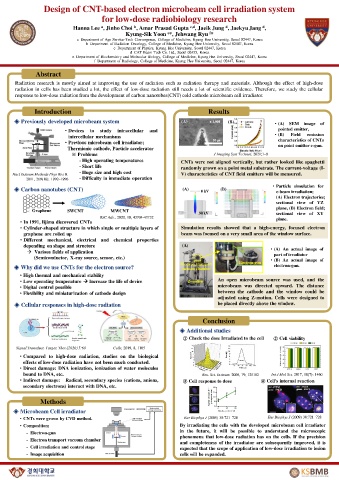
      ◈ Previously developed microbeam system                    (A)       x 1,000  (B)           • (A)  SEM  image  of
                        • Devices  to  study  intracellular  and                                   pointed emitter,
                         intercellular mechanisms                                                 • (B)  Field  emission
                        • Previous microbeam cell irradiator;               50 ㎛                   characteristics of CNTs
                         Thermionic cathode, Particle accelerator                                  on point emitter e-gun.
                          ※ Problems                                        J Imaging Syst Technol. 2021;1–8
                             - High operating temperatures       CNTs were not aligned vertically, but rather looked like spaghetti
                             - Short life                        randomly grown on a point metal substrate. The current-voltage (I-
                             - Huge size and high cost
     Nucl Instrum Methods Phys Res B.                            V) characteristics of CNT field emitters will be measured.
          2011, 269(18): 1992–1996  - Difficulty in immediate operation
                                                                                                 • Particle simulation for
      ◈ Carbon nanotubes (CNT)                                   (A)    0 kV   (B)                e-beam irradiation;
                                                                                                  (A) Electron trajectories;
                                                                                                  sectional view of YZ
                                                                                                  plane, (B) Electron field;
            Graphene     SWCNT          MWCNT
                                                                       30 kV                      sectional view of XY
                                    RSC Adv., 2020, 10, 43704-43732
        • In 1991, Iijima discovered CNTs                                                         plane.
        • Cylinder-shaped structure in which single or multiple layers of  Simulation results showed that a high-energy, focused electron
         graphene are rolled up                                  beam was focused on a very small area of the window surface.
        • Different mechanical, electrical and chemical properties
         depending on shape and structure                        (A)         (B)
          → Various fields of application                                                       • (A) An actual image of
                                                                                                 part of irradiator
             (Semiconductor, X-ray source, sensor, etc.)                                        • (B) An actual image of
                                                                Electron transport   Electron-gun
      ◈ Why did we use CNTs for the electron source?             vacuum chamber                  electron-gun.
        • High thermal and mechanical stability
        • Low operating temperature → Increase the life of device  Z-motion  An open microbeam source was used, and the
        • Digital control possible                                           microbeam was directed upward. The distance
        • Flexibility and miniaturization of cathode design                  between the cathode and the window could be
                                                                             adjusted using Z-motion. Cells were designed to
      ◈ Cellular responses in high-dose radiation                            be placed directly above the window.


                                                                        Conclusion
                                                                ◈ Additional studies
                                                                 ① Check the dose Irradiated to the cell  ② Cell viability
       Signal Transduct. Target. Ther.(2020) 5:60  Cells, 2019, 8, 1105
        • Compared to high-dose radiation, studies on the biological
         effects of low-dose radiation have not been much conducted.
        • Direct damage: DNA ionization, ionization of water molecules
         bound to DNA, etc.                                             Rev. Sci. Instrum. 2008, 79, 125102  Int J Mol Sci. 2017, 18(7): 1460
        • Indirect damage:  Radical, secondary species (cations, anions,  ③ Cell response to dose  ④ Cell's internal reaction
         secondary electrons) interact with DNA, etc.

               Methods

      ◈ Microbeam Cell irradiator
        • CNTs were grown by CVD method.                          Eur Biophys J (2009) 38:721–728  Eur Biophys J (2009) 38:721–728
        • Composition;                                          By irradiating the cells with the developed microbeam cell irradiator
          - Electron-gun                                        in the future, it will be possible to understand the microscopic
                                                                phenomena that low-dose radiation has on the cells. If the precision
          - Electron transport vacuum chamber
                                                                and completeness of the irradiator are subsequently improved, it is
          - Cell irradiation and control stage                  expected that the scope of application of low-dose irradiation to lesion
          - Image acquisition                                   cells will be expanded.

