


Page 308 - ebook
P. 308
Novel Bevemovirus and Celavirus Identified in
the Striga hermonthica RNA-Seq Data
Dongjin Choi, Chaerim Shin, and Yoonsoo Hahn
Department of Life Science, Chung-Ang University, Seoul 06974, South Korea
Identification of novel potyvirid viruses
RNA-Seq data obtained from plant tissues often contain viral sequences
derived from latently infected RNA viruses.
Potyvirids (family Potyviridae) are the largest family of plant RNA viruses.
Two novel potyvirid viruses, Striga-associated poty-like virus 1 (SaPlV1)
and Striga-associated poty-like virus 2 (SaPlV2), were identified from the
RNA-Seq data of purple witchweed (Striga hermonthica).
SaPlV1 genome
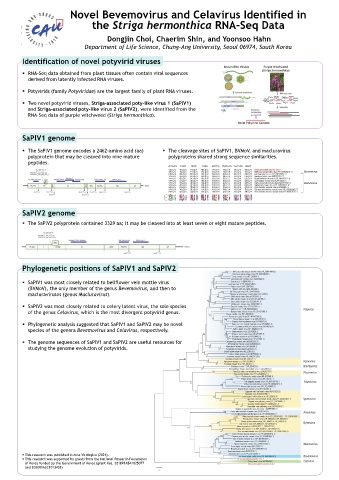
The SaPlV1 genome encodes a 2462-amino acid (aa) The cleavage sites of SaPlV1, BVMoV, and macluravirus
polyprotein that may be cleaved into nine mature polyproteins shared strong sequence similarities.
peptides.
SaPlV2 genome
The SaPlV2 polyprotein contained 3329 aa; it may be cleaved into at least seven or eight mature peptides.
Phylogenetic positions of SaPlV1 and SaPlV2
SaPlV1 was most closely related to bellflower vein mottle virus
(BVMoV), the only member of the genus Bevemovirus, and then to
macluraviruses (genus Macluravirus).
SaPlV2 was most closely related to celery latent virus, the sole species
of the genus Celavirus, which is the most divergent potyvirid genus.
Phylogenetic analysis suggested that SaPlV1 and SaPlV2 may be novel
species of the genera Bevemovirus and Celavirus, respectively.
The genome sequences of SaPlV1 and SaPlV2 are useful resources for
studying the genome evolution of potyvirids.
This research was published in Acta Virologica (2021).
This research was supported by grants from the National Research Foundation
of Korea funded by the Government of Korea (grant Nos. 2018R1A5A1025077
and 2020R1A2C1013403)

