


Page 312 - ebook
P. 312
Identification of transcription factors regulated by LEC2 in
                              triacylglycerol biosynthesis

                                  Hyung Ju Do and Hyun Uk Kim*
          Department of Bioindustry and Bioresource Engineering, Sejong University, Seoul, 05006 Republic of Korea

                        Abstract

    During the seed development, triacylglycerol (TAG) is accumulated in the cotyledon. The TAG is
    used as an energy source for seedling development in germinated seeds. The complex network of tr
    anscription factors (TFs) regulates genes involved in TAG biosynthesis during seed development. L
    EAFY COTYLEDON 2 (LEC2) is the master regulator for maturation and TAG biosynthesis in see
    d development. Currently, LEC2-downstream TF networks in the process of seed TAG biosynthesi
    s have not been studied well. In this study, we identified 25 seed-specific TFs upregulated by LEC2
    . To identify novel transcription factors that regulate TAG biosynthesis in the LEC2 regulatory net
    work, each of 25 seed-specific candidate TFs has been transforming to overexpress in leaves of Nic
    otiana benthamiana using Agrobacterium infiltration. Qualitative and quantitative analysis of TAG
    content in transformed leaves is progressed using thin-layer chromatography (TLC) and gas chrom
    atography (GC) to find TFs induce TAG accumulation. The discovery of novel TFs that regulate th
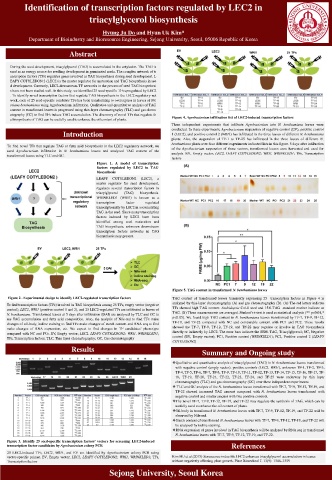
    e biosynthesis of TAG can be usefully used to enhance the oil content of plants.  Figure 4. Agrobacterium infiltration list of LEC2-induced transcription factors
                                                         Three independent experiments that infiltrate Agrobacterium into N. benthamiana leaves were
                                                         conducted. In these experiments, Agrobacterium suspension of negative control (EV), positive control
                      Introduction                       1 (LEC2), and positive control 2 (WRI1) has infiltrated in the three leaves of different N. benthamiana
                                                         plants. Also, the suspension of TF-1 to TF-25 has infiltrated in the three leaves of different N.
                                                         benthamiana plants over four different experiments indicated lists in this figure. 5 days after infiltration
   To find novel TFs that regulate TAG or fatty acid biosynthesis in the LEC2 regulatory network, we  of the Agrobacterium suspension of those vectors, transformed leaves were harvested and used for
   used Agrobacterium infiltration in N. benthamiana leaves and analyzed TAG content of the  analysis. EV, Empty vector; LEC2, LEAFY COTYLEDON2; WRI1, WRINKLED1; TFs, Transcription
   transformed leaves using TLC and GC.
                                                         factors
                                 Figure 1. A model of transcription
                                 factors regulated by LEC2 in TAG
                                 biosynthesis
                                LEAFY  COTYLEDON2  (LEC2),  a
                                master regulator for seed development,
                                regulates several transcription factors in
                                triacylglycerol  (TAG)  biosynthesis.
                                WRINKLED1 (WRI1) is known as a
                                transcription  factor  regulated
                                transcriptionally by LEC2 in accumulating
                                TAG in the seed. Since many transcription
                                factors induced by LEC2 have been
                                identified among seed maturation and
                                TAG biosynthesis, unknown downstream
                                transcription factors networks in TAG
                                biosynthesis may present.


                                                         Figure 5. TAG content in transformed N. benthamiana leaves
    Figure 2 . Experimental design to identify LEC2-regulated transcription factors  TAG content of transformed leaves transiently expressing 25 transcription factors in Figure 4 is
                                                         analyzed by thin-layer chromatography (A) and gas chromatography (B). (A) The red letters indicate
   To find transcription factors (TFs) involved in TAG biosynthesis among 25 TFs, empty vector (negative
   control), LEC2, WRI1 (positive control 1 and 2), and 25 LEC2-regulated TFs are infiltrated in leaves of  TFs showed high TAG content. Arabidopsis Col-0 seed and 15:0-TAG standard marker indicate as
   N. benthamiana. Transformed leaves at 5 days after infiltration (DAI) are analyzed by TLC and GC to  TAG. (B) Three measurements are averaged. Student’s t-test is used as statistical analysis (** p<0.01,*
   see TAG accumulation and fatty acid composition. Also, the analysis of Nile-red to find TFs make  p<0.05). We found high TAG content in N. benthamiana leaves transformed by TF-7, TF-9, TF-12,
   changes of oil-body, iodine staining to find TFs make changes of starch content and RNA seq to find  TF-19, and TF-22 compared with NC and comparable content with PC1 and PC2. These results
   make changes of RNA expression, etc. We expect to find changes in TF candidates’ phenotype  showed the TF-7, TF-9, TF-12, TF-19, and TF-22 may regulate or involve in TAG biosynthesis
   compared with NC and PCs. EV, Empty vector; LEC2, LEAFY COTYLEDON2; WRI1, WRINKLED1;  directly or indirectly by LEC2. The error bars indicate the SEM. TAG, Triacylglycerol; NC, Negative
   TFs, Transcription factors; TLC, Thin layer chromatography; GC, Gas chromatography  control (EV, Empty vector); PC1, Positive control (WRINKELD1); PC2, Positive control 2 (LEAFY
                                                         COTYLEDON2)
                        Results                                    Summary and Ongoing study
                                                         ❖Qualitative and quantitative analysis of triacylglycerol (TAG) in N. benthamiana leaves transformed
                                                          with negative control (empty vector), positive controls (LEC2, WRI1), unknown TF-1, TF-2, TF-3,
                                                          TF-4, TF-5, TF-6, TF-7, TF-8, TF-9, TF-10, TF-11, TF-12, TF-13, TF-14, TF-15, TF-16, TF-17, TF-
                                                          18, TF-19, TF-20, TF-21, TF-22, TF-23, TF-24, and TF-25 were underway by thin layer
                                                          chromatography (TLC) and gas chromatography (GC) over three independent experiments.
                                                         ❖ TLC and GC analysis of the N. benthamiana leaves transformed with TF-7, TF-9, TF-12, TF-19, and
                                                          TF-22 showed increased TAG amount compared with N. benthamiana leaves transformed with
                                                          negative control and similar amount with two positive controls.
                                                         ❖The novel TF-7, TF-9, TF-12, TF-19, and TF-22 may regulate the synthesis of TAG, which can be
                                                          usefully used to enhance the oil content of plants.
                                                         ❖Oil-body in transformed N. benthamiana leaves with TF-7, TF-9, TF-12, TF-19, and TF-22 will be
                                                          observed by Nile-red.
                                                         ❖Starch content of transformed N. benthamiana leaves with TF-7, TF-9, TF-12, TF-19, and TF-22 will
                                                          be analyzed by iodine staining.
                                                         ❖RNA expression of genes involved in TAG biosynthesis will be analyzed by RNA seq in transformed
                                                          N. benthamiana leaves with TF-7, TF-9, TF-12, TF-19, and TF-22.
   Figure 3. Identify 25 seed-specific transcription factors’ vectors for screening LEC2-induced
   transcription factor candidates by Agrobacterium colony PCR              References
   25 LEC2-induced TFs, LEC2, WRI1, and EV are identified by Agrobacterium colony PCR using
   vector-specific primer. EV, Empty vector; LEC2, LEAFY COTYLEDON2; WRI1, WRINKLED1; TFs,  Kim HU et al.(2015) Senescence-inducible LEC2 enhances triacylglycerol accumulation in leaves
   Transcription factors                                 without negatively affecting plant growth. Plant Biotechnol J. 13(9): 1346–1359
                                     Sejong University, Seoul Korea

