


Page 304 - ebook
P. 304
Investigation of the role of senescent macrophage in colorectal Carcinogenesis
So Yeong Eom²,³, So Hyun Park¹,², YoungHwa Kim²*, Jang-Hee Kim¹,²*
1 Pathology , Ajou University School of Medicine , Suwon 16499, Korea. 2 Inflamm-Aging Translational Research Center , Ajou University Medical Center , Suwon 16499, Korea. 3 Biomedical Sciences , Ajou University Graduate School of Medicine , Suwon 16499, Korea
ABSTRACT INTRODUCTION
Macrophages are a diverse group of white blood cells known for eliminating pathogens through
Tumor cells
phagocytosis. According to the activation state and functions of macrophages, they can be divided into Senescent macrophage
: p16 INK4A positive(paraffin)
M1-type (classically activated macrophage) and M2-type (alternatively activated macrophage) Especially :SA-β-gal positive(frozen)
p16 INK4A negative
M2 was tumor-associated macrophages (TAMs) are the key cells that create an immunosuppressive M2 macrophage *M2 type macrophage marker
:CD68, CD163
tumor microenvironment (TME). We found an interesting senescent (p16 positive) or non-senescent (p16
*M1 type macrophage marker
negative) M2 were located in a colorectal tumor, p16 was a general senescent cell marker. We previously p16 INK4A positive M2 :HLA-DR
macrophage
published that senescent tumor cells were found in many types of tumor and it is related to the tumor
The senescence is permanently stopping cell dividing and going cell death process but unfortunally in the tumor progression has the other story. Previous we studied senescent tumors and reported roll of
microenvironment. senescent tumor. senescent tumor cells have been found not only in premalignant tumors but also in developed malignant tumors. Although several studies have suggested that senescent stromal fibroblasts
could promote the proliferative and metastatic properties of adjacent tumor cells through the senescence-associated secretory phenotype (SASP), whether naturally occurring senescent tumor cells in malignant
The in vitro result shows that senescent tumor induced p16 positive m2 like macrophage phenotype tumors could mediate similar protumorigenic effects has not yet been fully elucidated. In our previous study, senescent tumor cells were shown to play an important role in cancer progression: senescent
tumor cells are actively involved in the collective invasion and metastasis via CXCL12/CXCR4 signaling.
might be closely related with tumor microenvironment. We discuss and prospect the potential Interestingly we founded senescent macrophage in Advanced CRC, Macrophages are a diverse group of white blood cells known for eliminating pathogens through phagocytosis. According to the activation
state and functions of macrophages, they can be divided into M1-type (classically activated macrophage) and M2-type (alternatively activated macrophage) Especially M2 was tumor-associated macrophages
applications of p16 positive m2 like macrophage strategies in the colorectal carcinogenesis environment (TAMs) are the key cells that create an immunosuppressive tumor microenvironment (TME). We found an interesting senescent (p16 positive) or non-senescent (p16 negative) M2 were located in a colorectal
tumor, p16 was a general senescent cell marker. We previously published that senescent tumor cells were found in many types of tumor and it is related to the tumor microenvironment.
and the clinical cancer treatment based on the result. The in vitro result shows that senescent tumor induced p16 positive m2 like macrophage phenotype might be closely related with tumor microenvironment. We discuss and prospect the potential applications
of p16 positive m2 like macrophage strategies in the colorectal carcinogenesis environment and the clinical cancer treatment based on the result.
RESULT
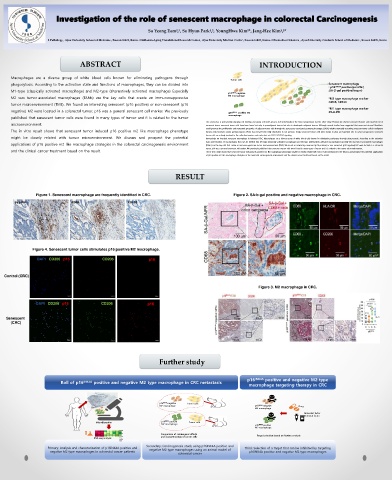
Figure 1. Senescent macrophage are frequently identified in CRC. Figure 2. SA-b-gal positive and negative macrophage in CRC.
Figure 4. Senescent tumor cells stimulates p16 positive M2 macrophage.
DAPI / CD206 / p16 / CD206 / p16
Control (CRC)
Figure 3. M2 macrophage in CRC.
DAPI / CD206 / p16 / CD206 / p16
Senescent
(CRC)
Further study
p16 INK4A positive and negative M2 type
Roll of p16 INK4A positive and negative M2 type macrophage in CRC metastasis
macrophage targeting therapy in CRC
p16 INK4A negative Tumor cells
M2 macrophage p16 INK4A negative Drug
M2 macrophage
Molecular factor
Chemical factor
Microdissection p16 INK4A positive Tumor cells
M2 macrophage p16 INK4A positive
M2 macrophage
IL-10
IL-x
IL-10 Comparison of carcinogenic effects
IL-x Target selection based on feature analysis
IL-10 and characterization of cancer cells
RNA seq analysis IL-x
IL-10
IL-x
Secondary: Carcinogenesis study using p16INK4A positive and
Primary: Analysis and characterization of p16INK4A positive and negative M2 type macrophages using an animal model of Third: Selection of a target that can be inhibited by targeting
negative M2 type macrophages in colorectal cancer patients p16INK4A positive and negative M2 type macrophages
colorectal cancer

