


Page 287 - ebook
P. 287
The role of reactive oxygen species (ROS) in hematopoietic
stem cells engraftment
Minji Choi , Mina Boo , Woo Yong Park , Gahee Song , Ja Yeon Park , Se Jin Jung , Jinbong Park , Jae-Young Um ,
²,³
¹,³
¹
²,³
²,³
²,³
²,³
²,³
Hyun Jeong Kwak ¹*
1 Department of Natural Science, College of Convergence and Integrated Science, Kyonggi University, Suwon 16227,
Korea 2 Department of sience of Korean Medicine, Graduate school, Kyung Hee University, Seoul 02447, Korea
3 Department of pharmacology, Collage of Korean Medicine, Kyung Hee University, Seoul 02447, Korea
ABSTRACT RESULTS
Hematopoietic stem cell transplantation (HSCT) can be curative for hematological and
immunological diseases. The success of HSCT is dependent on their ability of homing and
engraftment to the hematopoietic stem cells (HSCs) of recipients. Reactive oxygen species (ROS)
is traditional second messengers in many cell type including HSCs, however high levels of ROS
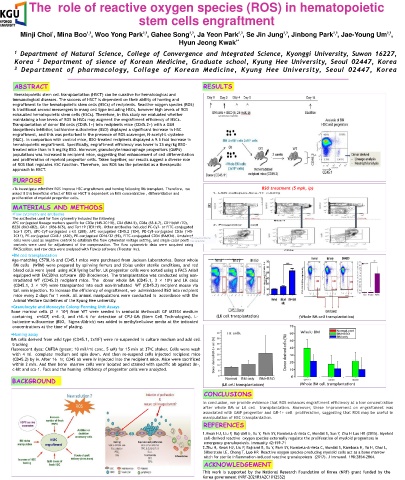
exhausted hematopoietic stem cells (HSCs). Therefore, in this study we evaluated whether Experimental setup for transplantation
maintaining a low levels of ROS in HSCs may augment the engraftment efficiency of HSCs.
Transplantation of donor BM cells (CD45.1+) into recipients mice (CD45.2+) with a GSH
biosynthesis inhibitor, buthionine sulfoximine (BSO) displayed a significant increase in HSC
engraftment, and this was perturbed in the presence of ROS scavenger, N-acetyl-L-cysteine
(NAC). In comparison with control mice, BSO-treated recipients displayed a 9.5 fold increase in
hematopoietic engraftment. Specifically, engraftment efficiency was lower in 25 mg/kg BSO-
treated mice than in 5 mg/kg BSO. Moreover, granulocyte/macrophage progenitors (GMPs)
populations was increased in recipient mice, suggesting that enhancement of cell differentiation
and proliferation of myeloid progenitor cells. Taken together, our results suggest a diverse role
of ROS that regulates HSC function. Therefore, low ROS has the potential as a therapeutic
approach in HSCT.
PURPOSE
•To investigate whether ROS improve HSC engraftment and homing following BM transplant. Therefore, we BSO treatment (5 mpk, ip)
asked if this beneficial effect of ROS on HSCT is dependent on ROS concentration , differentiation and
proliferation of myeloid progenitor cells.
MATERIALS AND METHODS
Flow cytometry and antibodies
The antibodies used for flow cytometry included the following:
APC conjugated lineage markers specific for CD3e (145-2C110), CD4 (RM4-5), CD8a (53-6.7), CD11b(M1/70),
B220 (RA3-6B2), GR-1 (RB6-8C5), and Ter119 (TER119). Other antibodies included PC-Cy7- or FITC-conjugated
Sca-1 (D7), APC-Cy7-conjugated c-kit (2B8), APC conjugated CD45.2 (104), PE-Cy5-conjugated CD3e (145-
2C11), PE-conjugated CD45.1 (A20), PE-conjugated CD16/32 (93), FITC-conjugated CD34 (RAM34). Unstained
cells were used as negative control to establish the flow cytometer voltage setting, and single-color positive
controls were used for adjustment of the compensation. The flow cytometric data were acquired using
FACScalibar, and raw data were analyzed with Flowjo software (Treestar Inc).
BM cell transplantation
Age-matching C57BL/6 and CD45.1 mice were purchased from Jackson Laboratories. Donor whole ROS leads to increase progenitor cell proliferation in the bone marrow
BM cells (WBM) were prepared by spinning femurs and tibias under sterile conditions, and red
blood cells were lysed using ACK lysing buffer. LK progenitor cells were sorted using a FACS AriaII
equipped with FACSDiva software (BD Bioscience). The transplantation was conducted using non-
irradiated WT (CD45.2) recipient mice. The donor whole BM (CD45.1, 3 × 10 ) and LK cells
6
(CD45.1, 2 × 10 ) were transplanted into each non-irradiated WT (CD45.2) recipient mouse via
5
tail vein injection. To increase the efficiency of engraftment, we administered BSO into recipient
mice every 2 days for 1 week. All animal manipulations were conducted in accordance with the
Animal Welfare Guidelines of the Kyung Hee university.
Granulocyte and Monocyte Colony-Forming Unit Assays
Bone marrow cells (2 × 10 ) from WT were seeded in semisolid Methocult GF M3534 medium
4
containing rmSCF, rmIL-3, and rhIL-6 for detection of CFU-GM (Stem Cell Technologies). L- (LK cell transplantation) (Whole BM cell transplantation)
butionine-sulfoxamine (BSO, Sigma-Aldrich) was added to methylcellulose media at the indicated
concentrations at the time of plating.
Homing assay
BM cells derived from wild type (CD45.1, 2x10 ) were re-suspended in culture medium and add cell
7
tracking
fluorescent dyes: CMFDA (green; 10 mil/ml conc. 5 uM) for 15 min at 37 C shaker. Cells were wash
o
with 4 ml complete medium and spin down. And then re-suspend cells injected recipient mice
(CD45.2) by iv. After 16 hr, CD45 ab were iv injected into the recipient mice. Mice were sacrificed
within 2 min. And then bone marrow cells were isolated and stained with specific ab against lin-,
c-kit and sca-1. Facs and the homing efficiency of progenitor cells were analyzed.
BACKGROUND
(LK cell transplantation) (Whole BM cell transplantation)
CONCLUSIONS
In conclusion, we provide evidence that ROS enhances engraftment efficiency at a low concentration
after whole BM or LK cell transplantation. Moreover, these improvement on engraftment was
associated with GMP progenitor and GR-1+ cell proliferation, suggesting that ROS may be useful in
manipulation of HSC transplantation.
REFERENCES
1.Kwak HJ, Liu P, BajrAMI b, Xu Y, Park SY, Nombela-Arrieta C, Mondal S, Sun Y, Zhu H Luo HR (2015). Myeloid
cell-derived reactive oxygen species externally regulate the proliferation of myeloid progenitors in
emergency granulopoiesis. Immunity 42:159-71
2.Zhu H, Kwak HJ, Liu P, Bajrami B, Xu Y, Park SY, Nombela-Arrieta C, Mondal S, Kambara H, Yu H, Chai L,
Silberstein LE, Cheng T, Luo HR Reactive oxygen species-producing myeloid cells act as a bone marrow
nitch for sterile inflammation-induced reactive granulopoiesis (2017). J Immunol. 198:2854-2864.
ACKNOWLEDGEMENT
This work is supported by the National Research Foundation of Korea (NRF) grant funded by the
Korea government (NRF-2021R1A2C1012532)

