


Page 159 - ebook
P. 159
Inhibition of JNK1 signaling by Indirubin-3-
monoxime prevents tumorigenesis in breast cancer
Hyung-Ju Lee , Mi-Yeon Kim , Eun-Hye Jo , So-I Noh , Hee-Sae Park ¹
¹
¹
¹
¹
School of Biological Sciences and Technology, Chonnam National University, Yongbong-dong, Buk-ku, Gwangju, 500-757, Republic of Korea
Abstract
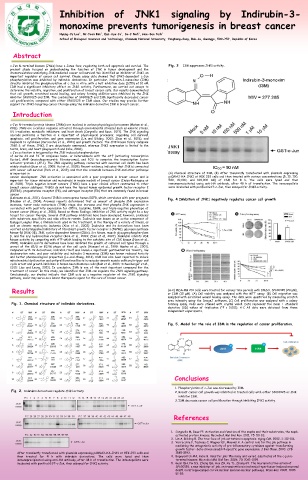
c-Jun N-terminal kinases (JNKs) have a Janus face, regulating both cell apoptosis and survival. The Fig. 3 I3M suppresses JNK1 activity.
present study focused on understanding the function of JNK in tumor development and the
chemoresistance underlying JNK-mediated cancer cell survival. We identified an inhibitor of JNK1, an
important regulator of cancer cell survival. Kinase assay data showed that JNK1-dependent c-Jun
phosphorylation was inhibited by indirubin derivatives. In particular, indirubin-3-monoxime (I3M)
directly inhibited the phosphorylation of c-Jun in vitro, with a half inhibition dose (IC50) of 10 nM
I3M had a significant inhibitory effect on JNK1 activity. Furthermore, we carried out assays to
determine the viability, migration, and proliferation of breast cancer cells. Our results demonstrated
that cell growth, scratched wound healing, and colony forming abilities were inhibited by the JNK
inhibitor SP600125 and I3M. The combination of SP600125 and I3M significantly decreased cancer
cell proliferation, compared with either SP600125 or I3M alone. Our studies may provide further
support for JNK1-targeting cancer therapy using the indirubin derivative I3M in breast cancer.
Introduction
c-Jun N-terminal protein kinases (JNKs) are involved in various physiological processes (Mehan et al.,
2011). JNKs are a cellular response activated through environmental stresses such as osmotic stress,
UV irradiation, metabolic inhibitors, and heat shock (Cargnello and Roux, 2011). The JNK signaling
cascade performs a function in a important of physiological processes, regarding cell survival,
apoptosis, cell proliferation, and gene expression (Lin and Dibling, 2002; Zhao et al., 2015), and
responds to cytokines (Verrecchia et al., 2003) and growth factors. The JNK kinase family comprise
JNK1-3; of these, JNK1, 2 are ubiquitously expressed, whereas JNK3 expression is limited to the
testis, brain, and heart (Bogoyevitch and Kobe, 2006).
c-Jun activation is triggered by the JNK-induced phosphorylation
of serine 63 and 73. It composes homo- or heterodimers with the ATF (activating transcription
factor), MAF (musculoaponeurotic fibrosarcoma), and FOS to comprise the transcription factor
activator protein-1 (AP-1). The JNK signaling pathway connected with neuronal cell death has been
widely studied (Guan et al., 2005; Hui et al., 2005). Recent evidence indicates that JNK is connected
with cancer cell survival (Park et al., 2019), and that the crosstalk between JNK and other pathways
is important in (A) Chemical structure of I3M. (B) After transiently transfected with plasmids expressing
cancer development. JNK activation is associated with a poor prognosis in breast cancer and is pcDNA3-HA-JNK1 at HEK 293 cells and then treated with various concentrations (5, 10, 100,
important for tumor initiation and metastasis in mouse models of breast cancer (Insua-Rodriguez et 500, 10,000, and 100,000 nM) of I3M for 4 h. The cells were lysed and then
al., 2018). Triple negative breast cancers (TNBC) have a poor clinical effect contrasted to other immunoprecipitated using anti-HA antibody, after 48 h of transfection. The immunopellets
breast cancer subtypes. TNBCs do not have the typical human epidermal growth factor receptor 2 were incubated with purified GST-c-Jun, then assayed for JNK1 activity.
(EGFR2), progesterone receptor (PR), and estrogen receptor (ER) that are commonly found in breast
cancer
(Lehmann et al., 2011). Several TNBCs overexpress human EGFR, which correlates with poor prognosis Fig. 4 Inhibition of JNK1 negatively regulates cancer cell growth
(Nielsen et al., 2004). Previous reports determined that as amount of phospho-JNK expression
increase, tumor node metastasis (TNM) stage also increase and that phospho-JNK expression is
correlated with positivity expression for CK5/6, basallike, EGFR, and triple-negative phenotype of
breast cancer (Wang et al., 2010). Based on these findings, inhibition of JNK activity might be a key
target for cancer therapy. Several JNK pathway inhibitors have been developed; however, problems
with substrate specificity and side effects remain. Indirubin was known as an active component of
Danggui Longhui Wan, a Chinese herb used in the treatment, in the therapy of a variety of illness, as
well as chronic myelocytic leukemia (Xiao et al., 2002). Indirubin and its derivatives have been
verified as distinguished inhibitors of fibroblast growth factor receptor 1 (FGFR1), glycogen synthase
kinase-3β (GSK-3β), JNK, cyclin-dependent kinases (CDKs), Src kinase, muscle glycogen phosphorylase
β, and the aryl hydrocarbon receptor (Bain et al., 2003; Zhen et al., 2007). Indirubin inhibits CDK
kinase activity by competing with ATP which binding to the catalytic site of CDK kinase (Nam et al.,
2005). Indirubin and its derivatives have been inhibited the growth of cultured cell types through a
arrest of the G1/S or G2/M phase of the cell cycle (Hoessel et al., 1999; Marko et al., 2001).
Compared with its derivatives, indirubin itself was known a significant gastrointestinal toxicity, low
ababsorption rate, and poor solubility and indirubin-3-monoxime (I3M) was known reduced toxicity
and better pharmacological properties (Lo and Chang, 2013). I3M has also been reported to induce
mitochondrial dysfunction and antiproliferativeeffects in vascular smooth muscle cells and trigger cell
cycle arrest and growth inhibition in human neuroblastoma cells (Bain et al., 2003; Schwaiberger et al.,
2010; Liao and Leung, 2013). In conclusion, I3M is one of the most important compound for the
treatment of cancer. In this study, we identified that I3M can regulate the JNK1 signaling pathway.
Conclusionally, our studies indicate that I3M acts as a negative regulator of the JNK1 signaling
pathway, and it may serve as a latent therapeutic agent for the cure of breast cancer.
Results (A-C) MDA-MB 231 cells were treated for various time periods with DMSO, SP600125 (20 μM),
or I3M (10 μM). (A) Cell viability was analyzed with the MTT assay. (B) Cell migration was
analyzed with scratched wound healing assay. The data were quantified by measuring scratch
area intensity using the ImageJ software. (C) Cell proliferation was analyzed with a colony
Fig. 1. Chemical structure of indirubin derivatives. forming assay. Cells were stained with crystal violet. Data represent the mean ± standard
deviation (SD) values of triplicates (*P ≤ 0.001). A-C All data were obtained from three
independent experiments.
Fig. 5. Model for the role of I3M in the regulation of cancer proliferation.
Conclusions
1. Phosphorylation of c-Jun was decreased by I3M.
Fig. 2. Indirubin derivatives regulate JNK1 activity 2. Breast cancer cell growth was inhibited in treated cells with either SP600125 or JNK
inhibitor I3M.
3. I3M decrease cancer cell proliferation through inhibiting JNK1 activity.
References
1. Cargnello M, Roux PP. Activation and function of the mapks and their substrates, the mapk-
activated protein kinases. Microbiol. Mol Biol Rev. 2011. 75: 50-83.
2. Lin A, Dibling B. The true face of jnk activation in apoptosis. Aging Cell. 2002. 1: 112-116.
3. Verrecchia F, Tacheau C, Wagner EF, Mauviel A. A central role for the jnk pathway in
mediating the antagonistic activity of pro-inflammatory cytokines against transforming
growth factor –beta-driven smad3/4-specific gene expression. J Biol Chem. 2003. 278:
After transiently transfected with plasmids expressing pcDNA3-HA-JNK1 at HEK 293 cells and 1585-1593.
then treated for 4 h with indirubin derivatives. The cells were lysed and then 4. Bogoyevitch MA, Kobe B. Uses for jnk: The many and varied. substrates of the c-jun n-
immunoprecipitated using anti-HA antibody, after 48 h of transfection. The immunopellets were terminal kinases. Microbiol Mol Biol Rev. 2006. 70: 1061-1095.
incubated with purified GST-c-Jun, then assayed for JNK1 activity. 5. Guan QH, Pei DS, Zhang QG, Hao ZB, Xu TL, Zhang GY. The neuroprotective action of
SP600125, a new inhibitor of jnk, on transient brain ischemia/reperfusion-induced neuronal
death in rat hippocampal ca1 via nuclear and non-nuclear pathways. Brain Res. 2005. 1035:
51-59.

