


Page 155 - ebook
P. 155
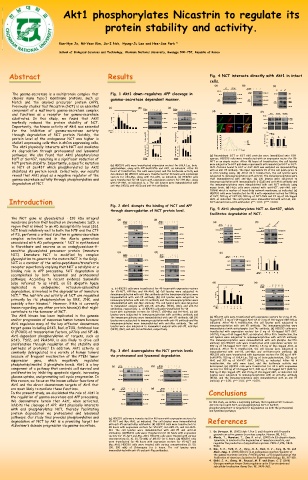
Akt1 phosphorylates Nicastrin to regulate its
protein stability and activity.
Eun-Hye Jo, Mi-Yeon Kim, So-I Noh, Hyung-Ju Lee and Hee-Sae Park *
School of Biological Sciences and Technology, Chonnam National University, Gwangju 500-757, Republic of Korea
Abstract Results Fig. 4 NCT interacts directly with Akt1 in intact
cells.
(a) (b) (c)
GST GST-Akt1 NCT-V5 : - + +
Myc-Akt1 : - - + IP:
-
+
-
+
NCT-V5 :
The gamma-secretase is a multiprotein complex that Fig. 1 Akt1 down-regulates APP cleavage in IB: V5 NCT-V5 IB: Myc Myc-Akt1 IB: NCT NCT
IP: V5
cleaves many type-I membrane proteins, such as gamma-secretase dependent manner. NCT-V5 NCT-V5 Akt1
Cell
Cell
Notch and the amyloid precursor protein (APP). Lysates b-actin Lysates Myc-Akt1 Lysates mNCT
Cell
ImNCT
Previously studies that Nicastrin (NCT) is an essential (a) (b) (c) b-actin b-actin
component of a multimeric gamma-secretase complex Gal4-Luc C83-Myc : - - + + ++ +++ C99-Myc : - + + ++ +++ (d) (e)
+
+
+
+
-
HA-Akt1 :
+
-
-
+
HA-Akt1 :
and functions as a receptor for gamma-secretase 8 ** IB: Myc C83-Myc IB: Myc C99-Myc NCT Akt1 TGN46 Merge NCT NCT-ER NCT-TGN
substrates. In this study, we found that Akt1 R.L.U (folds) 6 IB: AICD AICD IB: AICD AICD HA-Akt1 : - + - + - + mNCT
IB: NCT
ImNCT
markedly reduced the protein stability of NCT. 4 IB: HA HA-Akt1 IB: HA HA-Akt1 IB: HA HA-Akt1
Importantly, the kinase activity of Akt1 was essential 2 IB: b-actin b-actin IB: b-actin b-actin IB: b-actin
for the inhibition of gamma-secretase activity APP-GVP : 0 - + + + + - - - 12 4 ** 7.142 2.0 b-actin
through degradation of NCT protein. Notably, the Akt1 : - - + ++ +++ + ++ +++ 8 * 140 1.5 Mock
HA-Akt1
protein level of the endogenous NCT was higher in Relative level of C83 4 Relative level of C99 2 120 Relative Protein Level 1.0 ** ns ***
100
shAkt1 expressing cells than in shCon expressing cells. 0 0 Relative Fluorescence Intensity 80 NCT 0.5
Akt1
60
The Akt1 physically interacts with NCT and mediates 1.6 * 1.2 * 40 TGN46 0.0 NCT NCT-ER NCT-TGN
20
1.2
its degradation through proteasomal and lysosomal Relative level of AICD 0.8 Relative level of AICD 0.8 0 1 2 3 4 5 6 7 8 (μm)
pathways. We also found that Akt1 phosphorylates 0.4 0.4 (a) Recombinant GST or GST-Akt1 proteins were immobilized onto GSH-
0.0
0.0
NCT at Ser437, resulting in a significant reduction of C83-Myc : - + + ++ +++ C99-Myc : - - + + ++ +++ agarose. HEK293 cells were transfected with an expression vector for V5-
+
+
+
+
-
HA-Akt1 :
-
+
-
HA-Akt1 :
+
NCT protein stability. Importantly, a specific mutation NCT or an empty vector. After 48 hours of transfection, the cell lysates
were subjected to GST pull-down experiments with immobilized GST or GST–
in NCT at Ser437 which phosphorylated by Akt1 (a) HEK293 cells were transfected expression vectors for GAL4-Luc, beta- Akt1. Proteins bound to GST or GST–Akt1 was analyzed via immunoblotting
galactosidase, along with APP-Gal4/VP16 and Akt1, as indicated. After 48
stabilizes its protein levels. Collectively, our results hours of transfection, the cells were lysed, and the luciferase activity was with an anti-V5 antibody. The input represents 1% of the cell lysate prior to
in vitro binding assay. (b) After 48 h transfection, the cell lysates were
reveal that Akt1 plays as a negative regulator of the determined. (b) HEK293 cells were transfected for 48 hours with expression subjected to immunoprecipitation with anti-V5. The immunoprecipitates were
vectors for C83-Myc, along with HA-Akt1, as indicated. (c) HEK293 cells
gamma-secretase activity through phosphorylation and were transfected for 48 hours with expression vectors for C99-Myc, along then immunoblotted with anti-Myc. (c) Cell lysates were subjected to
degradation of NCT. with HA-Akt1, as indicated. b, c The cell lysates were immunoblotted with immunoprecipitation with immunoglobulin G (IgG) and anti-Akt1 antibody and
the immunoprecipitates were immuoblotted with anti-NCT antibody using
anti-Myc (9E10), anti-AICD and anti-HA antibodies. mouse brain. (d) HeLa cells were stained with anti-NCT, anti-Akt1 anti-
TGN46 which is marker of trans-Golgi network membrane, as indicated. (e)
HEK293 cells were transfected for 48 h with expression vectors for 500 ng
of NCT, 500 ng of NCT-ER, 500 ng of NCT-TGN and 1.5 mg of HA-tagged
Akt1, as indicated. The cell lysates were immunoblotted with anti-HA, anti-
Introduction NCT and anti-beta-actin antibodies. p** < 0.01; p*** < 0.001.
Fig. 2 Akt1 disrupts the binding of NCT and APP
through downregulation of NCT protein level. Fig. 5 Akt1 phosphorylates NCT on Ser437, which
facilitates degradation of NCT.
The NCT gene is glycosylated ∼130 kDa integral (a) (b)
membrane protein that located on chromosome 1q23, a APP-Myc : - - + + + + APP-Myc : - - - + + + + (a) (b)
NCT-V5 :
-
-
NCT-V5 :
-
+
+
-
-
-
-
+
+
region that is linked to an AD susceptibility locus [26]. HA-Akt1 : - + - - - + NCT-V5 HA-Akt1 : - + - - - + APP-Myc HA-Akt1 : + CA DN
+
NCT-V5 :
+
-
IB: V5
IB: Myc
Myc-Akt1 :
NCT binds relatively well to both the NTF and the CTF IP: Myc IP: V5 IB: phospho S/T phospho-NCT IB: phospho S/T - + - + phospho-NCT
IP: V5
IP: V5
of PS, performs a critical function in gamma-secretase IB: V5 NCT-V5 IB: V5 NCT-V5 IB: V5 NCT-V5 IB: V5 NCT-V5
complex activation and in the Abeta generation IB: Myc APP-Myc IB: Myc APP-Myc IB: HA HA-Akt1-DN IB: Myc Myc-Akt1
HA-Akt1-CA
associated with AD pathogenesis.¹ NCT is synthesized IB: HA HA-Akt1 IB: HA HA-Akt1 IB: b-actin b-actin IB: b-actin b-actin
in fibroblasts and neurons as an endoglycosidase-H- IB: b-actin b-actin IB: b-actin b-actin
sensitive glycosylated precursor protein (immature (c) (d)
NCT). Immature NCT is modified by complex C99-Myc : - - + + + + C99-Myc : - - - + + + + (c)
-
NCT-V5 :
NCT-V5 :
-
-
-
-
+
+
-
+
+
-
NCT-V5 :
glycosylation to generate the mature NCT in the Golgi . HA-Akt1 : - + - - - + NCT-V5 HA-Akt1 : - + - - - + Myc-Akt1 : - W W - M M 2 * ns
-
+
-
-
+
-
IB: V5
NCT is a member of the amino-peptidases/transferrin IP: Myc IB: Myc IP: V5 C99-Myc IB: V5 NCT-V5 Relative level of NCT-V5 1
receptor superfamily implying that NCT a catalytic or a IB: V5 NCT-V5 IB: V5 NCT-V5 IB: Myc Myc-Akt1
binding role in APP processing. NCT degradation is IB: Myc C99-Myc IB: Myc C99-Myc IB: b-actin b-actin NCT-V5 : - W W - M M
0
accomplished by both lysosomal and proteasomal IB: HA HA-Akt1 IB: HA HA-Akt1 Myc-Akt1 : - - + - - +
pathways. According to recent evidence Synoviolin IB: b-actin b-actin IB: b-actin b-actin
(also referred to as Hrd1), an E3 ubiquitin ligase (d) (e)
NCT-V5 :
-
implicated in endoplasmic reticulum-associated a, b HEK293 cells were transfected for 48 hours with expression vectors 80 *** ** Gal4-Luc APP-Myc : - + W W M M
-
+
+
+
+
HA-Akt1 :
-
-
-
+
-
+
degradation, is involved in the degradation of immature for V5-NCT, APP-Myc and HA-Akt1. (a) Cell lysates were subjected to 60 ns IB: V5 NCT-V5
NCT.² The half-life and activity of NCT are regulated immunoprecipitation with anti-Myc antibody and the immunoprecipitates were R.L.U (folds) 40 IB: V5 IP: Myc NCT-V5
immunoblotted with anti-V5 antibody. (b) Cell lysates were subjected to
primarily by its phosphorylation by ERK, JNK, and immunoprecipitation with anti-V5 antibody and the immunoprecipitates were 20 IB: Myc APP-Myc
possibly other kinases.³ However, little is currently immunoblotted with anti-Myc antibody. The cell lysates were also subjected 0 IB: HA HA-Akt1
known regarding any other protein kinase(s) that might to immunoblot analysis with anti-V5, anti-Myc (9E10), (M2), and anti-HA APP-GVP : - + + W W M M IB: b-actin b-actin
+
+
+
+
Akt1 :
+
-
+
-
-
+
-
antibodies, respectively. c, d HEK293 cells were transfected for 48
-
-
-
NCT :
contribute to the turnover of NCT. hours with expression vectors for V5-NCT, C99-Myc and HA-Akt1. (c) Cell
The Akt1 kinase has been implicated in the genesis lysates were subjected to immunoprecipitation with anti-Myc antibody and (a) HEK293 cells were transfected with expression vectors for 2 mg of V5-
the immunoprecipitates were immunoblotted with anti-V5 antibody. (d) Cell
and/or progression of numerous human tumors because lysates were subjected to immunoprecipitation with anti-V5 antibody and the tagged NCT, 2 mg of HA-tagged Akt1-CA or 2 mg of HA-tagged Akt1-DN,as
Akt1 regulates many of the key effector downstream immunoprecipitates were immunoblotted with anti-Myc antibody. The cell indicated. After 48 h transfection, the cell lysates were subjected to
immunoprecipitation with anti-V5 antibody. The immunoprecipitates were
target genes including GSK3, Bad, mTOR, forkhead box lysates were also subjected to immunoblot analysis with anti-V5, anti-Myc immunoblotted with anti-phospho Ser/Thr antibody. (b) HEK293 cells were
(9E10), (M2), and anti-HA antibodies, respectively.
O (FOXO) of transcription factors, p27kip and NF-kB. transfected with expression vectors for 2 mg of V5-tagged NCT (WT,
Akt1-dependent phosphorylation of targets, such as S437A), 2 mg of HA-tagged Akt1, as indicated. After 48 h transfection, the
cell lysates were subjected to immunoprecipitation with anti-V5 antibody.
GSK3, TSC2, and PRAS40, is also likely to drive cell The immunoprecipitates were immunoblotted with anti-phospho Ser/Thr
proliferation through regulation of the stability and antibody. (c) HEK293 cells were transfected with expression vectors for
500 ng of V5-tagged NCT (WT, S437A), 1.5 mg of Myc-tagged Akt1, as
synthesis of proteins. In addition, Akt1 activity is indicated. After 48 h transfection, the cell lysates were subjected to
4
commonly dysregulated in a variety of human tumors Fig. 3 Akt1 downregulates the NCT protein levels immunoblotted with anti-V5, anti-Myc and anti-beta-actin antibody. (d)
because of frequent inactivation of the PTEN tumor via proteasomal and lysosomal degradation. HEK293 cells were transfected with expression vectors for 100 ng of APP-
Gal4/VP16, 100 ng of GAL4-Luc, 100 ng of beta-galactosidase, 300 ng of
suppressor gene, which negatively regulates Akt1 and 100 ng of V5-NCT (WT, S437A), as indicated. After 48 h
phosphatidylinositol 3 phosphate levels. Akt1 is a key (b) NCT-V5 : - - - + + + transfection, the cells were lysed, and the luciferase activity was
determined. (e) HEK293 cells were transfected for 48 h with expression
NCT-V5 :
component of a pathway that controls cell survival and (a) Myc-Akt1: - + + + + - HA-Akt1-DN : - + + - + + vectors for 500 ng of V5-tagged NCT, 500 ng of V5-tagged NCT (S437A),
-
-
++
-
-
+
+++
+++
-
HA-Akt1-CA :
-
-
-
proliferation by inhibiting apoptosis signals, increasing IB: V5 NCT-V5 IB: V5 NCT-V5 500 ng of Myc-tagged APP, and 1.5 mg of HA-tagged Akt1, as indicated. Cell
glucose uptake, and promoting cell cycle progression. In IB: Myc Myc-Akt1 IB: HA HA-Akt1-DN lysates were subjected to immunoprecipitation with an anti-Myc antibody
(9E10), and the immunoprecipitates were immunoblotted with an anti-V5
HA-Akt1-CA
this reason, we focus on the known cellular functions of IB: b-actin b-actin IB: b-actin b-actin antibody. p* < 0.05; p** < 0.01; p*** < 0.001.
Akt1 and the direct downstream targets of Akt1 that
are most likely to mediate these functions. (c) Myc-Akt1 : + + + + + (d) Myc-Akt1 : + + + + +
NCT-V5 :
NCT-V5 :
+
+
+
+
-
+
+
+
-
+
In the present study, we elucidated the role of Akt1 in MG132 (uM) : - - 10 20 50 Chloroquine (uM) : - - 50 100 200 Conclusions
the regulation of gamma-secretase and APP processing. IB: V5 NCT-V5 IB: V5 NCT-V5
We demonstrate herein that Akt1, when activated, IB: Myc Myc-Akt1 IB: Myc Myc-Akt1 In this study, we define a surprising pathway that regulates NCT turnover.
inhibits the cleavage of APP. Akt1 physically interacts IB: b-actin b-actin IB: b-actin b-actin Akt1 interacts with NCT, and phosphorylates NCT at Ser437,
with and phosphorylates NCT, thereby facilitating phosphorylated NCT is targeted for degradation via both the proteasomal
and lysosomal pathways.
protein degradation via proteasomal and lysosomal
pathways. Our study thus provides phosphorylation and (a) HEK293 cells were transfected for 48 hours with expression vectors for
degradation of NCT by Akt is a promising target for V5-NCT and Myc-Akt1, as indicated. The cell lysates were immunoblotted References
Alzheimer’s disease progression via gamma-secretase. with anti-V5 and anti-Myc antibodies. (b) HEK293 cells were transfected for
48 hours with expression vectors for V5-NCT, HA-Akt1-CA, and HA-Akt1-
DN. The cell lysates were immunoblotted with anti-V5 and anti-HA 1. De Strooper, B. (2003) Aph-1, Pen-2, and Nicastrin with Presenilin
antibodies. (c)HEK293 cells were transfected for 48 hours with expression generate an active gamma-Secretase complex. Neuron, 38, 9-12.
vectors for V5-NCT and Myc-Akt1. HEK293 cells were treated with various 2. Maeda, T., Marutani, T., Zou, K. et al. (2009) An E3 ubiquitin ligase,
concentrations (0, 10, 20, 50 mM) of MG132 for 6 hours. (d) HEK293 cells Synoviolin, is involved in the degradation of immature nicastrin, and
were transfected for 48 hours with expression vectors for V5-NCT and regulates the production of amyloid beta-protein. FEBS J, 276, 5832-
Myc-Akt1. HEK293 cells were treated with various concentrations (0, 50, 5840.
100, 200 mM) of Chloroquine for 6 hours. The cell lysates were 3. Kim, S. K., Park, H. J., Hong, H. S., Baik, E. J., Jung, M. W. and
immunoblotted with anti-V5 and anti-Flag antibodies. Mook-Jung, I. (2006) ERK1/2 is an endogenous negative regulator of
the gamma-secretase activity. FASEB journal : official publication of the
Federation of American Societies for Experimental Biology, 20, 157-159..
4. Diehl, J. A., Cheng, M., Roussel, M. F. and Sherr, C. J. (1998)
Glycogen synthase kinase-3beta regulates cyclin D1 proteolysis and
subcellular localization. Genes Dev, 12, 3499-3511.

