


Page 23 - ebook
P. 23
Ginsenoside Rg1 protects polymorphonuclear
    neutrophils from suppression of immune function by
    mitochondrial damage-associated molecular patterns


    Mina Boo , Hyo In Kim , Woo Yong Park , Gahee Song , Ja Yeon Park , Se Jin Jung , Minji Choi ,
                                                                                       ³
                                                                          ³
              ¹#
                                                                                                   ¹
                           ²#
                                             ³
                                                           ³
    Jae-Young Um , Hyun Jeong Kwak , Jinbong Park      ³,⁴*
                                       ¹*
                   ³,⁴
    1  Department of Life Science, College of Natural Sciences, Kyonggi University, Suwon 16227, Korea
    2  Department of Surgery, Beth Israel Deaconess Medical Center / Harvard Medical School, Boston 02215, USA
    3  Department of Science in Korean Medicine, Graduate School, Kyung Hee University, Seoul 02447, Korea
    4  Department of Pharmacology and Basic Research Laboratory for Comorbidity Research, College of Korean Medicine, Kyung  Hee University,
    Seoul 02447, Korea
                     Introduction                         Exposure to ND6 100 nM induced a notable decrease
                                                          in PMN respiratory burst in response to fMLF or LTB4.
    Trauma is the leading cause of death in individuals   However, Rg1 pre-treatment of 30 min revoked this
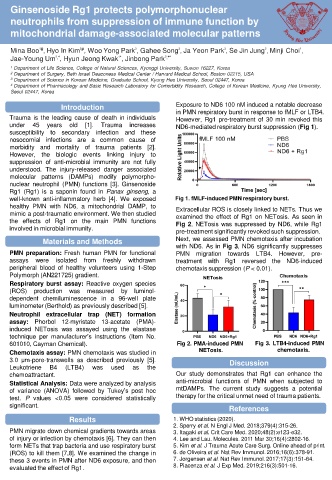
    under   45  years   old  [1].  Trauma  increases      ND6-mediated respiratory burst suppression (Fig 1).
    susceptibility to secondary infection and these
    nosocomial infections are a common cause of
    morbidity and mortality of trauma patients [2].
    However, the biologic events linking injury to
    suppression of anti-microbial immunity are not fully
    understood. The injury-released danger associated
    molecular patterns (DAMPs) modify polymorpho-
    nuclear neutrophil (PMN) functions [3]. Ginsenoside
    Rg1 (Rg1) is a saponin found in Panax ginseng, a
    well-known anti-inflammatory herb [4]. We exposed     Fig 1. fMLF-induced PMN respiratory burst.
    healthy PMN with ND6, a mitochondrial DAMP, to        Extracellular ROS is closely linked to NETs. Thus we
    mimic a post-traumatic environment. We then studied   examined the effect of Rg1 on NETosis. As seen in
    the effects of Rg1 on the main PMN functions          Fig 2, NETosis was suppressed by ND6, while Rg1
    involved in microbial immunity.                       pre-treatment significantly revoked such suppression.
               Materials and Methods                      Next, we assessed PMN chemotaxis after incubation
                                                          with ND6. As in Fig 3, ND6 significantly suppresses
    PMN preparation: Fresh human PMN for functional       PMN    migration  towards  LTB4.  However,  pre-
    assays   were  isolated  from  freshly  withdrawn     treatment with Rg1 reversed the ND6-induced
    peripheral blood of healthy volunteers using 1-Step   chemotaxis suppression (P < 0.01).
    Polymorph (AN221725) gradient.
    Respiratory burst assay: Reactive oxygen species
    (ROS)   production  was  measured   by   luminol-
    dependent chemiluminescence in a 96-well plate
    luminometer (Berthold) as previously described [5].
    Neutrophil extracellular trap (NET) formation
    assay: Phorbol 12-myristate 13-acetate (PMA)-
    induced NETosis was assayed using the elastase
    technique per manufacturer’s instructions (Item No.
    601010, Cayman Chemical).                              Fig 2. PMA-induced PMN   Fig 3. LTB4-induced PMN
    Chemotaxis assay: PMN chemotaxis was studied in               NETosis.                 chemotaxis.
    3.0 μm-pore-transwells as described previously [5].                     Discussion
    Leukotriene  B4   (LTB4)   was   used   as   the
    chemoattractant.                                      Our study demonstrates that Rg1 can enhance the
    Statistical Analysis: Data were analyzed by analysis  anti-microbial functions of PMN when subjected to
    of variance (ANOVA) followed by Tukey’s post hoc      mtDAMPs. The current study suggests a potential
    test. P values <0.05 were considered statistically    therapy for the critical unmet need of trauma patients.
    significant.                                                            References
                        Results                          1. WHO statistics (2020).
                                                         2. Sperry et al. N Engl J Med. 2018;379(4):315-26.
    PMN migrate down chemical gradients towards areas    3. Itagaki et al. Crit Care Med. 2020;48(2):e123-e32.
    of injury or infection by chemotaxis [6]. They can then  4. Lee and Lau. Molecules. 2011 Mar 30;16(4):2802-16.
    form NETs that trap bacteria and use respiratory burst  5. Kim et al. J Trauma Acute Care Surg. Online ahead of print.
    (ROS) to kill them [7,8]. We examined the change in  6. de Oliveira et al. Nat Rev Immunol. 2016;16(6):378-91.
    these 3 events in PMN after ND6 exposure, and then   7. Jorgensen et al. Nat Rev Immunol. 2017;17(3):151-64.
    evaluated the effect of Rg1.                         8. Piacenza et al. J Exp Med. 2019;216(3):501-16.

