


Page 31 - ebook
P. 31
The therapeutic potentials of Scutellaria Baicalensis Georgi for cognitive
                 and motor impairment after Stroke in the MCAO mouse model

                                                    1
                                         Ho-Won Seo , Geon Ko , Keun-A Chang  1,2,*
                                                               1
           1 Department of Health Sciences and Technology, Gachon Advanced Institute for Health Sciences & Technology, Gachon University, Incheon 21999, Korea
           2 Department of Pharmacology, College of Medicine, Gachon University, Incheon 21999, Korea
           * Correspondence: keuna705@gachon.ac.kr; Tel.: +82-32-899-6411
     introduction                                               Result

     Stroke is a primary debilitating disease in adults, occurring in  1. Effects of KMTT1 treatment on survival rate, body
     15 million individuals each year and causing high mortality  weight and mNSS in MCAO model.
     and disability rates. The most common cause of stroke is  A.                                 B.                                  C.
     when an ischemic state caused by an embolism is induced.
     When a stroke occurs, cognitive and behavioral impairments                                         *
     are mainly induced, and when the symptoms worsen, death              *      Weight (g)         mNSS scoring
     quickly. Currently, tPA is the only drug approved by the FDA
     for use in stroke treatment. This study was conducted to find                day 1 day 2 day 3 day 4 day 5 day 6 day 7 day 8 day 9 day 10 day 11 day 12 day 13 day 14 day 15 day 16 day 17 day 18 day 19 day 20 day 21  day 1 day 2 day 3 day 4 day 5 day 6 day 7 day 8 day 9 day 10 day 11 day 12 day 13 day 14 day 15 day 16 day 17 day 18 day 19 day 20 day 21
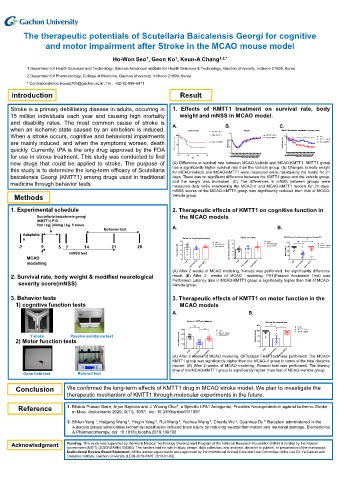
     new drugs that could be applied to stroke. The purpose of  (A) Difference in survival rate between MCAO-Vehicle and MCAO-KMTT1. KMTT1 group
     this study is to determine the long-term efficacy of Scutellaria  has a significantly higher survival rate than the Vehicle group. (B) Changes in body weight
                                                              for MCAO-Vehicle and MCAO-KMTT1 were measured while maintaining the model for 21
     baicalensis Georgi (KMTT1) among drugs used in traditional  days. There was no significant difference between the KMTT1 group and the vehicle group,
     medicine through behavior tests.                         and the weight was increased. (C) The differences in mNSS between groups were
                                                              measured daily while maintaining the MCAO-V and MCAO-KMTT1 models for 21 days.
                                                              mNSS scores of the MCAO-KMTT1 group was significantly reduced than that of MCAO-
      Methods                                                 Vehicle group.
     1. Experimental schedule                                 2. Therapeutic effects of KMTT1 on cognitive function in
              Scutellaria baicalensis georgi                    the MCAO models
              (KMTT1) P.O.
              5ml / kg  200mg / kg  5 times
                                      Behavior test           A.                                                                         B.
         Adaptatio
         n                                                                                               ****  ***
        -7      0     5  7     14       21       28                               Spontaneous alteration (%)
                         mNSS test                             total entrance (N)                    latency time (s)
          MCAO
          modelling                                               sham  MCAO-Vehicle  MCAO-KMTT1  sham  MCAO-Vehicle  MCAO-KMTT1  sham  MCAO - Vehicle  MCAO - KMTT1
                                                              (A) After 2 weeks of MCAO modeling, Y-maze was performed. No significantly difference
     2. Survival rate, body weight & modified neurological    result. (B) After 3  weeks of MCAO  modeling, PAT(Passive Avoidance Test) was
       severity score(mNSS)                                   Performed. Latency time in MCAO-KMTT1 group is significantly higher than that of MCAO-
                                                              Vehicle group.
     3. Behavior tests                                        3. Therapeutic effects of KMTT1 on motor function in the
       1) cognitive function tests                              MCAO models
                                                              A.                             B.

                                                                                                **
                                                                     ****                          **
                                                                         ****
            Y-maze        Passive avoidance test                                           latency time(s)
       2) Motor function tests                                  Total distance (cm)
                                                                                             sham
                                                                   sham                        MCAO-Vehicle  MCAO-KMTT1
                                                                     MCAO-Vehicle
                                                                        MCAO-KMTT1
                                                              (A) After 2 weeks of MCAO modeling, OFT(Open Field Test) was performed. The MCAO-
                                                              KMTT1 group was significantly higher than the MCAO-V group in terms of the total distance
                                                              moved. (B) After 2 weeks of MCAO modeling, Rotarod test was performed. The latency
                                                              time of the MCAO-KMTT1 group is significantly higher than that of MCAO-Vehicle group.
         Open field test    Rotarod test
       Conclusion        We confirmed the long-term effects of KMTT1 drug in MCAO stroke model. We plan to investigate the
                         therapeutic mechanism of KMTT1 through molecular experiments in the future.

       Reference         1. Bhakta Prasad Gaire, Arjun Sapkota and Ji Woong Choi*, a Specific LPA1 Antagonist, Provides Neuroprotection against Ischemic Stroke
                          in Mice. Antioxidants 2020, 9(11), 1097; doi: 10.3390/antiox9111097
                                                                                              5
                                                                           2
                         2. Shilun Yang , Haigang Wang , Yinglin Yang , Rui Wang , Yuehua Wang , Chunfu Wu , Guanhua Du Baicalein administered in the
                                                                                    4
                                  1
                                              2
                                                        2
                                                                3
                          subacute phase ameliorates ischemia-reperfusion-induced brain injury by reducing neuroinflammation and neuronal damage. Biomedicine
                          & Pharmacotherapy, doi: 10.1016/j.biopha.2019.109102.
     Acknowledgment      Funding: This study was supported by the Bio & Medical Technology Development Program of the National Research Foundation (NRF) & funded by the Korean
                         government (MSIT) (2020M3A9E4104384). The funders had no role in study design, data collection, and analysis, decision to publish, or preparation of the manuscript.
                         Institutional Review Board Statement: All the animal experiments were approved by the Institutional Animal Care and Use Committee of the Lee Gil Ya Cancer and
                         Diabetes Institute, Gachon University (LCDI-2018-0145: 2019-01-03).

