


Page 9 - ebook
P. 9
Mouse Brain N-Glycome DB:

            Investigation of brain region-specific

       N-glycome diversity using nanoLC-MS/MS

                      Dongtan Yin , Hee Young Jo , Hyun Joo An *
                                                              1,2
                                                1,2
                                 1,2
      1 Graduate School of Analytical Science and Technology, Chungnam National University, Daejeon, 34134, Korea
                      2 Asia-pacific Glycomics Reference Site, Daejeon, 34134, Korea
   Overview                                              Result

   Glycosylation is one of the most structurally complicated forms of post-
                                                            Elucidation of glycan structures by MS/MS
   translational modification of proteins. In the mammalian brain, over 70% of
                                                           Bisecting type  Core fucosylated type  Outer fucosylated type
   proteome is known to be glycosylated, and a large fraction of the glycosylation is  N-glycan  N-glycan  N-glycan
   N-glycome. N-glycosylation plays an important role in neuro-biological, including
                                                            Diagnostic
   nervous system development, and neurotransmitter receptor regulation. However,  fragment peaks  Diagnostic
                                                                                Diagnostic
                                                                               fragment peaks  fragment peaks
   our current understanding of N-glycome for exploring brain biological function
   remains largely limited due to structurally complexity and heterogeneity. To
   facilitate brain glycosylation studies, we built a glycome database using PGC
   nanoLC-MS/MS, an isomer-sensitive and highly reproducible glycan analysis
   platform. In detail, putative brain glycan structures were elucidated by considering
   diagnostic fragment peaks in MS/MS and RT together. A total of 130 N-glycans  Expression of N-glycomes in the mouse brain
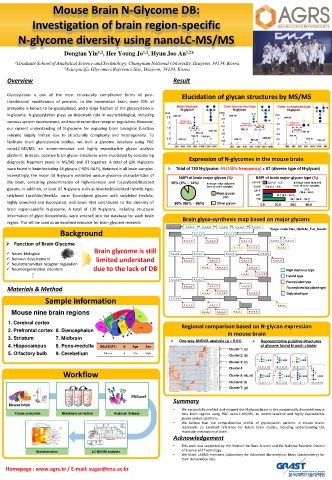
   were found in brain including 44 glycans (~90% NAPI), detected in all brain samples.  ➢  Total of 130 N-glycans: 44 (100% frenquency) + 87 (diverse type of N-glycan)
   Interestingly, the major 44 N-glycans exhibited unique glycomic characteristics of
                                                           NAPI of brain major glycan (%)  NAPI of brain major glycan type (%)
   the brain, consisting predominantly of high-mannose and fucosylated/bisected  10% (4% ~ 14%)  Average value obtained   C/H-FS  5.2 (4.5 ~ 6.3)  Average value obtained
                                                                    from all brain samples  C/H-S  0.4 (0.2 ~ 0.6)  from all brain samples
   glycans. In addition, at least 87 N-glycans such as bisected/sialylated hybride type,  C/H-F     42.4
                                                                       Major glycan                (39.6 ~ 46.0)
   sialylated LacdiNAc/HexNAc, outer fucosylated glycans with sialylated HexNAc,  (44)  C/H  12.7 (9.2 ~ 15.3)
                                                                                    HM          29.1 (25.0 ~ 34.1)
   highly branched and fucosylated, and Lewis Y(B) contributed to the diversity of  90% (86% ~ 96%)  Other glycan  0.0  20.0  40.0  60.0
   brain region-speicfic N-glycome, A total of 130 N-glycans, including structural
   information of glyco biosynthesis, were entered into the database for each brain  NAPI of brain glycome (%)
                                                            Brain glyco-synthesis map based on major glycans
   region. This will be used as an excellent resource for brain glycome research.
                                                                                         *Sugar code: Hex_HexNAc_Fuc_NeuAc
                     Background
   ➢ Function of Brain Glycome
                                Brain glycome is still
   ✓ Neuro-biological
   ✓ Nervous development        limited understand
   ✓ Neurotransmitter receptor regulation
   ✓ Neurodegenerative disorders  due to the lack of DB                                       High mannose type
                                                                                              Hybrid type
                                                                                              Fucosylated type
   Materials & Method                                                                         Fucosylated sialylated type
                                                                                              Sialylated type
                Sample Information
     Mouse nine brain regions

    1. Cerebral cortex
    2. Prefrontal cortex 6. Diencephalon                    Regional comparison based on N-glycan expression
    3. Striatum    7. Midbrain                                             in mouse brain
                                                         ➢  One-way ANOVA analysis (p < 0.01)  ➢  Representative putative structures
    4. Hippocampus  8. Pons-medulla                                                   of glycans found in each cluster
                                                                            Cluster 1: (a)
    5. Olfactory bulb  9. Cerebellum                                        Cluster 2: (b)
                                                                            Cluster 3: (c)
                                                                            Cluster 4
                      Workflow                                              Cluster 5: (d), (e)
                                                                            Cluster 6: (f)
                                                                            Cluster 7: (g)

                                                         Summary
    Mouse brain
                                                         •  We successfully profiled and mapped the N-glycosylation in the anatomically dissected mouse
      Tissue sonication  Membrane extraction  N-glycan Release  nine brain regions using PGC nanoLC-MS/MS, an isomer-sensitive and highly reproducible
                                                            glycan analysis platform.
                                                         •  We believe that our comprehensive profile of glycosylation patterns in mouse brains
                                                            represents an excellent reference for future brain studies, including understanding the
                                                            molecular mechanism of brain.
                                                         Acknowledgement
                                                         •  This work was supported by the Institute for Basic Science and the National Research Council
             Bioinformatics    LC-MS/MS analysis            of Science and Technology.
                                                         •  We thank LABMS members (Laboratory for Advanced Bio-analytical Mass Spectrometry) for
                                                            their tremendous help.
   Homepage : www.agrs.kr / E-mail: sugar@cnu.ac.kr

