


Page 93 - ebook
P. 93
Wnt signaling up-regulates microRNA-135b to promote intestinal tumorigenesis
1,2
Tae-Su Han , Masanobu Oshima 3
1 Biotherapeutics Translational Research Center, Korea Research Institute of Bioscience and Biotechnology (KRIBB)
2 Department of Functional Genomics, Korea University of Science & Technology (UST)
3 Division of Genetics, Cancer Research Institute, Kanazawa University, Kanazawa, Japan
ABSTRACT RESULTS
Colorectal cancer (CRC) is one of the leading causes of Figure 1. miR-135b is up-regulated by Wnt signaling
cancer-related death, but little is known about changes in A B Lgr5 expression miR-135b expression C 20 ***
microRNA expression patterns during CRC development. 2.0 *** *** 2.0 ** *** **
In this study, we examined the role of miR-135b in 1.5 1.0 1.5 15
intestinal tumorigenesis. Firstly, we found that the miR- Relative expression level of Lgr5 0.5 Relative expression level of miR-135b 1.0 miR-135b level 10
135b was up-regulated in intestinal crypt cells compared 0.0 0.5 5
with villus, and Wnt3a treatment induced miR-135b in -0.5 Bottom Top Villus 0.0 Bottom Top Villus 0
immortalized cells, suggesting that miR-135b can be Crypt Crypt Control Wnt3a Wnt3a+
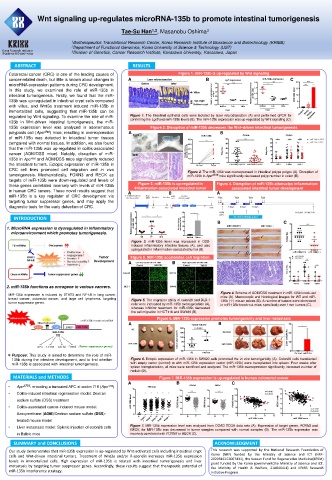
regulated by Wnt signaling. To examine the role of miR- Figure 1. The intestinal epithelial cells were isolated by laser microdissection (A) and performed qPCR for R-spondin
confirming the Lgr5 and miR-135b levels (B). The miR-135b expression was up-regulated by Wnt signaling (C).
135b in Wnt-driven intestinal tumorigenesis, the miR-
135b expression level was analyzed in adenomatous Figure 2. Disruption of miR-135b decreases the Wnt–driven intestinal tumorigenesis
polyposis coli (Apc D716 ) mice, resulting in overexpression A B
of miR-135b was detected in intestinal tumor tissues
compared with normal tissues. In addition, we also found
that the miR-135b was up-regulated in colitis-associated
cancer (AOM/DSS mice). Notably, disruption of miR-
135b in Apc D716 and AOM/DSS mice significantly reduced
the intestinal tumors. Ectopic expression of miR-135b in
CRC cell lines promoted cell migration and in vivo Figure 2. The miR-135b was overexpressed in intestinal polyps polyps (A). Disruption of
tumorigenesis. Mechanistically, FOXN3 and RECK as miR-135b in Apc D716 mice significantly decreased polyp number in colon (B).
targets of miR-135b were down-regulated and levels of
Figure 3. miR-135b is up-regulated in
these genes correlated inversely with levels of miR-135b Inflammation-associated intestinal tumor Figure 4. Disruption of miR-135b attenuates inflammation-
associated intestinal tumor development
in human CRC tumors. These novel results suggest that A B A
miR-135b is a key regulator of CRC development via
targeting tumor suppressor genes, and may apply the
diagnostic tools for the early detection of CRC.
INTRODUCTION
B C
1. MicroRNA expression is dysregulated in inflammatory
microenvironment which promotes tumorigenesis.
Figure 3. miR-135b level was increased in DSS-
induced inflammatory intestine tissues (A), and also
upregulated in inflammation-associated tumor (B).
Figure 5. MiR-135b accelerates cell migration.
A B
2. miR-135b functions as oncogene in various cancers.
Figure 4. Scheme of AOM/DSS treatment in miR-135b knock-out
MiR-135b expression is induced by STAT3 and NF-kB in lung cancer, mice (A). Macroscopic and histological images for WT and miR-
breast cancer, colorectal cancer, and large cell lymphoma, targeting Figure 5. The migration ability of colon26 and DLD-1
tumor suppressor genes. cells were increased by miR-135b overexpression (A), 135b (-/-) mouse colons (B). A number of tumors were decreased
in miR-135b knock-out mice, specifically over 1mm tumors (C).
whereas inhibitor treatment for miR-135b decreased
the cell migration in HCT116 and SW480 (B).
Figure 6. MiR-135b expression promotes tumorigenicity and liver metastasis
A Tumor volume B
2000 P=0.0487
Tumor volume (mm 3 ) 1000
1500
500
-500 0
NC miR-135b
Purpose: This study is aimed to determine the role of miR-
135b during the intestine development, and to find whether Figure 6. Ectopic expression of miR-135b in SW620 cells promoted the in vivo tumorigenicity (A). Colon26 cells transfected
miR-135b is associated with intestinal tumorigenesis. with empty vector (control) or with miR-135b expression vector (miR-135b) were transplanted into spleen. Four weeks after
spleen transplantation, all mice were sacrificed and analyzed. The miR-135b overexpression significantly increased number of
nodule (B).
MATERIALS and METHODS Figure 7. MiR-135b expression is up-regulated in human colorectal cancer
A B C
• Apc D716 : encoding a truncated APC at codon 716 (Apc D716 )
• Colitis-induced intestinal regeneration model: Dextran
sodium sulfate (DSS) treatment
• Colitis-associated cancer-induced mouse model:
Azoxymethane (AOM)/Dextran sodium sulfate (DSS)-
treated mouse model
• Liver metastasis model: Splenic injection of colon26 cells Figure 7. MiR-135b expression level was analyzed from COAD TCGA data sets (A). Expression of target genes, FOXN3 and
RECK, for MiR-135b was decreased in tumor samples compared with normal samples (B). The miR-135b expression was
in Balb/c mice inversely correlated with FOXN3 or RECK (C).
SUMMARY and CONCLUSIONS ACKNOWLEDGMENT
Our study demonstrates that miR-135b expression is up-regulated by Wnt-activated cells including intestinal crypt This research was supported by the National Research Foundation of
cells and Wnt-driven intestinal tumors. Treatment of Wnt3a and/or R-spondin increases miR-135b expression Korea (NRF) funded by the Ministry of Science and ICT (NRF-
levels in immortalized cells. High expression of miR-135b is related with intestinal tumorigenesis and liver 2020R1C1C1007431), the Korean Fund for Regenerative Medicine(KFRM)
grant funded by the Korea government(the Ministry of Science and ICT,
metastasis by targeting tumor suppressor genes. Accordingly, these results suggest that therapeutic potential of the Ministry of Health & Welfare, 21A0404L1) and KRIBB Research
miR-135b interference strategy.
Initiative Program.

