


Page 91 - ebook
P. 91
Targeted cancer stem cell therapy via lysophosphatidic acid pathway
inhibition in ovarian cancer stem cells
MinJoo Shin, SeoYul Lee, JunSe Kim, HoJun Kim, SeongMin Choi and JaeHo Kim
Department of Physiology, School of Medicine, Pusan National University, Yangsan- si,50612
Abstract
Ovarian cancer shows high mortality due to
development of resistance to chemotherapy and
relapse. Cancer stem cells are a subpopulation of
cancer cells characterized by self-renewal ability,
tumorigenesis and drug resistance. In previous studies,
we have shown that autotaxin and lysophosphatidic
acid (LPA) play an important role in cancer stem cell
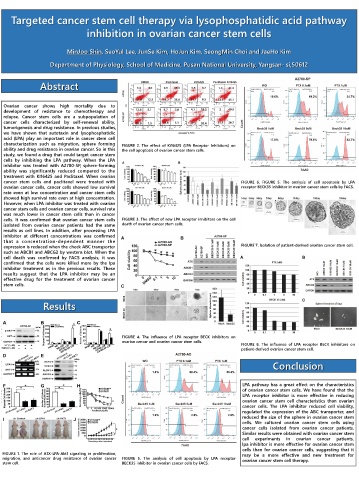
characterization such as migration, sphere forming FIGURE 2. The effect of Ki16425 (LPA Receptor Inhibitors) on
ability and drug resistance in ovarian cancer. So in this the cell apoptosis of ovarian cancer stem cells.
study, we found a drug that could target cancer stem
cells by inhibiting the LPA pathway. When the LPA
inhibitor was treated with A2780-SP, sphere-forming
ability was significantly reduced compared to the
treatment with KI16425 and Paclitaxel. When ovarian
cancer stem cells and paclitaxel were treated with FIGURE 6. FIGURE 5. The analysis of cell apoptosis by LPA
ovarian cancer cells, cancer cells showed low survival receptor BECK35 inhibitor in ovarian cancer stem cells by FACS.
rate even at low concentration and cancer stem cells
showed high survival rate even at high concentration.
However, when LPA inhibitor was treated with ovarian
cancer stem cells and ovarian cancer cells, survival rate
was much lower in cancer stem cells than in cancer
cells. It was confirmed that ovarian cancer stem cells FIGURE 3. The effect of new LPA receptor inhibitors on the cell
isolated from ovarian cancer patients had the same death of ovarian cancer stem cells.
results as cell lines. In addition, after processing LPA
inhibitor at different concentrations was confirmed
that a concentration-dependent manner the
expression is reduced when the check ABC transporter FIGURE 7. Isolation of patient-derived ovarian cancer stem cell.
such as ABCB1 and ABCG2 by western blot. When the
cell death was confirmed by FACS analysis, it was
confirmed that the cells were killed more by the lpa
inhibitor treatment as in the previous results. These
results suggest that the LPA inhibitor may be an
effective drug for the treatment of ovarian cancer
stem cells.
Results
FIGURE 4. The influence of LPA receptor BECK inhibitors on
ovarian cancer and ovarian cancer stem cells.
FIGURE 8. The influence of LPA receptor BECK inhibitors on
patient-derived ovarian cancer stem cell.
Conclusion
LPA pathway has a great effect on the characteristics
of ovarian cancer stem cells. We have found that the
LPA receptor inhibitor is more effective in reducing
ovarian cancer stem cell characteristics than ovarian
cancer cells. The LPA inhibitor reduced cell viability,
regulated the expression of the ABC transporter, and
reduced the size of the sphere in ovarian cancer stem
cells. We cultured ovarian cancer stem cells using
cancer cells isolated from ovarian cancer patients.
Similar results were obtained with ovarian cancer stem
cell experiments in ovarian cancer patients.
lpa inhibitor is more effective for ovarian cancer stem
cells than for ovarian cancer cells, suggesting that it
FIGURE 1. The role of ATX-LPA-Akt1 signaling in proliferation, may be a more effective and new treatment for
migration, and anticancer drug resistance of ovarian cancer FIGURE 5. The analysis of cell apoptosis by LPA receptor ovarian cancer stem cell therapy.
stem cell. BECK35 inhibitor in ovarian cancer cells by FACS.

