Page 67 - ebook
P. 67

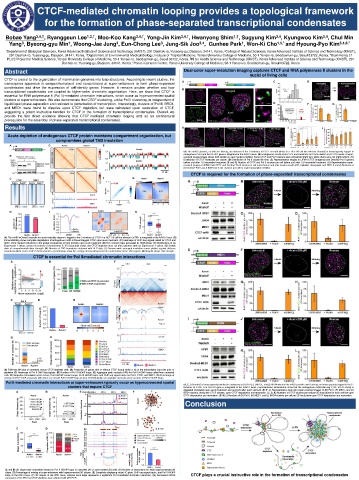
CTCF-mediated chromatin looping provides a topological framework


                                                                 for the formation of phase-separated transcriptional condensates


                                                                                                                                                                                                                                                                                                                                             1,†
         Bobae Yang                                 3,4,†       , Ryanggeun Lee                                              1,2,†      , Moo-Koo Kang                                            3,4,†       , Yong-Jin Kim                                      3,4,†       , Hwanyong Shim , Sugyung Kim , Kyungwoo Kim , Chul Min
                                                                                                                                                                                                                                                                                                                                                                                                                                                                            3,4
                                                                                                                                                                                                                                                                                                                                                                                                         3,4

                                                                                                  1
              Yang , Byeong-gyu Min , Woong-Jae Jung , Eun-Chong Lee , Jung-Sik Joo ,  Gunhee Park , Won-Ki Cho                                                                                                                                                                                                                                                                                            1,5,*       and Hyoung-Pyo Kim                                                           3,4,6,*
                                3
                                                                                                                                                                                                                                                                                            3,4
                                                                                                                                                                                                                                                                                                                                                         1
                                                                                                                                                                                                                                      3
                                                                                                                                                                      3
         1 Department of Biological Sciences, Korea Advanced Institute of Science and Technology (KAIST), 291 Daehak-ro, Yuseong-gu, Daejeon, 34141, Korea,  College of Natural Sciences, Korea Advanced Institute of Science and Technology (KAIST),
                                                                                                                                                                                                                                                                                                                                2
                                                                                                                                                                                                                                                                                                                                                                                                                                                                                      4
                                                                                                                            3
              291 Daehak-ro, Yuseong-gu, Daejeon, 34141, Korea,  Department of Environmental Medical Biology, Institute of Tropical Medicine, Yonsei University College of Medicine, 50-1 Yonsei-ro, Seodaemun-gu, Seoul 03722, Korea,  Brain Korea 21
                                                                                                                                                                                                                                                                               5
           PLUS Project for Medical Science, Yonsei University College of Medicine, 50-1 Yonsei-ro, Seodaemun-gu, Seoul 03722, Korea,  KI for Health Science and Technology (KIHST), Korea Advanced Institute of Science and Technology (KAIST), 291
                                                                                         Daehak-ro, Yuseong-gu, Daejeon, 34141, Korea,  Yonsei Genome Center, Yonsei University College of Medicine, 50-1 Yonsei-ro, Seodaemun-gu, Seoul 03722, Korea
                                                                                                                                                                                              6


        Abstract                                                                                                                                                                                                                                                       Dual-color super-resolution imaging captures CTCF and RNA polymerase II clusters in the


                                                                                                                                                                                                                                                                                                                                                                    nuclei of living cells


        CTCF is crucial to the organization of mammalian genomes into loop structures. According to recent studies, the

        transcription apparatus is compartmentalized and concentrated at super-enhancers to form phase-separated


        condensates and drive the expression of cell-identity genes. However, it remains unclear whether and how


        transcriptional condensates are coupled to higher-order chromatin organization. Here, we show that CTCF is

        essential for RNA polymerase II (Pol II)-mediated chromatin interactions, which occur as hyperconnected spatial


        clusters at super-enhancers. We also demonstrate that CTCF clustering, unlike Pol II clustering, is independent of

        liquid-liquid phase-separation and resistant to perturbation of transcription. Interestingly, clusters of Pol II, BRD4,


        and MED1 were found to dissolve upon CTCF depletion, but were reinstated upon restoration of CTCF,


        suggesting a potent instructive function for CTCF in the formation of transcriptional condensates. Overall, we

        provide the first direct evidence showing that CTCF-mediated chromatin looping acts as an architectural


        prerequisite for the assembly of phase-separated transcriptional condensates.


        Results


            Acute depletion of endogenous CTCF protein maintains compartment organization, but


                                                                                 compromises global TAD insulation


                                                                                                                                                                                                                                                                      (A) The mAID cassette, as well as HaloTag, are inserted at the C-terminus of CTCF on both alleles in a HCT116 cell line wherein Dendra2 is homozygously tagged to

                                                                                                                                                                                                                                                                      endogenous Pol II and the OsTIR1 gene is integrated at the AAVS1 locus. (B) Endogenous JF646-Halo-CTCF and Dendra2-Pol II form clusters in HCT116 nuclei. A super-
                                                                                                                                                                                                                                                                      resolved merged image shows both clusters in each nucleus (middle). Some CTCF and Pol II clusters were colocalized (right top), while others were not (right bottom). (C)
                                                                                                                                                                                                                                                                      Distribution of CTCF molecules per cluster. (D) Distribution of Pol II cluster life time. (E) Representative images for JF646-CTCF (magenta) and Dendra2-Pol II (green)

                                                                                                                                                                                                                                                                      before and after 1,6-hexanediol treatment. (F and G) Number of CTCF and Pol II clusters per cell before and after 1,6-hexanediol treatment. (H) Representative super-
                                                                                                                                                                                                                                                                      resolved images of JF646-Halo-CTCF and Dendra2-Pol II clusters in cell nuclei before and after treatment with JQ1, triptolide, flavopiridol, and DRB. (I and J) Numbers of

                                                                                                                                                                                                                                                                      (I) Dendra2-Pol II, (J) JF646-Halo-CTCF clusters per cell for each transcription inhibitor.


                                                                                                                                                                                                                                                                                CTCF is required for the formation of phase-separated transcriptional condensates


       (A) The mAID-mClover3 cassette for auxin-inducible degron is tagged to the C-terminus of CTCF in a HCT116 cell line wherein OsTIR1 is integrated at the AAVS1 locus. (B)

       Immunoblotting shows complete degradation of endogenous mAID-mClover3-tagged CTCF upon auxin treatment. (C) Heatmaps of ChIP-Seq signals called for CTCF and
       SMC1 show marked reductions in the global occupancies of both proteins upon auxin treatment. (D) Hi-C contact maps generated by HiCExplorer. (E) Distributions of cis
       Eigenvector 1 values across the entirety of chromosome 8. (F) Scatterplot shows that CTCF depletion does not affect genome-wide cis Eigenvector 1 values. (G) Saddle

       plots of compartmentalization strength. (H) Number of TAD boundaries obtained with Hi-C data. (I) Genome-wide averaged insulation scores plotted against distance
       around insulation center at WT TAD boundaries. (J) Heatmaps show the average observed/expected Hi-C interactions in the TAD regions. (K) Boxplot shows TAD strength.


                                                CTCF is essential for Pol II-mediated chromatin interactions


                                                                                                 Auxin-                 Auxin+
       (A) RNA-seq MA plot of untreated versus CTCF-depleted cells. (B) Proportion of genes with or without CTCF bound within 2 kb of the transcrtipion start site prior to

       depletion (C) Heatmaps of Pol II ChIP-Seq signals. (D) Number of Pol II HiChIP loops. (E) Aggregate peak analysis (APA) for Pol II HiChIP loops called from untreated
       cells. (F) Snapshot of insulation score curves, Pol II HiChIP contact maps, Pol II HiChIP loops, and ChIP-seq signal tracks for Pol II, CTCF, and SMC1. (G) Percentage of

       overlap of CTCF ChIP-seq peaks with either one or both Pol II HiChIP loop anchors. (H) Distribution of regulatory elements at the anchors of Pol II HiChIP loops.

          Pol II-mediated chromatin interactions at super-enhancers typically occur as hyperconnected spatial                                                                                                                                                         (A, E, I) Dendra2 is homozygously labelled to endogenous (A) Pol II, (E) MED1, and (I) BRD4 wherein the mAID cassette and HaloTag are homozygously tagged to the C-


                                                                                                  clusters that require CTCF                                                                                                                                          terminus of CTCF. The OsTIR1 gene is integrated at the AAVS1 locus. Representative immunoblots show that the endogenous mAID/HaloTag CTCF (CTCF-mAH) is

                                                                                                                                                                                                                                                                      degraded completely upon auxin treatment and recovers after auxin removal. (B, F, J) Representative dual-color super-resolved images of (B) Pol II, (F) MED1, and (J)

                                                                                                                                                                                                                                                                      BRD4 clusters, along with CTCF clusters, upon CTCF degradation and restoration. (C, G, K) Numbers of CTCF clusters per cell per 2D-focal plane for each cell line upon
                                                                                                                                                                                                                                                                      CTCF degradation and restoration. (D, H, L) Numbers of (D) Pol II, (H) MED1, and (L) BRD4 clusters per cell per 2D-focal plane upon CTCF degradation and restoration.


                                                                                                                                                                                                                                                                        Conclusion


        (A and B) 3D clique total connectivity based on Pol II HiChIP loops in untreated (A) or auxin-treated (B) cells. (C) Number of interactions for each hyperconnected 3D
        clique. (D) Percentage of overlap of super-enhancers with hyperconnected 3D cliques. (E) Snapshots displaying virtual 4C plots, ChIP-seq signal tracks, and Pol II HiChIP

        loops at the IRS1 locus. (F) 3D cliques in the IRS1 locus, wherein each edge represents a significant Pol II-mediated chromatin interaction. (G) Decreased mRNA                                                                                                         CTCF plays a crucial instructive role in the formation of transcriptional condensates
        expression of the IRS1 by CTCF depletion was validated with qRT-PCR.
   62   63   64   65   66   67   68   69   70   71   72