


Page 5 - ebook
P. 5
Acyl chain length of sphingolipid regulates cytokine secretion via endoplasmic
reticulum stress
Su-Jung Kim , Min hee Kim , Hee-Yeon Kim , Hee-Soo Yoon , Woo-Jae Park *, and Joo-Won Park *
2
2,
1,
1
1
2
1 Department of Biochemistry, School of Medicine, Gachon University, Incheon 21999, Republic of Korea
2 Department of Biochemistry, College of Medicine, Ewha Womans University, Seoul 07084, Republic of Korea
Abstract CerS6 overexpression synergistically increased
lipopolysaccharide (LPS)-induced inflammasome
Ceramide has been emerged as an important regulator in various cellular processes
such as apoptosis, differentiation, and inflammation. In the present study, we investigated formation and inflammatory cytokines release
whether ceramide can have different effects on inflammatory cytokine production and
inflammasome formation depending on its acyl chain length. LPS treatment increased
CerS6, but reduced CerS2 levels with concomitant increase of C16-ceramide. While
CerS6 overexpression augmented LPS-induced signaling cascades and inflammasome
formation, CerS2 overexpression inhibited it. Since ER stress pathways are known to be
involved in inflammatory cytokine production and inflammasome complex formation, we
then examined phosphorylation of PERK and eIF2A. Phosphorylation of PERK and
eIF2A were induced by LPS treatment, which was further intensified by CerS6
overexpression. However, CerS2 overexpression reduced LPS-induced ER stress
response. In addition, bortezomib, which increases CerS2 and reduces CerS6 protein
levels, diminished LPS-induced inflammatory cytokine production and inflammasome
complex formation. Taken together, long chain ceramides produced by CerS6 and veryl
long chain ceramides generated by CerS2 plays an opposite role in LPS-induced
inflammation and inflammsome complex formation by modulating ER stress, MAP kinase
and NF-kB signalling pathways.
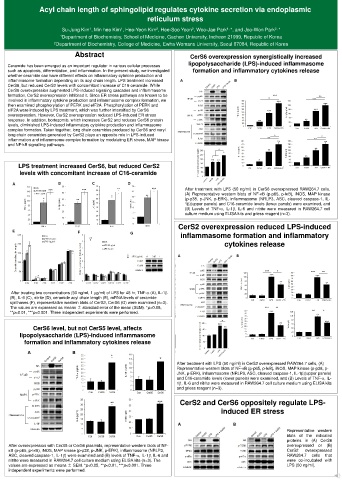
LPS treatment increased CerS6, but reduced CerS2
levels with concomitant increase of C16-ceramide
After treatment with LPS (50 ng/ml) in CerS6 overexpressed RAW264.7 cells,
(A) Representative western blots of NF-κB (p-p65, p-IκB), iNOS, MAP kinase
(p-p38, p-JNK, p-ERK), inflammasome (NRLP3, ASC, cleaved caspase-1, IL-
1)(upper panels) and C16-ceramide levels (lower panels) were examined, and
(B) Levels of TNF-, IL-1, IL-6 and nitrite were measured in RAW264.7 cell
culture medium using ELISA kits and griess reagent (n=3).
CerS2 overexpression reduced LPS-induced
inflammasome formation and inflammatory
cytokines release
After treating two concentrations (50 ng/ml, 1 µg/ml) of LPS for 48 hr, TNF- (A), IL-1
(B), IL-6 (C), nitrite (D), ceramide acyl chain length (E), mRNA levels of ceramide
synthases (F), representative western blots of CerS2, CerS6 (G) were examined (n=3).
The values are expressed as means ± standard error of the mean (SEM). *p<0.05,
**p<0.01, ***p<0.001. Three independent experiments were performed.
CerS6 level, but not CerS5 level, affects
lipopolysaccharide (LPS)-induced inflammasome
formation and inflammatory cytokines release
After treatment with LPS (50 ng/ml) in CerS2 overexpressed RAW264.7 cells, (A)
Representative western blots of NF-κB (p-p65, p-IκB), iNOS, MAP kinase (p-p38, p-
JNK, p-ERK), inflammasome (NRLP3, ASC, cleaved caspase-1, IL-1)(upper panels)
and C16-ceramide levels (lower panels) were examined, and (B) Levels of TNF-, IL-
1, IL-6 and nitrite were measured in RAW264.7 cell culture medium using ELISA kits
and griess reagent (n=3).
CerS2 and CerS6 oppositely regulate LPS-
induced ER stress
Representative western
blots of the indicated
proteins in (A) CerS6
After overexpression with CerS5 or CerS6 plasmids, representative western blots of NF- overexpressed or (B)
κB (p-p65, p-IκB), iNOS, MAP kinase (p-p38, p-JNK, p-ERK), inflammasome (NRLP3, CerS2 overexpressed
ASC, cleaved caspase-1, IL-1) were examined and (B) levels of TNF-, IL-1, IL-6 and RAW264.7 cells that
nitrite were measured in RAW264.7 cell culture medium using ELISA kits (n=3). The were co-incubated with
values are expressed as means ± SEM. *p<0.05, **p<0.01, ***p<0.001. Three LPS (50 ng/ml).
independent experiments were performed.

