


Page 3 - ebook
P. 3
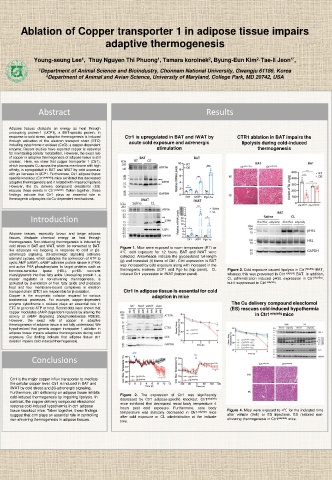
Ablation of Copper transporter 1 in adipose tissue impairs
                                   adaptive thermogenesis


            Young-seung Lee ,  Thuy Nguyen Thi Phuong , Tamara korolnek , Byung-Eun Kim Tae-Il Jeon ,
                            1
                                                                                                1*
                                                    1
                                                                     2
                                                                                    2,
              1 Department of Animal Science and Bioindustry, Chonnam National University, Gwangju 61186, Korea
                2 Department of Animal and Avian Science, University of Maryland, College Park, MD 20742, USA


              Abstract                                              Results


    Adipose tissues dissipate an energy as heat through
    uncoupling protein-1 (UCP1), a BAT-specific protein. In
    response to cold stress, adaptive thermogenesis is induced  Ctr1 is upregulated in BAT and iWAT by   CTR1 ablation in BAT impairs the
    through activation of the electron transport chain (ETC)  acute cold exposure and adrenergic   lipolysis during cold-induced
    including cytochrome c oxidase (CcO), a copper-dependent
    enzyme. Recent studies have reported copper is essential  stimulation            thermogenesis
    for maintaining cellular metabolism. However, the exact role
    of copper in adaptive thermogenesis of adipose tissue is still
    unclear. Here, we show that copper transporter 1 (Ctr1),
    which transports Cu across the plasma membrane with high
    affinity, is upregulated in BAT and iWAT by cold exposure
    with an increase in UCP1. Furthermore, Ctr1 adipose tissue
    specific knockout (Ctr1 adq/adq ) mice exhibited that decreased
    adaptive thermogenesis and it related with impaired lipolysis.
    However, the Cu delivery compound elesclomol (ES)
    rescues these events in Ctr1 adq/adq . Taken together, these
    findings indicate that Ctr1 plays an essential role in
    thermogenic adipocytes via Cu-dependent mechanisms.
           Introduction

    Adipose tissues, especially brown and beige adipose
    tissues, dissipate chemical energy as heat through
    thermogenesis. Non-shivering thermogenesis is induced by
    cold stress in BAT and WAT, which be converted to BAT-  Figure 1. Mice were exposed to room temperature (RT) or
    like adipocyte via beigeing in response to cold or β3-  4℃ cold exposure for 12 hours. BAT and iWAT were
    adrenergic signaling. β3-adrenergic signaling activates
    adenylyl cyclase, which catalyzes the conversion of ATP to  collected. Arrowheads indicate the glycosylated full-length
    cyclic AMP (cAMP). cAMP activates protein kinase A (PKA)  (g) and truncated (t) forms of Ctr1. Ctr1 expression in BAT
    and active PKA phosphorylates its target proteins such as  was increased by cold exposure along with increased in the
    hormone-sensitive  lipase  (HSL).  p-HSL  converts  thermogenic markers UCP1 and Pgc-1α (top panel). CL  Figure 3. Cold exposure caused lipolysis in Ctr1 flox/flox BAT,
    triacylglycerols into free fatty acids. Uncoupling protein-1, a  induced Ctr1 expression in iWAT (bottom panel).  whereas this was prevented in Ctr1 adq/adq BAT. In addition,
    master  regulator  in  non-shivering  thermogenesis,  is               CL administration induced pHSL expression in Ctr1 flox/flox ,
    activated by β-oxidation of free fatty acids and produces              but it suppressed in Ctr1 adq/adq .
    heat and four membrane-bound complexes in electron
    transport chain (ETC) are responsible for β-oxidation.  Ctr1 in adipose tissue is essential for cold
    Copper is the enzymatic cofactor required for various  adaption in mice
    biochemical processes. For example, copper-dependent
    enzyme cytochrome c oxidase plays an essential role in                  The Cu delivery compound elesclomol
    ETC to generate ATP or heat. Recent data have shown that                (ES) rescues cold-induced hypothermia
    copper modulates cAMP-dependent-lipolysis by altering the                       in Ctr1 adq/adq mice
    activity of cAMP degrading phosphodiesterase PDE3B.
    However,  the  exact  role  of  copper  in  adaptive
    thermogenesis of adipose tissue is not fully understood. We
    hypothesized that genetic copper transporter 1 ablation in
    adipose tissue impairs adaptive thermogenesis during cold
    exposure. Our finding indicate that adipose tissue ctr1
    deletion impairs cold-induced thermogenesis.
           Conclusions
    Ctr1 is the major copper influx transporter to mediate
    the cellular copper level. Ctr1 is induced in BAT and
    iWAT by cold stress and β3-adrenergic signaling.
    Furthermore, ctr1 deficiency on adipose tissue inhibits
    cold-induced thermogenesis by impairing lipolysis. In   Figure 2. The expression of Ctr1 was significantly
                                        decreased by Ctr1 adipose-specific knockout. Ctr1 adq/adq
    contrast, the copper delivery compound elesclomol  mice exhibited that decreased rectal body temperature 4
    restores cold-induced hypothermia in ctr1 adipose   hours  post  cold  exposure.  Furthermore,  core  body
    tissue knockout mice. Taken together, these findings   temperature was statically decreased in Ctr1 adq/adq mice  Figure 4. Mice were exposed to 4℃ for the indicated time
    suggest that ctr1 plays an essential role in controlling   after cold exposure or CL administration at the indicate  after vehicle (Veh) or ES injections. ES restored non-
    non-shivering thermogenesis in adipose tissues.  time.                 shivering thermogenesis in Ctr1 adq/adq mice.

