


Page 9 - Y. Vascular biology
P. 9
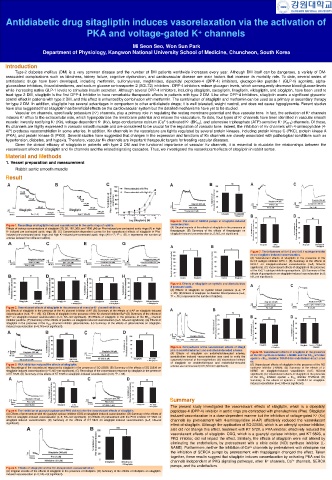
Antidiabetic drug sitagliptin induces vasorelaxation via the activation of
PKA and voltage-gated K channels
+
Mi Seon Seo, Won Sun Park
Department of Physiology, Kangwon National University School of Medicine, Chuncheon, South Korea
Introduction
Type-2 diabetes mellitus (DM) is a very common disease and the number of DM patients worldwide increases every year. Although DM itself can be dangerous, a variety of DM-
associated complications such as blindness, kidney failure, cognitive dysfunction, and cardiovascular disease are main factors that increase its mortality rate. To date, several series of
antidiabetic drugs have been developed, including metformin, sulfonylureas, meglitinides, dipeptidyl peptidase-4 (DPP-4) inhibitors, glucagon-like peptide-1 (GLP-1) agonists, alpha-
glucosidase inhibitors, thiazolidinediones, and sodium glucose co-transporter 2 (SGLT2) inhibitors . DPP-4 inhibitors reduce glucagon levels, which consequently decrease blood glucose levels
while increasing native GLP-1 levels to stimulate insulin secretion. Although several DPP-4 inhibitors, including sitagliptin, saxagliptin, linagliptin, vildagliptin, and alogliptin, have been used to
treat type 2 DM, sitagliptin is the first DPP-4 inhibitor to have remarkable therapeutic effects in patients with type 2 DM. Like other DPP-4 inhibitors, sitagliptin exerts a significant glycemic-
control effect in patients with type 2 DM, and this effect is enhanced by combination with metformin. The combination of sitagliptin and metformin can be used as a primary or secondary therapy
for type 2 DM. In addition, sitagliptin has several advantages in comparison to other anti-diabetic drugs; it is well tolerated, weight neutral, and does not cause hypoglycemia. Recent studies
have also suggested that sitagliptin has beneficial effects on the cardiovascular system but the detailed mechanisms have yet to be studied.
Vascular ion channels, specifically potassium (K ) channels, play a primary role in regulating the resting membrane potential and thus vascular tone. In fact, the activation of K channels
+
+
induces K efflux to the extracellular side, which hyperpolarizes the membrane potential and relaxes the vasculature. To date, four types of K channels have been identified in vascular smooth
+
+
muscle: inwardly rectifying K (Kir), voltage-dependent K (Kv), large-conductance calcium (Ca )-activated K (BK ), and adenosine triphosphate (ATP)-sensitive K (K ATP ) channels. Of these,
+
+
+
+
2+
Ca
Kv channels are highly expressed in vascular smooth muscle and are considered to be crucial for the regulation of vascular tone. Indeed, the inhibition of Kv channels with 4-aminopyridine (4-
AP) produces vasoconstriction in some arteries. In addition, Kv channels in the vasculature are tightly regulated by several protein kinases, including protein kinase C (PKC), protein kinase A
(PKA), and protein kinase G (PKG). Several studies have suggested that changes in the expression and functions of Kv channels are closely associated with pathological conditions such as
hypertension, diabetes, and hypoxia. Therefore, vascular Kv channels are important therapeutic targets for treating vascular diseases.
Given the clinical efficacy of sitagliptin in patients with type 2 DM and the functional importance of vascular Kv channels, it is essential to elucidate the relationships between the
vasorelaxant effects of sitagliptin and Kv channels and the related signaling cascades. Thus, we investigated the vasorelaxant effects of sitagliptin in rabbit aortas.
Material and Methods
1. Vessel preparation and measurement
Rabbit aortic smooth muscle
Result
Figure 6. The roles of SERCA pumps in sitagliptin-induced
Figure 1. Recordings of sitagliptin-induced vasorelaxation in the aortic rings of rabbits. vasorelaxation.
Effects of various concentrations of sitagliptin (10, 30, 100, 300, and 1000 μM) on Phe-induced pre-contracted aortic rings (A) or high (A) Original records of the effects of sitagliptin in the presence of
K -induced pre-contracted aortic rings (B). (C) Concentration-dependent curves for the vasorelaxant effects of sitagliptin in Phe- thapsigargin. (B) Summary of the effects of thapsigargin on
+
induced pre-contracted aortic rings and high K -induced pre-contracted aortic rings (All n=7; *P < .05; n represents the number of sitagliptin-induced vasorelaxation (n=5; NS=not significant).
+
arteries isolated from different rabbits).
Figure 7. The influences of Kv1.5 and Kv2.1 subtype inhibito
rs on sitagliptin-induced vasorelaxation.
(A) Vasorelaxant effects of sitagliptin in the presence of the
Kv1.5 subtype inhibitor DPO-1. (B) Summary of the effects of
DPO-1 on sitagliptin-induced vasorelaxation (n=5; NS=not
significant). (C) Vasorelaxant effects of sitagliptin in the presence
of the Kv2.1 subtype inhibitor guangxitoxin. (D) Summary of the
effects of guangxitoxin on sitagliptin-induced vasorelaxation (n=5;
NS=not significant).
Figure 8. Effects of sitagliptin on systolic and diastolic bloo
d pressure levels.
(A) Effects of sitagliptin on systolic blood pressure (n=4; *P
< .05). (B) Effects of sitagliptin on diastolic blood pressure (n=4;
*P < .05; n represents the number of rabbits).
Figure 2. Vasorelaxant effects of sitagliptin in the presence of vascular K channel inhibitors.
+
(A) Effects of sitagliptin in the presence of the Kv channel inhibitor 4-AP. (B) Summary of the effects of 4-AP on sitagliptin-induced
vasorelaxation (n=6; *P < .05). (C) Effects of sitagliptin in the presence of the Kir channel inhibitor Ba .(D) Summary of the effects of
2+
Ba 2+ on sitagliptin-induced vasorelaxation (n=5; NS=not significant). (E) Effects of sitagliptin in the presence of the BK Ca channel
inhibitor paxilline. (F) Summary of the effects of paxilline on sitagliptin-induced vasorelaxation (n=5. NS=not significant). (G) Effects of
sitagliptin in the presence of the K ATP channel inhibitor glibenclamide. (H) Summary of the effects of glibenclamide on sitagliptin-
induced vasorelaxation (n=5; NS=not significant).
Figure 9. Comparisons of the vasorelaxant effects of sitagli
ptin in endothelial-intact and endothelial-denuded arteries.
(A) Effects of sitagliptin on endothelial-denuded arteries; Figure 10. Vasorelaxant effects of sitagliptin in the presence
acetylcholine induced vasoconstriction was used to verify the of the NO synthase inhibitor L-NAME and the SK Ca inhibitor
successful removal of the endothelium. (B) Vasorelaxant effects apamin + IK Ca inhibitor TRAM-34 in endothelium-intact arteri
of sitagliptin on endothelial-intact and endothelial-denuded es.
Figure 3. PKA inhibition reduced the effects of sitagliptin. arteries are summarized (n=6; NS=not significant). (A) Vasorelaxant effects of sitagliptin in the presence of the NO
(A) Recordings of the vasorelaxant response by sitagliptin in the presence of SQ 22536. (B) Summary of the effects of SQ 22536 on synthase inhibitor L-NAME. (B) Summary of the effects of L-
sitagliptin-induced vasorelaxation (n=5; NS=not significant). (C) Recordings of the vasorelaxant response by sitagliptin in the presence NAME on sitagliptin-induced vasodilation (n=5; NS=not
of KT 5720. (D) Summary of the effects of KT 5720 on sitagliptin-induced vasorelaxation (n=6; *P < .05). significant). (C) Vasorelaxant effects of sitagliptin in the presence
of the SK Ca inhibitor apamin + IK Ca inhibitor TRAM-34. (D)
Summary of the effects of apamin + TRAM-34 on sitagliptin-
induced vasodilation (n=6; NS=not significant).
Summary
The present study investigated the vasorelaxant effects of sitagliptin, which is a dipeptidyl
Figure 4. The inhibition of guanylyl cyclase and PKG did not alter the vasorelaxant effects of sitagliptin. peptidase-4 (DPP-4) inhibitor in aortic rings pre-contracted with phenylephrine (Phe). Sitagliptin
(A) Effects of pretreatment with the guanylyl cyclase inhibitor ODQ on sitagliptin-induced vasorelaxation. (B) Summary of the effects of induced vasorelaxation in a dose-dependent manner but the inhibition of voltage-gated K (Kv)
+
ODQ on sitagliptin-induced vasorelaxation (n=5; NS=not significant). (C) Effects of pretreatment with the PKG inhibitor KT 5823 on
sitagliptin-induced vasorelaxation. (D) Summary of the effects of KT 5823 on sitagliptin-induced vasorelaxation (n=5; NS=not channels by pretreatment with 4-aminopyridine (4-AP) effectively reduced the vasorelaxant
significant).
effect of sitagliptin. Although the application of SQ 22536, which is an adenylyl cyclase inhibitor,
also did not change this effect, treatment with KT 5720, a PKA inhibitor, effectively reduced the
vasorelaxant effects of sitagliptin. ODQ, which is a guanylyl cyclase inhibitor, and KT 5823, a
PKG inhibitor, did not impact the effect. Similarly, the effects of sitagliptin were not altered by
eliminating the endothelium, by pretreatment with a nitric oxide (NO) synthase inhibitor (L-
NAME). Furthermore, neither the inhibition of Ca 2+ channels by pretreatment with nifedipine nor
the inhibition of SERCA pumps by pretreatment with thapsigargin changed the effect. Taken
together, these results suggest that sitagliptin induces vasorelaxation by activating PKA and Kv
channels independent of PKG signaling pathways, other K channels, Ca 2+ channels, SERCA
+
pumps, and the endothelium.
Figure 5. Effects of sitagliptin on the Em-independent vasoconstriction.
(A) Original records of the effects of sitagliptin in the presence of nifedipine. (B) Summary of the effects of nifedipine on sitagliptin-
induced vasorelaxation (n=5; NS=not significant).

