


Page 19 - X. Stem cell biology
P. 19
Oct-4, Sox2, Klf-4, and c-Myc Reprogramming Factors Delay
Premature Senescence through the Activation of Cyclin D1
Junghoon Kim, and Jungho Kim
ABSTRACT
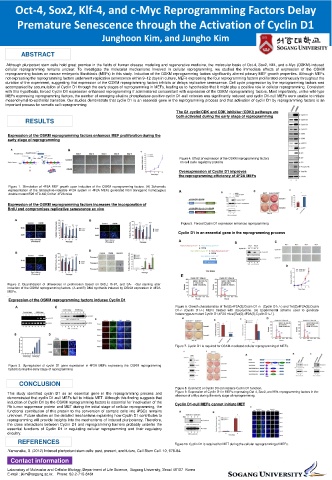
Although pluripotent stem cells hold great promise in the fields of human disease modeling and regenerative medicine, the molecular basis of Oct-4, Sox2, Klf4, and c-Myc (OSKM)-induced
cellular reprogramming remains unclear. To investigate the molecular mechanisms involved in cellular reprogramming, we studied the immediate effects of expression of the OSKM
reprogramming factors on mouse embryonic fibroblasts (MEFs) in this study. Induction of the OSKM reprogramming factors significantly altered primary MEF growth properties. Although MEFs
not expressing the reprogramming factors underwent replicative senescence within 9–12 days in culture, MEFs expressing the four reprogramming factors proliferated continuously throughout the
duration of the experiment, suggesting that expression of the OSKM reprogramming factors inhibits or delays replicative senescence. Cell cycle progression by the reprogramming factors was
accompanied by accumulation of Cyclin D1 through the early stages of reprogramming in MEFs, leading us to hypothesize that it might play a positive role in cellular reprogramming. Consistent
with this hypothesis, forced Cyclin D1 expression enhanced reprogramming if administered concomitant with expression of the OSKM reprogramming factors. Most importantly, unlike wild-type
MEFs expressing reprogramming factors, the number of emerging alkaline phosphatase-positive cyclin D1-null colonies was significantly reduced and cyclin D1-null MEFs were unable to initiate
mesenchymal-to-epithelial transition. Our studies demonstrate that cyclin D1 is an essential gene in the reprogramming process and that activation of cyclin D1 by reprogramming factors is an
important process for somatic cell reprogramming
The G1 cyclin/CDK and CDK inhibitor (CDKI) pathways are
both activated during the early stage of reprogramming
RESULTS
Expression of the OSKM reprogramming factors enhances MEF proliferation during the
early stage of reprogramming
Figure 4. Effect of expression of the OSKM reprogramming factors
on cell cycle regulatory proteins
Overexpression of Cyclin D1 improves
the reprogramming efficiency of 4F2A MEFs
Figure 1. Stimulation of 4F2A MEF growth upon induction of the OSKM reprogramming factors. (A) Schematic
representation of the tetracycline-inducible 4F2A system in 4F2A MEFs generated from transgenic homozygous
double mutant R26 rtTA-M2;Col1a1 4F2A mice
Expression of the OSKM reprogramming factors increases the incorporation of
BrdU and compromises replicative senescence ex vivo
Figure 5. Forced Cyclin D1 expression enhances reprogramming
Cyclin D1 is an essential gene in the reprogramming process
Figure 2. Quantification of differences in proliferation based on BrdU, Ki-67, and SA- -Gal staining after
induction of the OSKM reprogramming factors. (A and B) DNA synthesis induced by OSKM expression in 4F2A
MEFs.
.
Expression of the OSKM reprogramming factors induces Cyclin D1
Figure 6. Growth characteristics of Tet(2);4F2A(2);Cyclin D1+/+ (Cyclin D1+/+) and Tet(2);4F2A(2);Cyclin
D1-/- (Cyclin D1-/-) MEFs treated with doxycycline. (A) Experimental scheme used to generate
heterozygous mutant Cyclin D1;4F2A mice [Tet(2);4F2A(2);Cyclin D1+/-].
Figure 7. Cyclin D1 is required for OSKM-mediated cellular reprogramming of MEFs.
Figure 3. Up-regulation of cyclin D1 gene expression in 4F2A MEFs expressing the OSKM reprogramming
factors during the early stage of reprogramming
CONCLUSION
Figure 8. Cyclin D2 or Cyclin D3 can replace Cyclin D1 function.
This study identified cyclin D1 as an essential gene in the reprogramming process and Figure 9. Expression of Cyclin D1 in MEFs expressing Oct-4, Sox2, and Klf4 reprogramming factors in the
absence of c-Myc during the early stage of reprogramming.
demonstrated that cyclin D1-null MEFs fail to initiate MET. Although this finding suggests that .
induction of Cyclin D1 by the OSKM reprogramming factors is essential for inactivation of the Cyclin D1-null MEFs cannot initiate MET
Rb tumor suppressor protein and MET during the initial stage of cellular reprogramming, the
functional contribution of this protein to the conversion of somatic cells into iPSCs remains
unknown. Future studies on the detailed mechanisms explaining how Cyclin D1 contributes to
reprogramming will provide insights into the mechanisms of induced pluripotency. Therefore,
the close interactions between Cyclin D1 and reprogramming barriers probably underlie the
essential functions of Cyclin D1 in regulating cellular reprogramming and their regulatory
circuitry.
REFERENCES Figure 10. Cyclin D1 is required for MET during the cellular reprogramming of MEFs.
.
.Yamanaka, S. (2012) Induced pluripotent stem cells: past, present, and future, Cell Stem Cell. 10, 678-84.
Contact information
Laboratory of Molecular and Cellular Biology, Department of Life Science, Sogang University, Seoul 40107, Korea
E-mail : jkim@sogang.ac.kr, Phone: 82-2-715-8461

