


Page 7 - U. Protein structure and function
P. 7
Isolation and characterization of dopamine transporter in Clonorchis sinensis
                                Ho Jun Jang, Haneul Jung, Yunkyu Park, Seok Ho Cha
                     Dept. of Parasitology and Tropical Medicine, Inha University, Incheon, Korea


                                               Abstract

   Dopamine is an organic chemical of the catecholamine and phenethylamine families. The role of dopamine transporter is reabsorption the dopamine after it has been released and
   sent its message. There is a reports on existence of dopamine receptor in C. sinensis. It also suggest dopamine transporter for reabsorption of dopamine. Therefore, we try to
   isolate and characterize the dopamine transporter gene from adult C. sinensis.
   From NCBI database, the target dopamine transporter (CsDT) gene was isolated using reverse-transcription polymerase chain reaction. The open reading frame of CsDT cDNA
   consist of 1962 base pairs that encoded a 653-amino acid residue protein. Hydropathy analysis suggested that CsDT possess 12 putative membrane-spanning domains. When
   expressed in Xenopus oocytes, CsDT mediated the transport of radiolabeled dopamine in a time- and sodium-dependent manner. There was no efflux of radiolabeled dopamine by
   high concentration of extracellular unlabeled dopamine. From concentration dependent uptake, the Km value and Vmax value was 521.1 nM/oocyte/hr and 1616 fmol/oocyte/hr
   by Lineweaver-Burk equation.  These results might give a clue on neurotransmitter cycle in Chinese fluke.
                         AIM                                                  METHODS

                                                       ★ cDNA was prepared from adult Clonorchis sinensis cDNA library screening.
   To clarify the molecular properties of dopamine transporter of Clonorchis
   sinensis.                                           ★ CsDT gene was cloned by overlap PCR from adult Clonorchis sinensis total RNA using
                                                         reverse transcription-polymerase chain reaction.
                                                       ★ cRNA was synthesized using mMESSAGE mMACHINE T7 kit (Invitrogen).
                                                       ★ Substrate uptake was determined by Xenopus laevis oocyte expression system.
                                                       ★ Synthesized cRNA (50 ng/oocyte) was injected by manually using  micromanupilator.


                                                RESULTS

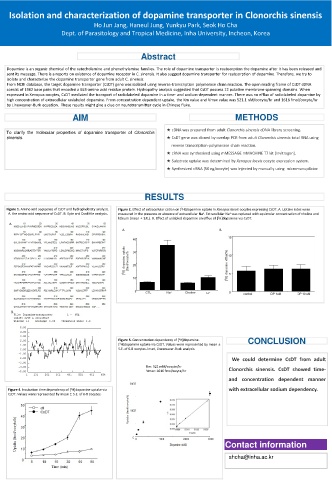
   Figure 1. Amino acid sequjence of CsDT and hydrophobicity analysis.  Figure 2. Effect of extracellular cation on [ 3 H]dopamine uptake in Xenopus laevis oocytes expressing CsDT. A. Uptake rates were
    A. the amino acid sequence of CsDT. B. Kyte and Doolittle analysis.  measured in the presence or absence of extracellular Na + . Extracellular Na + was replaced with equimolar concentration of choline and
                                        lithium (mean ± S.E.). B. Effect of unlabled dopamine on efflux of [ 3 H]dopamine via CsDT.
    A.
                                         A.                             B.


     B.


                                        Figure 5. Concentration dependency of [ 3 H]dopamine.    CONCLUSION
                                        [ 3 H]dopamine uptake via CsDT. Values were represented by mean ±
                                        S.E. of 6-8 oocytes. Inset, Lineweaver-Burk analysis.
                                                                            We could determine CsDT from adult
                                                 Km: 521 mM/oocyte/hr      Clonorchis sinensis. CsDT showed time-
                                                 Vmax: 1616 fmol/ooyte/hr
                                                                           and concentration dependent manner

    Figure 4. Incubation time dependency of [ 3 H]dopamine uptake via      with extracellular sodium dependency.
    CsDT. Values were represented by mean ± S.E. of 6-8 oocytes.


                                                                          Contact information

                                                                           shcha@inha.ac.kr

