Page 3 - U. Protein structure and function
P. 3
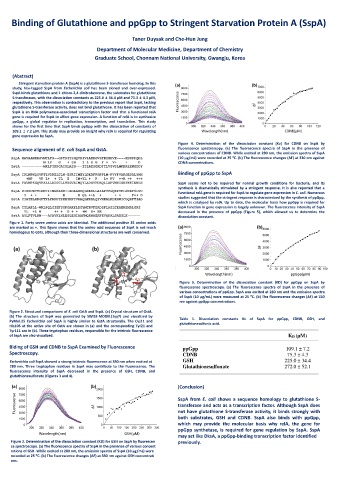
Binding of Glutathione and ppGpp to Stringent Starvation Protein A (SspA)


                                                                                                                                                                                            Taner Duysak and Che-Hun Jung


                                                                                                                                          Department of Molecular Medicine, Department of Chemistry


                                                                                                                                       Graduate School, Chonnam National University, Gwangju, Korea


                   (Abstract)


                            Stringent starvation protein A (SspA) is a glutathione S-transferase homolog. In this


                   study, his6-tagged SspA from Escherichia coli has been cloned and over-expressed.


                   SspA binds glutathione and 1-chloro-2,4-dinitrobenzene, the substrates for glutathione


                   S-transferases, with the dissociation constants as 225.0 ± 34.4 μM and 75.3 ± 4.3 μM,


                   respectively. This observation is contradictory to the previous report that SspA, lacking


                   glutathione S-transferase activity, does not bind glutathione. It has been reported that


                   SspA is an RNA polymerase-associated transcription factor and that a functional relA


                   gene is required for SspA to affect gene expression. A function of relA is to synthesize


                   ppGpp, a global regulator in replication, transcription, and translation. This study


                   shows for the first time that SspA binds ppGpp with the dissociation of constants of


                   109.1 ± 7.2 μM. This study may provide an insight why relA is required for regulating


                   gene expression by SspA.


                                                                                                                                                                                                                                                            Figure 4. Determination of the dissociation constant (KD) for CDNB on SspA by


                  Sequence alignment of E. coli SspA and GstA.                                                                                                                                                                                              fluorescence spectroscopy. (a) The fluorescence spectra of SspA in the presence of


                                                                                                                                                                                                                                                            various concentrations of CDNB. While excited at 280 nm, the emission spectra of SspA


                 SspA MAVAANKRSVMTLFS--GPTDIYSHQVRIVLAEKGVSFEIEHVE----KDNPPQDL                                                                                                                                                                              (10 μg/mL) were recorded at 25 ⁰C. (b) The fluorescence changes (ΔF) at 330 nm against


                                M LF   G   + SH   I L E G  F +  V+    +     D                                                                                                                                                                               CDNB concentrations.

                 GstA ----------MKLFYKPGACSLASH---ITLRESGKDFTLVSVDLMKKRLENGDDY


                                                                                                                                                                                                                                                            Binding of ppGpp to SspA

                 SspA IDLNPNQSVPTLVDRELTLW-ESRIIMEYLDERFPHPPLM-PVYPVARGESRLYMH


                        +NP   VP L+  + TL  E   IM+YL +  P   L+ PV  ++R ++  +++


                 GstA FAVNPKGQVPALLLDDGTLLTEGVAIMQYLADSVPDRQLLAPVNSISRYKTIEWLN                                                                                                                                                                              SspA seems not to be required for normal growth conditions for bacteria, and its

                                                                                                                                                                                                                                                            synthesis is dramatically stimulated by a stringent response. It is also reported that a


                 SspA RIEKDWYTLMNTIINGSASE--ADAARKQLREELLAIAPVFGQKPYFLSDEFSLVD                                                                                                                                                                              functional relA gene is required for SspA to regulate gene expression in E. coli. Numerous

                       I  + +     +      E      R QL ++L  +      + +     F++ D                                                                                                                                                                              studies suggested that the stringent response is characterized by the synthesis of ppGpp,


                 GstA YIATELHKGFTPLFRPDTPEEYKPTVRAQLEKKLQYVNEALKDEHWICGQRFTIAD


                                                                                                                                                                                                                                                            which is catalyzed by relA. Up to date, the molecular basis how ppGpp is required for

                 SspA CYLAPLL-WRLPQLGIEFSGPGAKELKGYMTRVFERDSFLASLTEAEREMRLGRS                                                                                                                                                                               SspA function in gene expression is largely unknown. The fluorescence intensity of SspA


                       YL  +L W      ++ +  G + +  +M  R+ ER                                                                                                                                                                                                 decreased in the presence of ppGpp (Figure 5), which allowed us to determine the

                 GstA AYLFTVLRW---AYAVKLNLEGLEHIAAFMQRMAERPEVQDALSAEGLK------                                                                                                                                                                               dissociation constant.


               Figure 1. Forty seven amino acids are identical. The additional positive 35 amino acids


               are marked as +. This figure shows that the amino acid sequence of SspA is not much


               homologous to GSTs, although their three-dimensional structures are well conserved.


                                                                                                                                                                                                                                                              Figure 5. Determination of the dissociation constant (KD) for ppGpp on SspA by


                                                                                                                                                                                                                                                              fluorescence spectroscopy. (a) The fluorescence spectra of SspA in the presence of


                                                                                                                                                                                                                                                              various concentrations of ppGpp. SspA was excited at 280 nm and the emission spectra


                                                                                                                                                                                                                                                              of SspA (10 μg/mL) were measured at 25 ⁰C. (b) The fluorescence changes (ΔF) at 330


                                                                                                                                                                                                                                                              nm against ppGpp concentrations.


               Figure 2. Structural comparisons of E. coli GstA and SspA. (a) Crystal structure of GstA.


               (b) The structure of SspA was generated by SWISS-MODEL(1yy7) and visualized by


               PyMol.25 Escherichia coli SspA is highly similar to GstA structurally. The Cys11 and                                                                                                                                                           Table 1. Dissociation constants KD of SspA for ppGpp, CDNB, GSH, and


               His106 at the active site of GstA are shown in (a) and the corresponding Tyr21 and                                                                                                                                                             glutathionesulfonic acid.


              Tyr111 are in (b). Three tryptophan residues, responsible for the intrinsic fluorescence


              of SspA are also visualized.                                                                                                                                                                                                                                                                                                                                                                             KD (µM)


               Biding of GSH and CDNB to SspA Examined by Fluorescence                                                                                                                                                                                             ppGpp                                                                                                                                            109.1 ± 7.2


               Spectroscopy.                                                                                                                                                                                                                                       CDNB                                                                                                                                               75.3 ± 4.3


               Escherichia coli SspA showed a strong intrinsic fluorescence at 330 nm when excited at                                                                                                                                                              GSH                                                                                                                                            225.0 ± 34.4


               280 nm. Three tryptophan residues in SspA may contribute to the fluorescence. The                                                                                                                                                                   Glutathionesulfonate                                                                                                                           272.0 ± 52.1


               fluorescence intensity of SspA decreased in the presence of GSH, CDNB, and


               glutathionesulfonate (Figures 3 and 4).


                                                                                                                                                                                                                                                            (Conclusion)


                                                                                                                                                                                                                                                            SspA from E. coli shows a sequence homology to glutathione S-


                                                                                                                                                                                                                                                            transferase and acts as a transcription factor. Although SspA does


                                                                                                                                                                                                                                                            not have glutathione S-transferase activity, it binds strongly with


                                                                                                                                                                                                                                                            both substrates, GSH and CDNB. SspA also binds with ppGpp,


                                                                                                                                                                                                                                                            which may provide the molecular basis why relA, the gene for


                                                                                                                                                                                                                                                            ppGpp synthetase, is required for gene regulation by SspA. SspA


                                                                                                                                                                                                                                                            may act like DksA, a ppGpp-binding transcription factor identified


                Figure 3. Determination of the dissociation constant (KD) for GSH on SspA by fluorescen                                                                                                                                                     previously.


                ce spectroscopy. (a) The fluorescence spectra of SspA in the presence of various concent


                rations of GSH. While excited at 280 nm, the emission spectra of SspA (10 μg/mL) were


                recorded at 25 ⁰C. (b) The fluorescence changes (ΔF) at 330 nm against GSH concentrati


                ons.
   1   2   3   4   5   6   7   8