


Page 1 - U. Protein structure and function
P. 1
The activation of glycerol dehydrogenase by ppGpp
Huyen Nga Hoang, Thanh Tuyen Tran, and Che-Hun Jung
Department of Molecular Medicine, Department of Chemistry
Graduate school, Chonnam National University, Gwangju, Korea
ABSTRACT
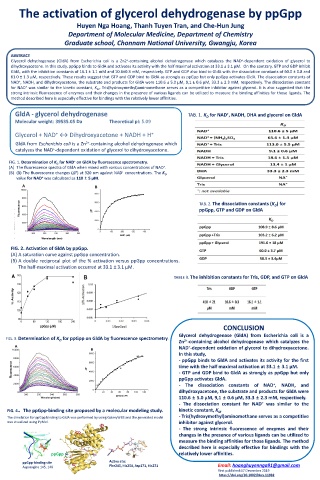
Glycerol dehydrogenase (GldA) from Escherichia coli is a Zn2 -containing alcohol dehydrogenase which catalyzes the NAD -dependent oxidation of glycerol to
+
+
dihydroxyacetone. In this study, ppGpp binds to GldA and activates its activity with the half maximal activation at 33.1 ± 3.1 µM. On the contrary, GTP and GDP inhibit
GldA, with the inhibition constants of 16.1 ± 1.1 mM and 10.6±0.3 mM, respectively. GTP and GDP also bind to GldA with the dissociation constants of 60.0 ± 0.8 and
61.0 ± 1.3 µM, respectively. These results suggest that GTP and GDP bind to GldA as strongly as ppGpp but only ppGpp activates GldA. The dissociation constants of
NAD , NADH, and dihydroxyacetone, the substrate and products for GldA were 110.6 ± 5.0 µM, 9,1 ± 0.6 µM, 33.3 ± 2.3 mM, respectively. The dissociation constant
+
for NAD was similar to the kinetic constant, K . Tris(hydroxymethyl)aminomethane serves as a competitive inhibitor against glycerol. It is also suggested that the
+
M
strong intrinsic fluorescence of enzymes and their changes in the presence of various ligands can be utilized to measure the binding affinities for those ligands. The
method described here is especially effective for bindings with the relatively lower affinities.
GldA - glycerol dehydrogenase TAB. 1. K for NAD , NADH, DHA and glycerol on GldA
+
D
Molecular weight: 39535.05 Da Theoretical pI: 5.09
Glycerol + NAD ↔ Dihydroxyacetone + NADH + H +
+
GldA from Escherichia coli is a Zn -containing alcohol dehydrogenase which
2+
catalyzes the NAD -dependent oxidation of glycerol to dihydroxyacetone.
+
FIG. 1. Determination of K for NAD on GldA by fluorescence spectrometry.
+
D
(A) The fluorescence spectra of GldA when mixed with various concentrations of NAD .
+
(B) (B) The fluorescence changes (ΔF) at 320 nm against NAD concentrations. The K D
+
value for NAD was calculated as 110 ± 5 μM.
+
TAB. 2. The dissociation constants (K ) for
D
ppGpp, GTP and GDP on GldA
FIG. 2. Activation of GldA by ppGpp.
(A) A saturation curve against ppGpp concentration.
(B) A double reciprocal plot of the % activation versus ppGpp concentrations.
The half-maximal activation occurred at 33.1 ± 3.1 µM.
TABLE 3. The inhibition constants for Tris, GDP, and GTP on GldA
CONCLUSION
Glycerol dehydrogenase (GldA) from Escherichia coli is a
FIG. 3. Determination of K for ppGpp on GldA by fluorescence spectrometry. Zn -containing alcohol dehydrogenase which catalyzes the
D
2+
NAD -dependent oxidation of glycerol to dihydroxyacetone.
+
In this study,
- ppGpp binds to GldA and activates its activity for the first
time with the half maximal activation at 33.1 ± 3.1 µM.
- GTP and GDP bind to GldA as strongly as ppGpp but only
ppGpp activates GldA.
- The dissociation constants of NAD , NADH, and
+
dihydroxyacetone, the substrate and products for GldA were
110.6 ± 5.0 µM, 9,1 ± 0.6 µM, 33.3 ± 2.3 mM, respectively.
- The dissociation constant for NAD was similar to the
+
FIG. 4. The ppGpp-binding site proposed by a molecular modeling study. kinetic constant, K M
The simulation for ppGpp binding to GldA was performed by using GalaxyWEB and the generated model - Tris(hydroxymethyl)aminomethane serves as a competitive
was visualized using PyMol. inhibitor against glycerol.
- The strong intrinsic fluorescence of enzymes and their
changes in the presence of various ligands can be utilized to
measure the binding affinities for those ligands. The method
described here is especially effective for bindings with the
ppGpp relatively lower affinities.
ppGpp-binding site Active site:
Asparagine 145, 148 Phe245, His254, Asp171, His271 Email: hoanghuyennga91@gmail.com
First published:17 December 2019
https://doi.org/10.1002/bkcs.11932

