


Page 9 - U. Protein structure and function
P. 9
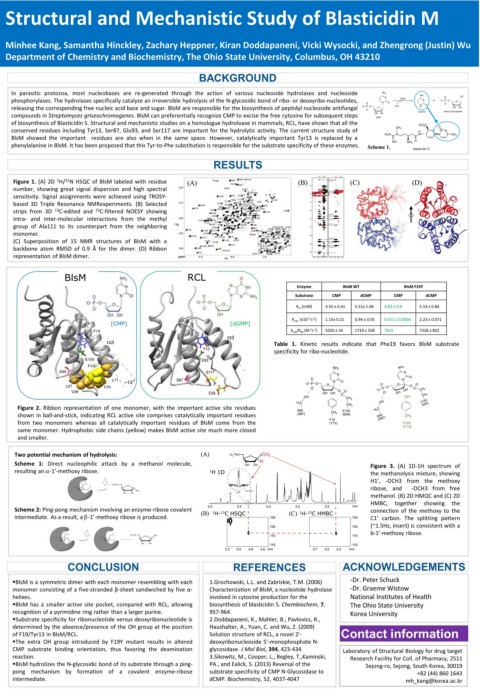
Structural and Mechanistic Study of Blasticidin M
Minhee Kang, Samantha Hinckley, Zachary Heppner, Kiran Doddapaneni, Vicki Wysocki, and Zhengrong (Justin) Wu
Department of Chemistry and Biochemistry, The Ohio State University, Columbus, OH 43210
BACKGROUND
In parasitic protozoa, most nucleobases are re-generated through the action of various nucleoside hydrolases and nucleoside
phosphorylases. The hydrolases specifically catalyze an irreversible hydrolysis of the N-glycosidic bond of ribo- or deoxyribo-nucleotides,
releasing the corresponding free nucleic acid base and sugar. BlsM are responsible for the biosynthesis of peptidyl nucleoside antifungal
compounds in Streptomyces griseochromogenes. BlsM can preferentially recognize CMP to excise the free cytosine for subsequent steps
of biosynthesis of Blasticidin S. Structural and mechanistic studies on a homologue hydroloase in mammals, RCL, have shown that all the
conserved residues including Tyr13, Ser87, Glu93, and Ser117 are important for the hydrolytic activity. The current structure study of
BlsM showed the important residues are also when in the same space. However, catalytically important Tyr13 is replaced by a
phenylalanine in BlsM. It has been proposed that this Tyr-to-Phe substitution is responsible for the substrate specificity of these enzymes. Scheme 1.
RESULTS
Figure 1. (A) 2D H/ N HSQC of BlsM labeled with residue (A) (B) (C) (D)
15
1
number, showing great signal dispersion and high spectral
sensitivity. Signal assignments were achieved using TROSY-
based 3D Triple Resonance NMRexperiments. (B) Selected
strips from 3D 13 C-edited and 13 C-filtered NOESY showing
intra- and inter-molecular interactions from the methyl
group of Ala111 to its counterpart from the neighboring
monomer.
(C) Superposition of 15 NMR structures of BlsM with a
backbone atom RMSD of 0.9 Å for the dimer. (D) Ribbon
representation of BlsM dimer.
BlsM RCL
Enzyme BlsM WT BlsM F19Y
Substrate CMP dCMP CMP dCMP
K m (mM) 3.55 ± 0.41 5.51± 1.96 4.83 ± 0.9 5.14 ± 0.84
K cat (x10 -2 s -1 ) 1.15± 0.21 0.94 ± 0.05 0.011 ± 0.0004 2.23 ± 0.071
[CMP] [dGMP]
k cat /K M (M -1 s -1 ) 3250 ± 34 1719 ± 558 70±5 7318 ± 832
Table 1. Kinetic results indicate that Phe19 favors BlsM substrate
specificity for ribo-nucleotide.
Figure 2. Ribbon representation of one monomer, with the important active site residues
shown in ball-and-stick, indicating RCL active site comprises catalytically important residues
from two monomers whereas all catalytically important residues of BlsM come from the
same monomer. Hydrophobic side chains (yellow) makes BlsM active site much more closed
and smaller.
Two potential mechanism of hydrolysis: (A)
Scheme 1: Direct nucleophilic attack by a methanol molecule, Figure 3. (A) 1D-1H spectrum of
resulting an α-1’-methoxy ribose. the methanolysis mixture, showing
H1’, -OCH3 from the methoxy
ribose, and -OCH3 from free
methanol. (B) 2D HMQC and (C) 2D
HMBC, together showing the
Scheme 2: Ping-pong mechanism involving an enzyme-ribose covalent (B) (C) connection of the methoxy to the
intermediate. As a result, a β-1’-methoxy ribose is produced. C1’ carbon. The splitting pattern
(~1.5Hz, insert) is consistent with a
b-1’-methoxy ribose.
CONCLUSION REFERENCES ACKNOWLEDGEMENTS
BlsM is a symmetric dimer with each monomer resembling with each 1.Grochowski, L.L. and Zabriskie, T.M. (2006) -Dr. Peter Schuck
monomer consisting of a five-stranded β-sheet sandwiched by five α- Characterization of BlsM, a nucleotide hydrolase -Dr. Graeme Wistow
helixes. involved in cytosine production for the National Institutes of Health
BlsM has a smaller active site pocket, compared with RCL, allowing biosynthesis of blasticidin S. Chembiochem, 7, The Ohio State University
recognition of a pyrimidine ring rather than a larger purine. 957-964. Korea University
Substrate specificity for ribonucleotide versus deoxyribonucleotide is 2.Doddapaneni, K., Mahler, B., Pavlovicz, R.,
determined by the absence/presence of the OH group at the position Haushalter, A., Yuan, C. and Wu, Z. (2009)
of F19/Tyr13 in BlsM/RCL. Solution structure of RCL, a novel 2'- Contact information
The extra OH group introduced by F19Y mutant results in altered deoxyribonucleoside 5'-monophosphate N-
CMP substrate binding orientation, thus favoring the deamination glycosidase. J Mol Biol, 394, 423-434 Laboratory of Structural Biology for drug target
reaction. 3.Sikowitz, M., Cooper, L., Begley, T.,Kaminski, Research Facility for Coll. of Pharmacy, 2511
BlsM hydrolizes the N-glycosidic bond of its substrate through a ping- PA., and Ealick, S. (2013) Reversal of the Sejong-ro, Sejong, South Korea, 30019
pong mechanism by formation of a covalent enzyme-ribose substrate specificity of CMP N-Glycosidase to +82 (44) 860 1643
intermediate. dCMP. Biochemistry, 52, 4037-4047 mh_kang@korea.ac.kr

