


Page 11 - U. Protein structure and function
P. 11
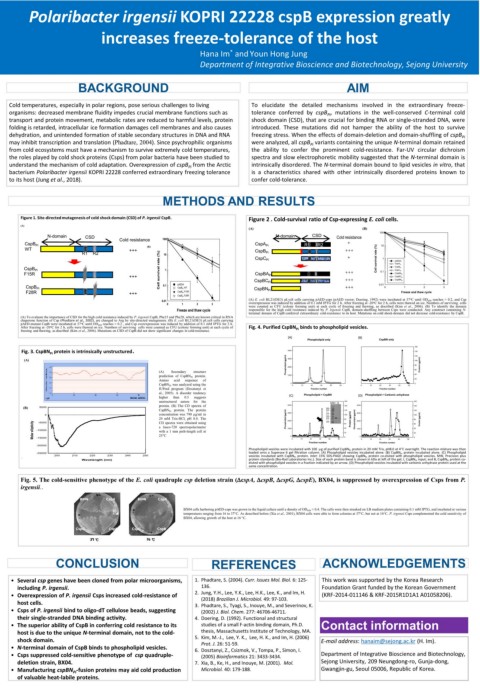
Polaribacter irgensii KOPRI 22228 cspB expression greatly

                        increases freeze-tolerance of the host

                                                     *
                                              Hana Im andYoun Hong Jung
                                              Department of Integrative Bioscience and Biotechnology, Sejong University
                   BACKGROUND                                                  AIM

   Cold temperatures, especially in polar regions, pose serious challenges to living   To elucidate the detailed mechanisms involved in the extraordinary freeze-
   organisms: decreased membrane fluidity impedes crucial membrane functions such as   tolerance conferred by cspB Pi , mutations in the well-conserved C-terminal cold
   transport and protein movement, metabolic rates are reduced to harmful levels, protein   shock domain (CSD), that are crucial for binding RNA or single-stranded DNA, were
   folding is retarded, intracellular ice formation damages cell membranes and also causes   introduced. These mutations did not hamper the ability of the host to survive
   dehydration, and unintended formation of stable secondary structures in DNA and RNA   freezing stress. When the effects of domain-deletion and domain-shuffling of cspB Pi
   may inhibit transcription and translation (Phadtare, 2004). Since psychrophilic organisms   were analyzed, all cspB Pi variants containing the unique N-terminal domain retained
   from cold ecosystems must have a mechanism to survive extremely cold temperatures,   the ability to confer the prominent cold-resistance. Far-UV circular dichroism
   the roles played by cold shock proteins (Csps) from polar bacteria have been studied to   spectra and slow electrophoretic mobility suggested that the N-terminal domain is
   understand the mechanism of cold adaptation. Overexpression of cspB Pi from the Arctic   intrinsically disordered. The N-terminal domain bound to lipid vesicles in vitro, that
   bacterium Polaribacter irgensii KOPRI 22228 conferred extraordinary freezing tolerance   is a characteristics shared with other intrinsically disordered proteins known to
   to its host (Jung et al., 2018).                       confer cold-tolerance.
                                      METHODS AND RESULTS

      Figure 1. Site-directedmutagenesis of cold shock domain (CSD) of P. irgensii CspB.  Figure 2 . Cold-survival ratio of Csp-expressing E. coli cells.
      (A)
                                                         (A)                       (B)
            N-domain  CSD                                      N-domain  CSD  Cold resistance  100
                            Cold resistance  100
      CspB Pi                     (B)                     CspA Pi    R1  R2    +       10
      WT                      +++                                              +++
                   R1  R2             10                  CspB Pi              +      Cell survival rate (%)  1  pAED4
                                                          CspC Pi
                                                                                          CspB Pi
      CspB Pi                        Cell survival rate (%)  1                            CspA Pi
                                                                                          CspC Pi
      F15R                    +++                         CspBA Pi             +++     0.1  CspBA Pi
                                                                                          CspBC Pi
                                                                               +++
                                                                                          CspBN Pi
       CspB Pi                        0.1  pAED4          CspBC Pi             +++    0.01  0  1  2  3
                                         CspB Pi  WT
                                                          CspBN Pi
       F28R                   +++        CspB Pi  F15R                                     Freeze and thaw cycle
                                         CspB Pi  F28R
                                     0.01                (A) E. coli BL21(DE3) pLysS cells carrying pAED-csps (pAED vector; Doering, 1992) were incubated at 37 o C until OD 600 reaches ≈ 0.2, and Csp
                                                         overexpression was induced by addition of 0.1 mM IPTG for 2 h. After freezing at -20 o C for 2 h, cells were thawed on ice. Numbers of surviving cells
                                       0  1  2   3       were counted as CFU (colony forming unit) at each cycle of freezing and thawing, as discribed (Kim et al., 2006). (B) To identify the domain
                                         Freeze and thaw cycle  responsible for the high cold resistance induced by P. irgensii CspB, domain-shuffling between Csps were conducted. Any construct containing N-
      (A) To evaluate the importance of CSD for the high cold resistance induced by P. irgensii CspB, Phe15 and Phe28, which are known critical in RNA  terminal domain of CspB conferred extraordinary cold-resistance to its host. Mutations on cold shock-domain did not decrease cold-resistance by CspB.
      chaperone function of Csp (Phadtare et al., 2002), are changed to Arg by site-directed mutagenesis. (B) E. coli BL21(DE3) pLysS cells carrying
      pAED-mutant CspB were incubated at 37 o C until OD 600 reaches ≈ 0.2 , and Csp overexpression was induced by addition of 0.1 mM IPTG for 2 h.
      After freezing at -20 o C for 2 h, cells were thawed on ice. Numbers of surviving cells were counted as CFU (colony forming unit) at each cycle of  Fig. 4. Purified CspBN Pi binds to phospholipid vesicles.
      freezing and thawing, as discribed (Kim et al., 2006). Mutations on CSD of CspB did not show significant changes in cold-resistance.
                                                                  (A)             (B)
                                                                      Phospholipid only  CspBN only
      Fig. 3. CspBN Pi protein is intrinsically unstructured.     4000                        160 140
      (A)                                                        Phospholipid (µg/ml)  3000   120 100 80  Proteins (µg/ml)
                                     (A)  Secondary  structure    2000                        60
                                     prediction of CspBN Pi protein.  1000                    40
                                     Amino  acid  sequence  of                                20
                                     CspBN Pi was analyzed using the  0  0  10  20  30  40  50  0  10  20  30  40  50  0
                                     IUPred program (Dosztanyi et      Fraction number  Fraction number
                                     al., 2005). A disorder tendency  (C)  Phospholipid + CspBN  (D)  Phospholipid + Carbonic anhydrase
                                     higher  than  0.5  suggests
                                     unstructured  nature  for  the        MW I  B  160       160
      (B)  5000                      protein. (B) The CD spectra of  4000     140  4000       140
                                     CspBN Pi protein. The protein        50 -  120           120
                                                                          37 -
           0                         concentration was 790 µg/ml in  3000  25 -  100  3000    100
                                     20 mM Tris-HCl, pH 8.0. The  Phospholipid (µg/ml)  2000  20 -  80  Protein (µg/ml)  Phospholipid (µg/ml)  2000  80  Protein (µg/ml)
                                                                          15 -
                                     CD spectra were obtained using
                                                                          10 -
          -5000
        Molar ellipticity  -10000    a Jasco-720 spectropolarimeter  1000     60 40  1000     60 40
                                     with a 1 mm path-length cell at  0       20 0  0         20 0
                                     25°C
         -15000
                                                                         30
                                                                       20
                                                                                        30
                                                                     10
                                                                   0
                                                                       Fraction number  40  50  0  10  20 Fraction number  40  50
         -20000
                                                         Phospholipid vesicles were incubated with 100  µg of purified CspBN Pi protein in 20 mM Tris, pH8.0 at 4°C overnight. The reaction mixture was then

         -25000                                          loaded onto a Superose 6 gel filtration column. (A) Phospholipid vesicles incubated alone. (B) CspBN Pi protein incubated alone. (C) Phospholipid
      .      200  210  220  230  240  250                vesicles incubated with CspBN Pi protein. Inlet: 15% SDS-PAGE showing CspBN Pi protein co-eluted with phospholipid vesicles. MW, Precision plus
                                                         protein standards (Bio-Rad Laboratories Inc.). Size of each protein band is shown in kDa at left of the gel; I, CspBN Pi input; and B, CspBN Pi protein co-
                   Wavelength (nm)
                                                         eluted with phospholipid vesicles in a fraction indicated by an arrow. (D) Phospholipid vesicles incubated with carbonic anhydrase protein used at the
                                                         same concentration.
      Fig. 5. The cold-sensitive phenotype of the E. coli quadruple csp deletion strain (∆cspA, ∆cspB, ∆cspG, ∆cspE), BX04, is suppressed by overexpression of Csps from P.
      irgensii..
                   BX04  CspA   BX04  CspA
                                          BX04 cells harboring pAED-csps was grown in the liquid culture until a density of OD 600 ≈ 0.4. The cells were then streaked on LB medium plates containing 0.1 mM IPTG, and incubated at various
                                          temperatures ranging from 16 to 37°C. As described before (Xia et al., 2001), BX04 cells were able to form colonies at 37°C, but not at 16°C. P. irgensii Csps complemented the cold sensitivity of
                                          BX04, allowing growth of the host at 16 °C.
                  CspC   CspB  CspC  CspB
                     37 ℃         16 ℃
             CONCLUSION                          REFERENCES               ACKNOWLEDGEMENTS
   • Several csp genes have been cloned from polar microorganisms,   1. Phadtare, S. (2004). Curr. Issues Mol. Biol. 6: 125-  This work was supported by the Korea Research
     including P. irgensii.                   136.                       Foundation Grant funded by the Korean Government
   • Overexpression of P. irgensii Csps increased cold-resistance of   2. Jung, Y.H., Lee, Y.K., Lee, H.K., Lee, K., and Im, H.   (KRF-2014-011146 & KRF-2015R1D1A1 A01058206).
                                              (2018) Brazilian J. Microbiol. 49: 97-103.
     host cells.                             3. Phadtare, S., Tyagi, S., Inouye, M., and Severinov, K.
   • Csps of P. irgensii bind to oligo-dT cellulose beads, suggesting   (2002) J. Biol. Chem. 277: 46706-46711.
     their single-stranded DNA binding activity.  4. Doering, D. (1992). Functional and structural
   • The superior ability of CspB in conferring cold resistance to its   studies of a small F-actin binding domain, Ph.D.   Contact information
     host is due to the unique N-terminal domain, not to the cold-  thesis, Massachusetts Institute of Technology, MA.
     shock domain.                           5. Kim, M.-J.,  Lee, Y. K.,  Lee, H. K., and Im, H. (2006)   E-mail address: hanaim@sejong.ac.kr (H. Im).
                                              Prot. J. 26: 51-59.
   • N-terminal domain of CspB binds to phospholipid vesicles.  6. Dosztanyi, Z., Csizmok, V., Tompa, P., Simon, I.
   • Csps suppressed cold-sensitive phenotype of  csp quadruple-  (2005) Bioinformatics 21: 3433-3434.  Department of Integrative Bioscience and Biotechnology,
     deletion strain, BX04.                  7. Xia, B., Ke, H., and Inouye, M. (2001).  Mol.   Sejong University, 209 Neungdong-ro, Gunja-dong,
   • Manufacturing cspBN Pi -fusion proteins may aid cold production   Microbiol. 40: 179-188.  Gwangjin-gu, Seoul 05006, Republic of Korea.
     of valuable heat-labile proteins.

