


Page 15 - U. Protein structure and function
P. 15
Purification and protein interaction of weak binding human
                       chromatin remodeling component by crosslinking experiments
                                       Gye-young Park, Jeongmin Han, Jae-Hyun Park, Ji-Hye Yun, Weontae Lee *
                    Structural Biochemistry & Molecular Biophysics Laboratory, Department of Biochemistry, College of life Science & Biotechnology,
                                                   Yonsei University, Seoul, 120-749, Korea.


            ABSTRACT

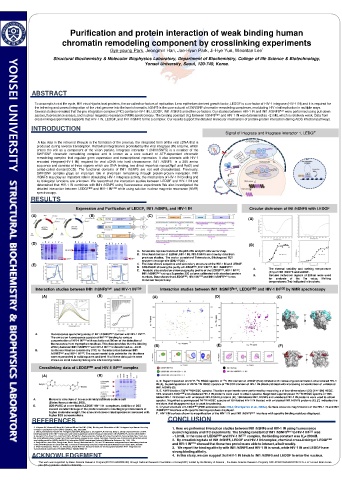
             To accomplish viral life cycle, HIV virus hijacks host proteins, the so-called co-factors of replication. Lens epithelium derived growth factor, LEDGF is a co-factor of HIV-1 integrase (HIV-1 IN) and it is required for
             the tethering and correct integration of the viral genome into the host chromatin. hSNF5 is the core subunit of SWI/SNF chromatin-remodeling complexes, modulating HIV viral replication in multiple ways.
             Several studies revealed that the pre integration complex (PIC) contains HIV-1 IN, LEDGF, INI1 /hSNF5 and other co-factors. Our studies between HIV-1 IN and INI1 /hSNF5 Rpt1 were performed using pull down
             assays, fluorescence assays, and nuclear magnetic resonance (NMR) spectroscopy. The binding constant (K d ) between hSNF5 Rpt1 and HIV-1 IN was determined as ~2 mM, which is relatively weak. Data from
             cross-linking experiments supports that HIV-1 IN, LEDGF, and INI1 /hSNF5 forms a complex. Our results support the detailed molecular mechanism of protein-protein interaction during AIDS infection pathways.
            INTRODUCTION
                                                                                Signal of Integrase and Integrase interactor 1, LEDGF
              A key step in the retroviral lifecycle is the formation of the provirus, the integrated form of the viral cDNA that is
              produced during reverse transcription. Retroviral integration is promoted by the viral integrase (IN) enzyme, which
              enters the cell as a component of the virion particle. Integrase interactor 1 (INI1/hSNF5) is a member of the
              SWF/SNF chromatin remodeling complex and is known as a core subunit of ATP-dependent chromatin
              remodeling complex that regulate gene expression and transcriptional repression. It also interacts with HIV-1
              encoded integrase(HIV-1 IN) required for viral cDNA into host chromosome. INI1 /hSNF5  is a 385 amino
              sequence and consists of three regions which are DNA binding, two direct imperfect repeat(Rpt1 and Rpt2) and
              coiled-coiled domain(CCD). The functional domains of INI1 /hSNF5 are not well characterized. Previously,
              SWF/SNF complex plays an important role in chromatin remodeling through protein-protein interaction. INI1
              /hSNF5 may play an important role in stimulating HIV-1 integrase activity, the mechanism of HIV-1 IN binding and
              its biological functions are unknown. We researched the interaction studies between LEDGF and HIV-1 IN and
              determined that HIV-1 IN combines with INI1 /hSNF5 using fluorescence experiments We also investigated the
              detailed interaction between LEDGF IBD and HIV-1 IN CCD while using solution nuclear magnetic resonance (NMR)
              spectroscopy.
            RESULTS
                            Expression and Purification of LEDGF, INI1 /hSNF5, and HIV-1 IN  Circular dichroism of INI /hSNF5 with LEDGF
            (A)                 (B)                 (C)
                                                                                       (A)


                                                                                                                    2
                                                                                                                    5 0
            (D)  kDa  M  sup  ppt  F/t  w1  w2  E  sup  ppt  F/t  w1  w2  E  M
               70                  kDa 70  100 70                                       (B)
               50
                                   50  50
               35
                        HIV-1 IN  CCD  35  35    A. Schematic representation of the pET-21b and pET-32a vector map.
               26                  26  26
               20                                B. Structural domain of LEDGF, HIV-1 IN, INI1 /hSNF5 are draw by data from
                                   20
                                      20
               15                  15  15         previous studies.  The vector consists of Thioredoxin, (His)tag and TEV
                        LEDGF  BD              INI1 Rpt1
                                                  enzyme cleavage site (ENLYFQG)  .
            (E)                                  C. The data shows sequence and secondary structure of the HIV-1 IN and LEDGF.
                                                 D. SDS-PAGE showing the purity of LEDGF IBD , HIV-1 IN CCD , INI1 /hSNF5 Rpt1 .  A.  The thermal stability and melting temperature
                                                 E.  Analytic size exclusion chromatography profile of the LEDGF IBD , HIV-1 IN CCD ,   (Tm) of INI1 /hSNF5 and LEDGF.
                                                  INI1 /hSNF5 Rpt1 using a Superdex 200 column calibrated with standard protein   B.  Circular dichroism signals at 220nm were used
                                                  markers. Data shows that LEDGF IBD , HIV-1 IN CCD  and INI1 /hSNF5 Rpt1 forms   for  analysis  of  the  Tm  value.  Melting
        a                                         monomer respectively.
                                                                                               temperatures (Tm) indicated in brackets.
             Interaction studies between INI1 /hSNF5 Rpt1 and HIV-1 IN CCD  Interaction studies between INI1 /hSNF5 Rpt1 , LEDGF IBD and HIV-1 IN CCD  by NMR spectroscopy
                (A)                (B)                (A)                   (D)                  (C)
             A.    Fluorescence quenching assay of INI1 /hSNF5 Rpt1 domain with HIV-1 IN CCD .
                   The emission fluorescence spectra of INI1 Rpt1  binding to various
                   concentration of HIV-1 IN CCD  with excitation at 280nm of the detection of
                   fluorescence from tryptophan residues. This data provides that the binding   (E)
                   affinity between INI1 /hSNF5 Rpt1 and HIV-1 IN CCD is determined as ~2mM.  (B)  (F)
             B.    Isothermal titration calorimetry (ITC) for the interaction between INI1
                   /hSNF5 Rpt1 and HIV-1 IN CCD . The experimental data points for the titrations
                   were represented in solid squares and best fit of these data points were
                   shown as solid curve by taking one site binding model.
               Crosslinking data of LEDGF IBD and HIV-1 IN CCD complex
                (A)                (B)
                                                       A, D. Superimposition of 2D 1 H- 15 N HSQC spectra of 15 N IBD domain of LEDGF (Red) titrated with increasing concentration of unlabeled HIV-1
                                                       IN (A), Superimposition of 2D 1 H- 15 N HSQC spectra of 15 N CCD domain of HIV-1 IN (Black) titrated with increasing concentration of unlabeled
                                                       INI1 /hSNF5 (D).
                                                       B, E. NMR titration 2D[ 1 H- 15 N]HSQC spectra. Titration experiments were performed by recording a of two-dimensional (2D) [1H-15N] HSQC.
                                                       15N-labeled LEDGF IBD  and unlabeled HIV-1 IN proteins were used to obtain spectra. Magnified superimposed  1 H- 15 N HSQC spectra of 15N-
                                                       labled HIV-1 IN titrated with unlabeled INI1 /hSNF5 proteins (B) ,15N-labeled INI1 /hSNF5 and unlabeled HIV-1 IN proteins were used to obtain
             A.   Molecular structure of bis-succinimidylsuberate sodium salt   spectra. Magnified superimposed  1 H- 15 N HSQC spectra of 15N-labled HIV-1 IN titrated with unlabeled INI1 /hSNF5 proteins (E). [*] indicates the
                  (Bis(sulfosuccinimidyl, BS3).        residues that disappeared due to peak broadening.
             B.   SDS-PAGE of cross-linked LEDGF/ HIV-1 IN  complexes. Addition of BS3   C. Crystal structure of LEDGF IBD (PDB accession code 2B4J; Cherepanov et al., 2005a). Surface shown is magnification of the HIV-1 IN and INI1
                  caused covalent linkage of the protein subunits resulting in protein bands at   /hSNF5 Rpt1 interface with specific binding residues displayed.
                  higher molecular weight. The amount of cross-linked species is increased with   F.  HIV-1 IN surface shown is magnification of the HIV-1 IN and INI1 /hSNF5 Rpt1 interface with specific binding residues displayed.
                  higher BS3 concentrations.
            REFERENCES                                      CONCLUSION
             1.  Kalpana GV, MarmonS, Wang W, Crabtree GR and Goff SP. (1994)  Binding and Stimulation of HIV-1 Integrase by a Human Homolog   1. Here we performed Interaction studies between INI1 /hSNF5 and HIV-1 IN using fluorescence
             of Yeast Transcription Factor SNF5. SCIENCE, 266, 2002-2006.
             2.  Das S, Banerjee B, Hossain M, Thangamuniyandi M, Dasgupta S, Chongdar N, Kumar GS, Basu G. (2013) Characterization of DNA   quenching assay and ITC experiments. The binding constant of INI1 /hSNF5 Rpt1 to HIV-1 IN CCD was
             binding properity of the HIV-1 host factor and tumor suppressor protein Integrase interactor 1 (INI1/hSNF5). PLoS One 4;8(7) e66581
             3. Jeongmin Han, Iktae Kim, Jae-Hyun Park, Ji-Hye Yun, Keehyoung Joo, Taehee Kim, Gye-Young Park, Kyoung-Seok Ryu, Yoon-Joo  ~1.3mM, In the case of LEDGF IBD and HIV-1 IN CCD complex, the binding constant was K d = 200nM.
             Ko, Kenji Mizutani, Sam-Young Park, Rho Hyun Seong, Jooyoung Lee, Jeong-Yong Suh, Weontae Lee A coil-to-helix transition serves
             as a binding motif for hSNF5 and BAF155 interaction (2020) International Journal of Molecular Sciences. 95, 1120- 1125.   2. By crosslinking data of INI1 /hSNF5, LEDGF and HIV-1 IN complex, chemical cross-linking of LEDGF IBD
             4. Sunjin Moon, Joon Shin, Dongju Lee, Rho H. Seong, Weontae Lee  1 H, 15 N, and 13 C resonance assignments and secondary structure   and HIV-1 IN CCD showed that these two proteins are able to interact, albeit weakly.
    YONSEI UNIVERSITY  STRUCTURAL BIOCHEMISTRY & BIOPHYSICS LABORATORY
             of the SWIRM domain of human BAF155, a chromatin remodeling complex component (2013) Molecules and Cells 36(4), 333-339.
             5.  Peter Cherepanov, Andre L. B. Ambrosio, Shaila Rahman. Structural basis for the recognition between HIV-1 integrase and   3. We report the binding affinity with INI1 /hSNF5 and HIV-1 IN is weak, while HIV-1 IN and LEDGF have
             transcriptional coactivator p75 (2005). PNAS, 102(48):19903-14  strong binding affinity.
            ACKNOWLEDGEMENT                                  4. In this study, we can suggest that HIV-1 IN binds to INI1 /hSNF5 and LEDGF to enter the nucleus.
              This work was supported by Basic Science Research Program(2017R1A2B2008483) through National  Research Foundation  of Korea(NRF) funded by the Ministry of Science ,  the Baisic Science Research  Program( NRF-2016R1A6A3A04010213 to J.H.Yun and Brain Korea
              plus (BK+) graduate  student scholarship.

