


Page 21 - U. Protein structure and function
P. 21
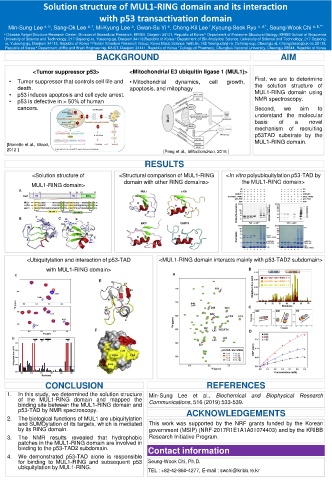
Solution structure of MUL1-RING domain and its interaction
                                 with p53 transactivation domain

                                            a
                                                                     f
                              a, f
    Min-Sung Lee  a, b , Sang-Ok Lee  , Mi-Kyung Lee  , Gwan-Su Yi  , Chong-Kil Lee  ,Kyoung-Seok Ryu  c, d,* , Seung-Wook Chi  a, b,**
                                                        e
  a Disease Target Structure Research Center, Division of Biomedical Research, KRIBB, Daejeon 34141, Republic of Korea  b Department of Proteome Structural Biology, KRIBB School of Bioscience,
  University of Science and Technology, 217 Gajeong-ro, Yuseong-gu, Daejeon 34113,Republic of Korea  c Department of Bio-Analytical Science, University of Science and Technology, 217 Gajeong-
   ro, Yuseong-gu, Daejeon 34113, Republic of Korea  d Protein Structure Research Group, Korea Basic Science Institute, 162 Yeongudanji-ro, Ochang-eup, Cheongju-si, Chungcheongbuk-do 28119,
   Republic of Korea  e Department of Bio and Brain Engineering, KAIST, Daejeon 34141, Republic of Korea  f College of Pharmacy, Chungbuk National University, Cheongju 28644, Republic of Korea
                                BACKGROUND                                                  AIM
            <Tumor suppressor p53>         <Mitochondrial E3 ubiquitin ligase 1 (MUL1)>
    •  Tumor suppressor that controls cell life and   • Mitochondrial  dynamics,  cell  growth,  First, we are to deterimine
       death.                              apoptosis, and mitophagy                 the solution structure of
    •  p53 induces apoptosis and cell cycle arrest.                                 MUL1-RING domain using
    •  p53 is defective in > 50% of human                                           NMR spectroscopy.
       cancers.                                                                     Second,  we    aim  to
                                                                                    understand the molecular
                                                                                    basis   of   a    novel
                                                                                    mechanism  of  recruiting
                                                                                    p53TAD substrate by the
                                                                                    MUL1-RING domain.
   [Monette et al., Blood,
   2012 ]                                             [Peng et al., Mitochondrion, 2016 ]
                                                RESULTS

           <Solution structure of       <Structural comparison of MUL1-RING   <In vitro polyubiquitylation p53-TAD by
           MUL1-RING domain>             domain with other RING domains>        the MUL1-RING domain>


          <Ubiquitylation and interaction of p53-TAD   <MUL1-RING domain interacts mainly with p53-TAD2 subdomain>
                with MUL1-RING domain>


                CONCLUSION                                          REFERENCES
   1.  In this study, we determined the solution structure  Min-Sung  Lee  et  al.,  Biochemical and  Biophysical Research
       of the MUL1-RING domain and mapped the
       binding site between the MUL1-RING domain and  Communications, 516 (2019) 533-539.
       p53-TAD by NMR spectroscopy.                           ACKNOWLEDGEMENTS
   2.  The biological functions of MUL1 are ubiquitylation
       and SUMOylation of its targets, which is mediated  This work was supported by the NRF grants funded by the Korean
       by its RING domain.                       government (MSIP) (NRF-2017R1E1A1A01074403) and by the KRIBB
   3.  The NMR results revealed that hydrophobic  Research Initiative Program.
       patches in the MUL1-RING domain are involved in
       binding to the p53-TAD2 subdomain.        Contact information
   4.  We demonstrated p53-TAD alone is responsible
       for binding to MUL1-RING and subsequent p53  Seung-Wook Chi, Ph.D.
       ubiquitylation by MUL1-RING.
                                                 TEL : +82-42-860-4277, E-mail : swchi@kribb.re.kr

