


Page 47 - Q. Neuroscience
P. 47
Small RNAs regulate pheromone-mediated avoidance in C. elegans
Hyeonjeong Hwang and Kyuhyung Kim
Department of Brain and Cognitive Sciences, DGIST, Daegu, 42988, Republic of Korea
Abstract
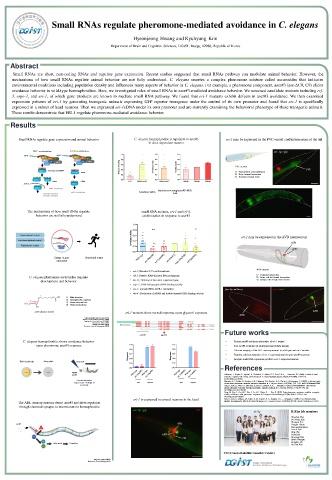
Small RNAs are short, non-coding RNAs and regulate gene expression. Recent studies suggested that small RNAs pathway can modulate animal behavior. However, the
mechanisms of how small RNAs regulate animal behavior are not fully understood. C. elegans secretes a complex pheromone mixture called ascarosides that indicates
environmental conditions including population density and influences many aspects of behavior in C. elegans. For example, a pheromone component, ascr#3 (asc-ΔC9, C9) elicits
avoidance behavior in wild-type hermaphrodites. Here, we investigated roles of small RNAs in ascr#3-mediated avoidance behavior. We screened candidate mutants including rrf-
3, ergo-1, and eri-1, of which gene products are known to mediate small RNA pathway. We found that eri-1 mutants exhibit defects in ascr#3 avoidance. We then examined
expression patterns of eri-1 by generating transgenic animals expressing GFP reporter transgenes under the control of its own promoter and found that eri-1 is specifically
expressed in a subset of head neurons. Then we expressed eri-1cDNA under its own promoter and are currently examining the behavioral phenotype of these transgenic animals.
These results demonstrate that ERI-1 regulate pheromone-mediated avoidance behavior.
Results
Small RNAs regulate gene expression and animal behavior C. elegans hermaphrodite is repulsive to ascr#3 eri-1 may be expressed in the PVC ventral cord interneurons of the tail
in dose dependent manner
ERGO-1 associated pathway ALG-3/4 associated pathway eri-1p::gfp
mRNA mRNA 1.0 1.0 1.0
RRF-3 RRF-3 DCR-1 ERI-1
DCR-1 ERI-1 0.8 0.8 0.8
DRH-3 DRH-3 RDE-4 ERI-3
RDE-4 ERI-3
ERI-5 ERI-5 0.6 Avoidance index 0.6 0.6 PVC neuron
ERGO-1 Passenger strand siRNA Fraction reversing 0.4 0.4 Avoidance index 0.4 1) Ventral nerve cord interneuron PVC
ALG-3/4 siRNA
0.2 0.2 0.2 2) Drive forward locomotion
3) Response to harsh touch
NRDE-3 WAGO 0.0 0.0 0.0
siRNA siRNA M13 100nM ascr#3 100nM ascr#3 100nM 300nM 500nM
nucleus WAGO
NRDE-3 mRNA destabilization
mRNA destabilization Avoidance index = fraction reversing(ascr#3−M13)
total
Transcription inhibition
Chromatin modification
The mechanisms of how small RNAs regulate small RNA mutants, eri-1 and rrf-3,
behavior are not fully understood exhibit defect in response to ascr#3
1.0
0.8 ** *
Avoidance index
Transcriptional control 0.6 eri-1 may be expressed in the AVB interneurons
Post-transcriptional control 0.4 AVB
Translational control 0.2
AVD
0.0
Change in gene Behavioral output Wild-type eri-1(mg366) eri-1(ok2386) lin-35(n745) rrf-3(pk1426)
expression ergo-1(tm1860)
AVB neuron
• eri-1 ; Encodes 3'-5'-exoribonuclease
C. elegans pheromone ascarosides regulate • rrf-3 ; Putative RNA-directed RNA polymerase 1) Command interneuron
2) Driver cell for forward locomotion
development and behavior • lin-35 ; Ortholog of the tumor suppressor gene 3) Synapse onto B-type motor neuron
• ergo-1 ; RNA helicase and siRNA binding activity
• eri-3 ; promote ERI-1-DCR-1 interaction frpr-8p::mCherry frpr-8 eri-1
• rde-4 ; Production of siRNA and double-stranded RNA binding activity
1) Male attraction
2) Hermaphrodite repulsion
3) Dauer entry and exit
4) Olfactory plasticity
AVD
ascr#3 chemical structure eri-1 mutants show normal response upon glycerol exposure
AVD
Golden and Riddle, Mol. Gen. Genet (1985)
Butcher et al., Nature Chemical Biology (2008)
Pungaliya et al., Proc. Natl. Acad. Sci. (2009)
Macosko et al., Nature (2009)
Yamada et al., Science (2010)
Cheon et al., Journal of Neurogenetics (2020)
Future works
ok2683 mg366
C. elegans hermaphrodite shows avoidance behavior • Rescue ascr#3 avoidance phenotype of eri-1 mutant
upon pheromone ascr#3 exposure 1.0 1.0 • Test ascr#3 avoidance in additional small RNAs mutants
0.8 0.8 • Calcium imaging of the ADL sensory neurons in wild type and eri-1 mutants
Response 0.6 0.4 Response 0.6 0.4 • • Examine calcium dynamics of eri-1-expressed neurons upon ascr#3 exposure
Analyze small RNA expression profile in eri-1-expressed neurons
Well-fed animals Assay plate Drop test
0.2 0.2
0.0 0.0 References
100nM Wild-type eri-1(mg366) Wild-type eri-1(mg366) Wild-type eri-1(ok2683) Wild-type eri-1(ok2683)
ascr#3 Srinivasan, J., Kaplan, F., Ajredini, R., Zachariah, C., Alborn, H.T., Teal, P.E.A., … Schroeder, F.C. (2008). A blend of small
molecules regulates both mating and development in Caenorhabditis elegans. Nature,454 (7208), 1115–1118.
doi:10.1038/nature07168
5 second observation Macosko, E.Z., Pokala, N., Feinberg, E.H., Chalasani, S.H., Butcher, R.A., Clardy, J., & Bargmann, C.I. (2009). A hub-and-spoke
Long reversal = ½ length of M13 Glycerol M13 Glycerol circuit drives pheromone attraction and social behaviour in C. elegans. Nature,458 (7242), 1171–1175. doi:10.1038/nature07886
worm body
Jang, H., Kim, K., Neal, S.J., Macosko, E., Kim, D., Butcher, R.A., … Sengupta, P. (2012). Neuromodulatory state and sex
specify alternative behaviors through antagonistic synaptic pathways in C. elegans. Neuron, 75 (4), 585–592. doi:
10.1016/j.neuron.2012.06.034
Hong, M., Ryu, L., Ow, M.C., Kim, J., Je, A.R., Chinta, S., … Kim, K. (2017). Early pheromone experience modifies a synaptic
activity to influence adult pheromone responses of C. elegans. Current Biology,27 (20), 3168.e3–3177.e3. doi:
10.1016/j.cub.2017.08.068
eri-1 is expressed in several neurons in the head Kim, K., Sato, K., Shibuya, M., Zeiger, D. M., Butcher, R. A., Ragains, J. R., . . . Sengupta, P. (2009). Two Chemoreceptors
The ADL sensory neurons detect ascr#3 and drive repulsion Mediate Developmental Effects of Dauer Pheromone in C. elegans. Science, 326(5955), 994-998. doi:10.1126/science.1176331
through chemical synapse to interneurons in hermaphrodite
eri-1p::gfp DiI K.Kim lab members
ASJ
Woochan Choi
Do-Young Kim
Woojung Heo
ascr#3 ADL YongJin Cheon
Kyeong Min Moon
ADL
YeonJi Park
Jihye Cho
ASH Jimin Kim
AVA ASJ Seoyoung Kim
Semin Hwangbo
VA Seunghee Oh
V Body muscle Repulsion
A Ok Hwa Kim
DA
CGC(Caenorhabditis Genetics Center)
Jang et al., Neuron (2012)
Hong et al., Current Biology (2017)

