


Page 45 - Q. Neuroscience
P. 45
Gene regulatory networks underlying cell fate specification of
a C. elegans sensory/inter/motor neuron-type
Woojung Heo, Hyeonjeong Hwang and Kyuhyung Kim
Department of Brain and Cognitive Sciences, DGIST, Daegu, 42988, Republic of Korea
* E-mail : khkim@dgist.ac.kr
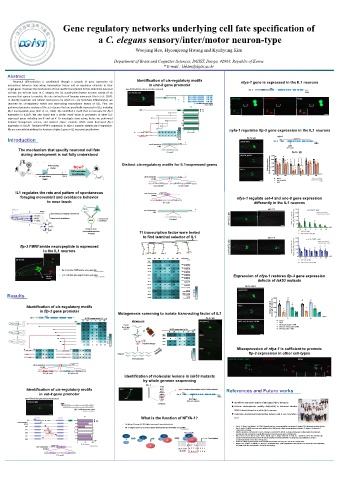
Neuronal differentiation is coordinated through a cascade of gene expression via Identification of cis-regulatory motifs nfya-1 gene is expressed in the IL1 neurons
interactions between trans-acting transcription factors and cis-regulatory elements of their in unc-8 gene promoter
target genes. However, the mechanisms of how specific transcription factors determine neuronal unc-8 (DEG/ENaC cation-selective channel) Chr. X 2kb ATG
cell fate are still not clear. In C. elegans, the IL1 sensory/inter/motor neurons consist of six unc-8 del7p::gfp 200bp
neurons that appear to regulate the rate and pattern of foraging movement (Hart et al., 1995).
To identify molecular and cellular mechanisms by which IL1s are terminally differentiated, we 3kb nfya-1p::gfp flp-3p::mCherry Merge
searched for cis-regulatory motifs and trans-acting transcription factors of IL1s. First, we :Candidate promoter region
Confirmed by JM
performed promoter analysis of the set of genes that are specifically expressed in IL1s, including IL 1
flp-3 neuropeptide gene (Kim et al., 2004). We identified a motif that is necessary for flp-3 -2928 gfp fu l l 1 O n O ff
expression in IL1L/R. We also found that a similar motif exists in promoters of other IL1- 2 1 2
expressed genes including unc-8 and eat-4. To investigate trans-acting factor, we performed 3 3
forward mutagenesis screens and isolated nfya-1 mutants which show decreased flp-3 5 4 4 5
expression in IL1L/R. Transient NFYA-1 expression in nfya-1 mutants restores flp-3 expression. 6 6
We are currently identifying the function of nfya-1 gene in IL1 neuronal specification. 7 5 4 7 0 5 1 0 15 nyfa-1 regulates flp-3 gene expression in the IL1 neurons
5 87 81 76 78 86 89 GFP intensity 3 # o f w o rm s
70 70 52 42 61 70 2
GGAA TTTT 1 nfya-1
0 flp-3p::gfp ATG ok1174
ynIs21 (WT) Chr. X
unc-8 promoter ATG 200bp
lsk53
(3kb) (R117Opal)
The mechanism that specify neuronal cell fate ataccGGAAataag
during development is not fully understood IL1 motif ok1174; ynIs21 250 flp-3p::gfp
200 *** ***
trans-acting How? Distinct cis-regulatory motifs for IL1-expressed genes 150
100
factor lsk53
Differentiation 50
Specification 0 N=6
cis-regulatory Gene flp-3 promoter ATG DL DR L R VL VR
Mean area: 400 px
region (1.7kb) ynIs21 Exposure time: 30ms
ok1174; ynIs21 n=10
atgcaTAAatTGAggtgc gtttgAAGGagtgttGGGcggcg lsk53
IL1 L/R motif IL1 D/V motif
IL1 regulates the rate and pattern of spontaneous eat-4 promoter ATG
foraging movement and avoidance behavior (500bp) nfya-1 regulate eat-4 and unc-8 gene expression
to nose touch acaaaAAGGcacacggccGTGAaattg differently in the IL1 neurons
IL1 motif
OLQ IL1 ok1174 25 0 e a t-4 p 1 2: :g fp
D Muscle unc-8 promoter ATG 20 0 Mean area: 400 px
(3kb)
Spontaneous foraging movement Exposure time: 300ms
IL1D(L/R) ataccGGAAataag 15 0
IL1(L/R) Nose-touch avoidance :glutamatergic IL1 motif eat-4 p12::gfp
IL1V(L/R) D RMD :cholinergic 10 0
IL1DL IL1DR 5 0
V
L IL1L IL1R R Body muscle 0 D L D R L R V L V R N=3
IL1VL IL1VR (Head withdrawal and e a t - 4 p 1 2 : : g f p
V foraging) 11 transcription factor were tested o k 1 1 7 4 ; e a t - 4 p 1 2 : :g fp
to find terminal selector of IL1 ok1174 2 50
P0 2 00 u n c - 8 d e l7 p ::g fp Mean area: 400 px
flp-3 FMRFamide neuropeptide is expressed unc-8 del7p::gfp 1 50 Exposure time: 30ms
in the IL1 neurons 1 00
IL1R IL1L IL1DL IL1DR IL1VL IL1VR 50
0 N=3
D R
flp-3p::gfp D Gene DL DR L R VL VR Reference n=30 D L u n c - 8 d e l7 p :: g f p L R V L V R
flp-
V 3p::gfp 97 100 93 90 100 97 o k 1 1 7 4 ; u n c - 8 d e l7 p :: g f p
sma-9 93 83 53 77 93 90 Murray et al, Genome
Research(2012)
lin-26 87 90 87 83 97 93 Murray et al, Genome
flp-3 encodes FMRFamide neuropeptide.
Research(2012)
Li and Kim (2001) ceh-43 83 79 71 75 92 83 Murray et al, Genome
Research(2012)
FLP-3 inhibits pharyngeal action potential. cnd-1 97 70 77 83 80 93 Murray et al, Genome Expression of nfya-1 restores flp-3 gene expression
Research(2012)
IL1 injection Rogers et al (2001) Murray et al, Genome
marker eor-1 97 100 90 87 93 93 Research(2012)
hlh-3 100 100 97 97 100 100 Murray et al, Genome defects of lsk53 mutants
Research(2012)
hlh-26 90 80 70 80 90 87 Murray et al, Genome flp-3p::gfp Is
Research(2012)
unc-86 87 90 53 60 87 93 Chalfie et al, Cell(1981) 5
elt-6 100 94 94 94 94 100 Development(2001) 4 3 ynIs21 (WT)
Kho et al,
egl-43 91 97 91 94 100 97 Baum et al, Genes & GFP intensity 2 1
Development(1999)
Kho et al,
egl-18 88 94 76 71 88 94 Development(2001) 0 200 ***
***
150 *
Identification of cis-regulatory motifs lsk53 100
in flp-3 gene promoter 50
Mutagenesis screening to isolate trans-acting factor of IL1
ATG N=3-6
flp-3 1.7kb % GFP expression in IL1 n>30 flp-3p::gfp 0 L R
DL DR L R VL VR Mutagenesis ynIs21
ATG WT (ynIs21) lsk53; rgef-1p::nfya-1 cDNA
1 gfp 98 100 95 93 100 98 Parent lsk53
lsk53; rgef-1p::nfya-1 cDNA
2 100 97 67 57 100 100 flp-3p::gfp Is lsk53; unc-8 del7p::nfya-1 gDNA
3 97 98 82 82 90 100 (ynIs21) % GFP expression in IL1 n=20 lsk53; hsp::nfya-1 cDNA
4 97 91 89 74 97 94 DL DR L R VL VR
5 92 94 73 76 96 92 5 4 ynIs21 100 100 100 96 100 100 lsk50
(WT)
6 87 90 23 40 87 90 GFP intensity 3 lsk50 15 0 40 5 75 90
7 46 42 4 4 58 58 2 1 lsk53 100 94 41 35 100 100
8 19 45 3 13 10 23 0 Random damage lsk52 100 100 40 35 100 100
lsk53 Misexpression of nfya-1 is sufficient to promote
5 6 6 7 5
TAA TGA 92 94 73 76 96 92 AAGG GGG 87 90 23 40 87 90 4
GGG 96 96 48 44 85 89 TTT 56 60 24 28 64 68 Progeny GFP intensity 3 2 flp-3 expression in other cell-types
GGG 90 73 20 30 80 90 TTTT 77 77 50 43 73 67 1
Several mutants ynIs21; flp-7p::nfya-1 cDNA flp-7p::mCherry Merge
0
flp-3 promoter ATG
(1.7kb)
atgcaTAAatTGAggtgc gtttgAAGGagtgttGGGcggcg
IL1 L/R motif IL1 D/V motif
Identification of molecular lesions in lsk53 mutants
by whole genome sequencing
Chr. X col-164
Identification of cis-regulatory motifs lsk53 IL1D aman-1 nfya-1: Nuclear transcription factor Y alpha subunit
klp-13
mtp-18
in eat-4 gene promoter C34D10.2 Chr. X ATG
srh-11
nfya-1 200bp
F11C1.5
eat-4 (Vesicular glutamate transporter) IL1V F28H6.4 R117Opal
eat-4 p12::gfp eor-2 Nonsense mutation Identify the expression pattern of gfp-tagged nfya-1 transgene
500bp 10 genes
Perform electrophoretic mobility shift(EMSA) to determine whether
:Candidate promoter region NFYA-1 directly bound cis-motif in flp-3 promoter
Serrano-Saiz et al (2013)
Determine developmental relationship between vab-3, sox-2 and nfya-1
Exon1 Exon2 IL 1 What is the function of NFYA-1? in IL1
-49 ATG gfp control On
point mutation 1 60 O ff
(pm1) 94 pm 1 Ortholog of human NF-YA, highly conserved transcription factor
pm2 pm 2 Hart A. C., Sims S., and Kaplan J. M. (1995). Synaptic code for sensory modalities revealed by C. elegans GLR-1 glutamate receptor. Nature.
116 NF-Y complex serves as a pioneer factor which promotes chromatin accessibility Kim K., and Li C. (2004). Expression and regulation of an FMRFamide-related neuropeptide gene family in C. elegans. The journal of
pm3 pm 3 Ly et al (2013) comparative neurology.
AAGG TTTT
pm4 129 pm 4 NFY complex Vidal B., Santella A., Serrano-Saiz E., Bao Z., Chuang C., and Hobert O. (2015). C. elegans SoxB genes are dispensable for embryonic
GTGA TACT 204 neurogenesis but required for terminal differentiation of specific neuron types. Development.
pm5 pm 5 C C C Kim J., Yeon J., Choi S., Huh Y., Fang Z., Park S., Kim M., Ryoo Z., Kang K., Kweon H., Jeon W., Li C., and Kim K. (2015). The evolutionarily
74 C conserved LIM homeodomain protein LIM-4/LHX6 specifies the terminal identity of a cholinergic and peptidergic C. elegans
pm6 pm 6 + B A B A Transcription sensory/inter/motor neuron-type. PLOS genetics.
n>20 B
0 50 100 B C C A A T Hobert O. (2008). Regulatory logic of neuronal diversity terminal selector genes and selector motifs. PNAS
% o f w orm s A G G T T A Rogers C. M., Franks C. J., Walker R. J., Burke J. F., and Holden-Dye L. (2001). Regulation of the pharynx of C. elegans by 5-HT, octopamine,
and FMRFamide-like neuropdptides. Journal of neurobiology.
eat-4 promoter ATG Confirmed by HJ
(500bp) flp-3 motif A T T G A G G T
(IL1L/R)
acaaaAAGGcacacggccGTGAaattg T A A C T C C A
IL1 motif

