


Page 35 - Q. Neuroscience
P. 35
Inhibitory effect of carvacrol on
                                    lipopolysaccharide-induced memory
                                                   impairment in rats

                                      Bombi Lee , Insop Shim 1,2 , Hyejung Lee , and Dae-Hyun Hahm 1,2
                                                                   1
                                              1
                                                                                                    Q20
                 1 Acupuncture & Meridian Science Research Center (AMSRC),
                 2 Department of Physiology, College of Medicine,  Kyung Hee University, Seoul, 02447, Republic of Korea.
     ABSTRACT                                              RESULTS
   Neuroinflammation  is  an  important  process  underlying  a  wide  variety  of  Behavioral test
   neurodegenerative diseases. Carvacrol (CAR) is a phenolic monoterpene commonly used
   as a food additive due to its antibacterial properties, but it has also been shown to  A  B  C
   exhibit strong antioxidative, anti-inflammatory, and neuroprotective effects. Here, we
   sought to investigate the effects of CAR on inflammation in the hippocampus and
   prefrontal cortex, as well as the molecular mechanisms underlying these effects. In our
   study, lipopolysaccharide (LPS) was injected into the lateral ventricle of rats to induce
   memory impairment and neuroinflammation. Daily administration of CAR (25, 50, and
   100 mg/kg) for 21 days improved recognition, discrimination, and memory impairments
   relative to untreated controls. CAR administration significantly attenuated expression of
   several inflammatory factors in the brain, including interleukin-1β, tumor necrosis
   factor-α, and cyclooxygenase-2. In addition, CAR significantly increased expression of
   brain-derived neurotrophic factor (BDNF) mRNA, and decreased expression of Toll-like
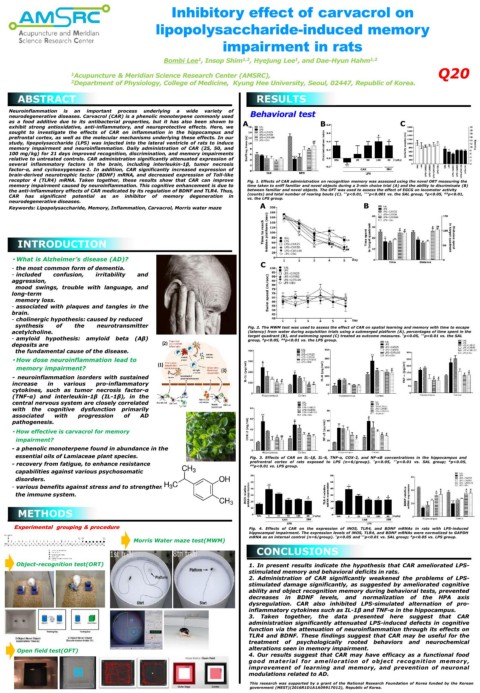
   receptor 4 (TLR4) mRNA. Taken together, these results show that CAR can improve  Fig. 1. Effects of CAR administration on recognition memory was assessed using the novel ORT measuring the
   memory impairment caused by neuroinflammation. This cognitive enhancement is due to  time taken to sniff familiar and novel objects during a 3-min choice trial (A) and the ability to discriminate (B)
   the anti-inflammatory effects of CAR medicated by its regulation of BDNF and TLR4. Thus,  between familiar and novel objects. The OFT was used to assess the effect of EGCG on locomotor activity
   CAR  has  significant  potential  as  an  inhibitor  of  memory  degeneration  in  (counts) and total number of rearing bouts (C).  ** p<0.01,  *** p<0.001 vs. the SAL group,  # p<0.05,  ## p<0.01,
                                                         vs. the LPS group.
   neurodegenerative diseases.
   Keywords: Lipopolysaccharide, Memory, Inflammation, Carvacrol, Morris water maze  A  B
     INTRODUCTION
    • What is Alzheimer’s disease (AD)?                     C
    - the most common form of dementia.
    - included  confusion,  irritability  and
    aggression,
    mood swings, trouble with language, and
    long-term
    memory loss.
    - associated with plaques and tangles in the
    brain.
    - cholinergic hypothesis: caused by reduced
    synthesis  of  the  neurotransmitter                 Fig. 2. The MWM test was used to assess the effect of CAR on spatial learning and memory with time to escape
    acetylcholine.                                       (latency) from water during acquisition trials using a submerged platform (A), percentages of time spent in the
    - amyloid  hypothesis:  amyloid  beta  (Aβ)          target quadrant (B), and swimming speed (C) treated as outcome measures.  * p<0.05,  ** p<0.01 vs. the SAL
                                                         group,  # p<0.05,  ## p<0.01 vs. the LPS group.
    deposits are
    the fundamental cause of the disease.
    • How dose neuroinflammation lead to
     memory impairment?
    - neuroinflammation isorders with sustained
    increase  in  various  pro-inflammatory
    cytokines, such as tumor necrosis factor-α
    (TNF-α) and interleukin-1β (IL-1β), in the
    central nervous system are closely correlated
    with  the  cognitive  dysfunction  primarily
    associated  with  progression  of  AD
    pathogenesis.
    • How effective is carvacrol for memory
    impairment?
    - a phenolic monoterpene found in abundance in the
    essential oils of Lamiaceae plant species.           Fig. 3. Effects of CAR on IL-1β, IL-6, TNF-α, COX-2, and NF-κB concentrations in the hippocampus and
    - recovery from fatigue, to enhance resistance       prefrontral cortex of rats exposed to LPS (n=6/group).  * p<0.05,  ** p<0.01 vs. SAL group;  # p<0.05,
                                                         ## p<0.01 vs. LPS group.
    capabilities against various psychosomatic
    disorders.
    - various benefits against stress and to strengthen
    the immune system.
     METHODS
    Experimental  grouping & procedure                   Fig. 4. Effects of CAR on the expression of iNOS, TLR4, and BDNF mRNAs in rats with LPS-induced
                                                         hippocampal impairment. The expression levels of iNOS, TLR4, and BDNF mRNAs were normalized to GAPDH
                               Morris Water maze test(MWM)   mRNA as an internal control (n=6/group). * p<0.05 and ** p<0.01 vs. SAL group; # p<0.05 vs. LPS group.
                                                           CONCLUSIONS
     Object-recognition test(ORT)                        1. In present results indicate the hypothesis that CAR ameliorated LPS-
                                                         stimulated memory and behavioral deficits in rats.
                                                         2. Administration of CAR significantly weakened the problems of LPS-
                                                         stimulated damage significantly, as suggested by ameliorated cognitive
                                                         ability and object recognition memory during behavioral tests, prevented
                                                         decreases  in  BDNF  levels,  and  normalization  of  the  HPA  axis
                                                         dysregulation. CAR also inhibited LPS-simulated alternation of pro-
                                                         inflammatory cytokines such as IL-1β and TNF-α in the hippocampus.
                                                         3.  Taken  together,  the  data  presented  here  suggest  that  CAR
                                                         administration significantly attenuated LPS-induced defects in cognitive
                                                         function via the attenuation of neuroinflammation through its effects on
                                                         TLR4 and BDNF. These findings suggest that CAR may be useful for the
                                                         treatment  of  psychologically  rooted  behaviors  and  neurochemical
     Open field test(OFT)                                alterations seen in memory impairment.
                                                         4. Our results suggest that CAR may have efficacy as a functional food
                                                         good material for amelioration of object recognition memory,
                                                         improvement of learning and memory, and prevention of neuronal
                                                         modulations related to AD.
                                                         This research was supported by a grant of the National Research Foundation of Korea funded by the Korean
                                                         government (MEST)(2016R1D1A1A09917012), Republic of Korea.

