


Page 3 - P. Molecular medicine and imaging
P. 3
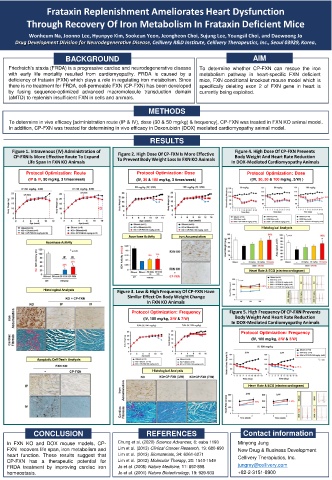
Frataxin Replenishment Ameliorates Heart Dysfunction
          Through Recovery Of Iron Metabolism In Frataxin Deficient Mice

          Wonheum Na, Joonno Lee, Hyunpyo Kim, Sookeun Yeon, Jeongheon Choi, Sujung Lee, Youngsil Choi, and Daewoong Jo
      Drug Development Division for Neurodegenerative Disease, Cellivery R&D Institute, Cellivery Therapeutics, Inc., Seoul 03929, Korea.

                      BACKGROUND                                                   AIM
    Friedreich’s ataxia (FRDA) is a progressive cardiac and neurodegenerative disease  To determine whether CP-FXN can rescue the iron
    with early life mortality resulted from cardiomyopathy. FRDA is caused by a  metabolism pathway in heart-specific FXN deficient
    deficiency of frataxin (FXN) which plays a role in regulating iron metabolism. Since  mice, FXN conditional knockout mouse model which is
    there is no treatment for FRDA, cell-permeable FXN (CP-FXN) has been developed  specifically deleting exon 2 of FXN gene in heart is
    by fusing sequence-optimized advanced macromolecule transduction domain  currently being exploited.
    (aMTD) to replenish insufficient FXN in cells and animals.

                                                 METHODS
    To determine in vivo efficacy [administration route (IP & IV), dose (30 & 50 mg/kg) & frequency], CP-FXN was treated in FXN KO animal model.
    In addition, CP-FXN was treated for determining in vivo efficacy in Doxorubicin (DOX) mediated cardiomyopathy animal model.

                                                  RESULTS
     Figure 1. Intravenous (IV) Administration of                            Figure 4. High Dose Of CP-FXN Prevents
                                       Figure 2. High Dose Of CP-FXN Is More Effective
     CP-FXN Is More Effective Route To Expand   To Prevent Body Weight Loss In FXN KO Animals   Body Weight And Heart Rate Reduction
          Life Span In FXN KO Animals                                       In DOX-Mediated Cardiomyopathy Animals
          Protocol Optimization: Route        Protocol Optimization: Dose        Protocol Optimization: Dose
          (IP & IV, 50 mg/kg, 3 times/week)   (IV, 30 & 100 mg/kg, 3 times/week)   ((IV, 30, 50 & 100 mg/kg, 3/W) )


                                                                                      Histological Analysis
                                           Aconitase Activity  Iron Accumulation
                Aconitase Activity


                                                                                  Heart Rate & ECG (electrocardiogram)


               Histological Analysis   Figure 3. Low & High Frequency Of CP-FXN Have
                                           Similar Effect On Body Weight Change
                                                 In FXN KO Animals
                                            Protocol Optimization: Frequency   Figure 5. High Frequency Of CP-FXN Prevents
                                                (IV, 100 mg/kg, 3/W & 7/W)   Body Weight And Heart Rate Reduction
                                                                            In DOX-Mediated Cardiomyopathy Animals
                                                                               Protocol Optimization: Frequency
                                                                                   (IV, 100 mg/kg, 2/W & 3/W)


             Apoptotic Cell Death Analysis
                                                   Histological Analysis

                                                                                  Heart Rate & ECG (electrocardiogram)


            CONCLUSION                           REFERENCES                     Contact information
   In FXN KO and DOX mouse models, CP-  Chung et al. (2020) Science Advances, 6: eaba 1193  Minyong Jung
   FXN recovers life span, iron metabolism and  Lim et al. (2013) Clinical Cancer Research, 19: 680-690  New Drug & Business Development
   heart function. These results suggest that  Lim et al. (2013) Biomaterials, 34: 6261-6271  Cellivery Therapiutics, Inc.
   CP-FXN has a therapeutic potential for  Lim et al. (2012) Molecular Therapy, 20: 1540-1549
   FRDA treatment by improving cardiac iron  Jo et al. (2005) Nature Medicine, 11: 892-898  jungmy@cellivery.com
   homeostasis.                        Jo et al. (2001) Nature Biotechnology, 19: 929-933  +82-2-3151-8900

