


Page 1 - P. Molecular medicine and imaging
P. 1
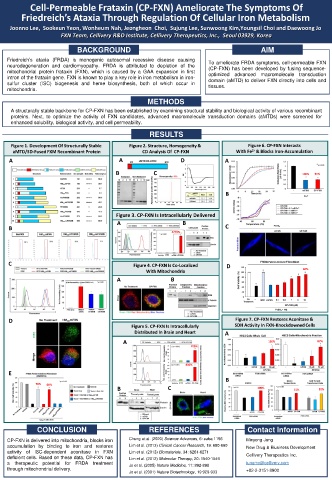
Cell-Permeable Frataxin (CP-FXN) Ameliorate The Symptoms Of
        Friedreich’s Ataxia Through Regulation Of Cellular Iron Metabolism

    Joonno Lee,  Sookeun Yeon, Wonheum Nah, Jeongheon Choi,  Sujung Lee, Sunwoong Kim,Youngsil Choi and Daewoong Jo
                     FXN Team, Cellivery R&D Institute, Cellivery Therapeutics, Inc.,  Seoul 03929, Korea

                          BACKGROUND                                                  AIM

   Friedreich’s ataxia (FRDA) is monogenic autosomal recessive disease causing  To ameliorate FRDA symptoms, cell-permeable FXN
   neurodegeneration and cardiomyopathy. FRDA is attributed to depletion of the  (CP-FXN) has been developed by fusing sequence-
   mitochondrial protein frataxin (FXN), which is caused by a GAA expansion in first  optimized advanced macromolecule transduction
   intron of the frataxin gene. FXN is known to play a key role in iron metabolism in iron-  domain (aMTD) to deliver FXN directly into cells and
   sulfur cluster (ISC) biogenesis and heme biosynthesis, both of which occur in  tissues.
   mitochondria.
                                                 METHODS
     A structurally stable backbone for CP-FXN has been established by examining structural stability and biological activity of various recombinant
     proteins. Next, to optimize the activity of FXN candidates, advanced macromolecule transduction domains (aMTDs) were screened for
     enhanced solubility, biological activity, and cell permeability.
                                                  RESULTS

     Figure 1. Development Of Structurally Stable   Figure 2. Structure, Homogeneity &   Figure 6. CP-FXN Interacts
     aMTD/SD-Fused FXM Recombinant Protein     CD Analysis Of  CP-FXN         With Fe & Blocks Iron-Accumulation
                                                                                   2+
    A                                   A                   D             A
                                       B           C                                               100%  95%


                                                                          B


                                       Figure 3. CP-FXN Is Intracellularly Delivered
                                       A                    B
    B                                                                     C
                                                         5770%


    C                                       Figure 4. CP-FXN Is Co-Localized  D
                                                 With Mitochondria                                  84%
                                       A                 B


    D                                                                         Figure 7. CP-FXN Restores Aconitase &
                                            Figure 5. CP-FXN Is Intracellularly   SDH Activity In FXN-Knockdowned Cells
                                             Distributed In Brain and Heart   A
                                         A                                              110%            87%
                                                               700%


                                                             800%
    E
                                                                          B
             70%  68%
                                       B                C                            100%        51%     55%


             CONCLUSION                          REFERENCES                       Contact Information

   CP-FXN is delivered into mitochondria, blocks iron  Chung et al. (2020) Science Advances, 6: eaba 1193  Minyong Jung
   accumulation by binding to iron and restores  Lim et al. (2013) Clinical Cancer Research, 19: 680-690  New Drug & Biusiness Development
   activity of ISC-dependent aconitase in FXN  Lim et al. (2013) Biomaterials, 34: 6261-6271
   deficient cells. Based on these data, CP-FXN has  Lim et al. (2012) Molecular Therapy, 20: 1540-1549  Cellivery Therapeutics Inc.
   a  therapeutic  potential for FRDA  treatment  Jo et al. (2005) Nature Medicine, 11: 892-898  jungmy@cellivery.com
   through mitochondrial delivery.                                               +82-2-3151-8900
                                           Jo et al. (2001) Nature Biotechnology, 19:929-933

