


Page 13 - O. Microbiology
P. 13
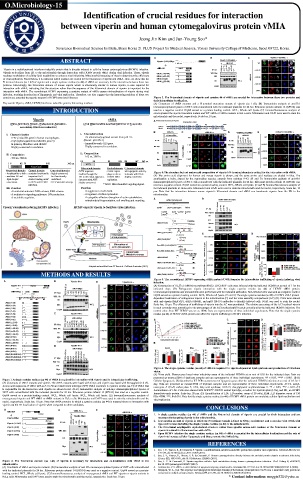
O.Microbiology-15
Identification of crucial residues for interaction
between viperin and human cytomegalovirus protein vMIA
Jeong Jin Kim and Jun-Young Seo*
Severance Biomedical Science Institute, Brain Korea 21 PLUS Project for Medical Science, Yonsei University College of Medicine, Seoul 03722, Korea.
A B C Viperin (1-42)-6Myc +
ABSTRACT Viperin (1-42)-6Myc 6Myc Viperin (1-42)-6Myc + Myc Mitotracker HA DAPI Merge
1 42 aa vMIA-HA WT
HA
Viperin is a multifunctional interferon-inducible protein that is directly induced in cells by human cytomegalovirus (HCMV) infection. vMIA-HA 1 vMIA 163aa IP: HA RPS14-HA △40-44 △40-42 C44A △50-60 WT △40-42
Viperin re-localizes from ER to the mitochondria through interaction with HCMV protein vMIA during viral infection. There, viperin vMIA (△40-44) HA WB: Myc
mediates modulation of cellular lipid metabolism to enhance viral infectivity. Mitochondrial targeting of viperin determines the efficiency vMIA (△40-42) HA Myc △50-60
of viral replication. Nevertheless, it is unknown which residues are crucial for the interaction of viperin and vMIA. Here, we show that the vMIA (C44A) HA vMIA-HA
N-terminal domain (aa 1-42) of viperin and a single cysteine residue (aa 44) of vMIA are necessary for the interaction between these two vMIA (△50-60) HA HA WCL
proteins. Interestingly, the N-terminal domain of mouse viperin which is structurally similar to human viperin, is also required for Grp94 △40-44
interaction with vMIA, indicating that the structure rather than the sequence of the N-terminal domain of viperin is important for the
interaction with vMIA. The recombinant HCMV expressing a cysteine mutant of vMIA causes mislocalization of viperin during viral C44A
infection, resulting in reduction of lipogenesis and viral replication. Therefore, our data suggest that the interacting residues of these two
proteins are potential therapeutic targets for HCMV-associated diseases. Figure 3. The N-terminal domain of viperin and cysteine 44 of vMIA are crucial for interaction between these two proteins and
their intracellular localization.
Key words: Viperin, vMIA, HCMV, Interferon-inducible protein, Interacting residues (A) Constructs of vMIA mutants and a N-terminal truncation mutant of viperin (aa 1-42). (B) Immunoblot analysis of anti-HA
immunoprecipitated lysates of 293T cells cotransfected with the indicated plasmids for 24 hrs. Ribosome protein subunit 14 (RPS14) was
INTRODUCTION used as a negative control. Grp94 served as a protein-loading control. WCL, Whole cell lysate. (C) Immunofluorescence analysis of
overexpressed the viperin truncation mutant and WT vMIA or vMIA mutants in HeLa cells. Mitotracker and DAPI were used to stain the
mitochondria and the nuclei, respectively. Scale bar, 10 μm.
Viperin vMIA A N-terminal domain of Viperin
(Amphipathic α-helix)
(Virus Inhibitory Protein, Endoplasmic Reticulum- (viral Mitochondria localized Inhibitor of Apoptosis) 1 33 42 60aa
associated, INterferon-inducible) Human MWVLTPAAFAGKLLSVFRQPLSSLWRSLVPLFCWLRATFWLLATKRRKQQL VLRGPDETK
Mouse MGMLVPTALAARLLSLFQQQLGSLWSGLAILFCWLRIALGW LDP–GKEQPQVRGELEETQ
59aa
B vMIA-HA + C vMIA-HA + D mViperin (1-42)-6Myc + E mViperin (1-42)-6Myc +
I. Characterization I. Characterization mViperin-6Myc Myc Mitotracker HA DAPI Merge vMIA-HA Myc Mitotracker HA DAPI Merge
- IFN-γ-inducible gene in human macrophages. - An alternatively spliced variant from pUL37. RPS14-6Myc WT WT
- Cig5 (cytomegalovirus-inducible gene 5) (Exon1: pUL37x1) IP: HA △2-42 1-42 C33A 1-80 WT IP: HA RPS14-HA △40-44 △40-42 C44A △50-60 WT
in primary fibroblast with HCMV. - Immediate-early (IE) gene. 1-42 WB: Myc △40-42
- Highly conserved in evolution. - Highly conserved in evolution. WB: Myc Myc
II. Composition HA mViperin-6Myc 1-80 HA WCL vMIA-HA △50-60
II. Composition
- 362 aa, 42kDa. - 162 aa, 28kDa. Grp94 △40-44
Myc WCL C33A
1 5 34 81 108 118 147 162 aa
1 9 42 71 182 362 aa MTS C44A
α-helix CxxxCxxC Grp94 △2-42
N-terminal domain Central domain C-terminal domain
N-terminal domain Central domain C-terminal domain - MTS sequence - Acidic region : anti-apoptotic activity.
- Amphipathic α-helix : contains functionally : highly conserved : traffics through the : plays a role in : interacts with BAX. Figure 4. The structure but not amino acid composition of viperin’s N-terminal domain is critical for the interaction with vMIA.
: mediates ER and important Fe-S but functionally ER to the Golgi apparatus. HCMV DNA : highly conserved. (A) The amino acid alignment for human and mouse viperin is shown, and the same amino acid residues are shaded in blue. The
lipid droplet cluster binding motif undefined. : interacts with ANT. replication. amphipathic a helix, shared by the mammalian species, extends from residues 9–42. (B and D) Immunoblot analysis of anti-HA
association. in HCV and HCMV : HCV-antiviral activity. : highly conserved. immunoprecipitated lysates of 293T cells cotransfected with the indicated plasmids for 24 hrs. Ribosome protein subunit 14 (RPS14) was
infection. * MTS: Mitochondrial targeting signal. used as a negative control. Grp94 served as a protein-loading control. WCL, Whole cell lysate. (C and E) Immunofluorescence analysis of
III. Function Function the indicated plasmids in HeLa cells. Mitotracker and DAPI were used to stain the mitochondria and the nuclei, respectively. Scale bar, 10
- An antiviral activator: DNA viruses, RNA viruses. - A suppressor of cell death. μm. Note that the interaction between mouse viperin’s N-terminal domain and vMIA can translocate viperin from the ER to the
- A mediator in signaling pathways: IFN production. - A regulator of DNA replication. mitochondria.
- A metabolic regulator. - A cytopathic effector: disruption of actin cytoskeleton, A B
mitochondrial fragmentation, cell swelling and rounding. HCMV (AD169)-BAC HCMV-vMIA-HA (1dpi)
Non-infected
Viperin’s localization during HCMV infection HCMV exploits viperin to facilitate virus infection. 52706 UL37-UL38 region 49910
IP: HA △40-44 △40-42 C44A WT
UL37x1 UL38 UL37x2 UL37x3 WB: Viperin
(vMIA)
HA
1 atg cag489bp IE1
vMIA WT-BAC Viperin
1 (163aa) WCL
HA
----EDPLPPWLRK KKACALTRRS----
31 40 44 50 Grp94
vMIA (△40-42)-BAC C D
(△40-42) pp65 Viperin vMIA DAPI Merge pp65 Viperin vMIA DAPI Merge
tgt→gcg Non-infected Non-infected
vMIA (C44A)-BAC
(C→A)
Disruption of Rev-vMIA (△40-42)-BAC (1dpi) WT (5dpi) WT
actin cytoskeleton (KKK) HCMV
gcg→tgt -vMIA
- Lipogenesis Rev-vMIA (C44A)-BAC (A→C) HCMV-vMIA Δ40-42 C44A
- Metabolic change Splicing site Stop
atg ca/g taa
vMIA-HA-BAC C44A RevHCMV -vMIA (5dpi) C44A
HA
vMIA (△40-44)-HA-BAC (1dpi)
(△40-44) Δ40-42 150
Adapted and modified from JY Seo et al. Cell host & microbe (2011). HCMV-vMIA WT
vMIA (△40-42)-HA-BAC 100 HCMV-vMIA (C44A)
RevHCMV-vMIA (C44A)
(△40-42) RevHCMV-vMIA C44A The number of viperin in the AC (%) 50
METHODS AND RESULTS vMIA (C44A)-HA-BAC (C→A) 0 5dpi
tgt→gcg
Figure 5. The recombinant HCMV expressing vMIA mutant (C44A) impairs the intracellular trafficking of viperin induring viral
A B Viperin-HA + E Viperin-HA + infection.
Viperin-HA Viperin HA HA Mitotracker Myc DAPI Merge (A) Construction of UL37x1 (vMIA) recombinant BACs. (B-D) HFF cells were infected with the indicated HCMVs at an moi of 1 for the
1 362 aa vMIA-6Myc WT indicated days. (B) Endogenous viperin interaction with the single cysteine residue (aa 44) of HCMV vMIA protein.
vMIA-6Myc vMIA 6Myc RPS14-6Myc Coimmunoprecipitations and immunoblots were performed with the indicated antibodies. Non-infected cells was used as a negative control.
1 163 IP: Myc 1-22 1-34 1-39 1-44 1-49 1-54 1-60 WT Grp94 served as a protein-loading control. WCL, Whole cell lysate. (C and D) The single cysteine residue (aa 44) of HCMV vMIA protein-
aa WB: HA 1-44
----EDPLPPWLRKKKACALTRRS---- dependent localization of endogenous viperin to the mitochondria (C) and the virus assembly compartment (AC) (D). Cells were stained
31 40 44 50 HA
with anti-viperin (MaP.VIP), vMIA (4B6-B), and pp65 (28-19) antibodies to identify infected cells. DAPI was used to stain the nuclei.
vMIA (1-22) 6Myc
vMIA (1-34) 6Myc Myc WCL △40-42 Scale bar, 10 μm. The efficiency of trafficking of viperin into the AC was quantitated. The relative percentage of the AC-localized viperin
vMIA (1-39) 6Myc in each coverslip were normalized to the percentages of the AC-localized pp65 in each coverslip after the indicated HCMVs infection. The
Grp94
vMIA (1-44) 6Myc control value from WT HCMV was set as 100%. Data are representative of three individual experiments. Note that the single cysteine
vMIA (1-49) 6Myc C Viperin-HA + vMIA-6Myc △50-60 residue (aa 44) of HCMV vMIA protein can affect for viperin trafficking in HCMV infection.
vMIA (1-54) 6Myc vMIA-6Myc
vMIA (1-60) 6Myc A C BODIPY IE1 Merge D Merge 2
vMIA (△2-34) 6Myc RPS14-6Myc 1-39 5 HCMV-vMIA WT Non-infected 8 FAS **
IP: Myc △2-34 △2-22 △35-39 △40-44 △40-42 △45-49 △50-60 4 70 * *** * Non-infected
vMIA (△2-22) 6Myc C44A WT HCMV-vMIA (40-42) 6 60 ** *** *** *** HCMV-vMIA WT
HCMV-vMIA (C44A)
vMIA (△35-39) 6Myc WB: HA Log (Infectious unit) 3 RevHCMV-vMIA (C44A) Relative mRNA level Number of LDs per cell 4 50 HCMV-vMIA (40-42)
40
HCMV-vMIA (C44A)
vMIA (△40-44) 6Myc △40-44 2 WT 30 RevHCMV-vMIA (40-42)
RevHCMV-vMIA (C44A)
HA 1 (3dpi) 220
vMIA (△40-42) 6Myc FAS 0 10
0
FAS 3dpi
vMIA (C44A) 6Myc Myc WCL 0 0 1 2 3 4 5 6 7 8 * * ** Non-infected 8 1dpi ** ***
vMIA (△45-49) 6Myc C44A Days post infection (dpi) 6 ** HCMV-vMIA WT HCMV-vMIA Δ40-42 6 1.8 * ** * *** Non-infected
1.5
***
HCMV-vMIA (40-42)
HCMV-vMIA WT
vMIA (△50-60) 6Myc Grp94 B Relative mRNA level 4 HCMV-vMIA (C44A) Relative mRNA level Diameter of LDs (μm) 4 1.2 *** HCMV-vMIA (40-42)
RevHCMV-vMIA (40-42)
HCMV-vMIA (C44A)
0.9
vMIA (K40A) 6Myc D Viperin-HA + 2 RevHCMV-vMIA (C44A) C44A 2 0.6 RevHCMV-vMIA (40-42)
RevHCMV-vMIA (C44A)
0.3
vMIA (K41A) 6Myc vMIA-6Myc △2-34 ACC2 0 FAS ** DGAT2 00.0
1dpi
vMIA (K42A) 6Myc 6 * ** 8 Non-infected * * 60 Non-infected* ** (3dpi) 1dpi3dpi
5
50
**
vMIA (KK4041AA) 6Myc RPS14-6Myc 4 ** 6 HCMV-vMIA WT 40 HCMV-vMIA WT * Δ40-42
HCMV-vMIA (△ 40-42)
HCMV-vMIA (△ 40-42)
vMIA (KK4042AA) 6Myc KK4041AA KK4042AA KK4142AA △40-42 Relative mRNA level 3 Relative mRNA level 4 HCMV-vMIA (C44A) Relative mRNA level HCMV-vMIA (C44A)
RevHCMV-vMIA (△ 40-42)
RevHCMV-vMIA (△ 40-42)
IP: Myc K40A K41A K42A 2 RevHCMV-vMIA (C44A) 30 RevHCMV-vMIA (C44A)
vMIA (KK4142AA) 6Myc WT 1 2 1 RevHCMV-vMIA
WB: HA 0 0 0 C44A
1dpi 1dpi 1dpi
HA
Figure 6. The single cysteine residue (aa 44) of vMIA is required for viperin-dependent lipid synthesis and production of infectious
Myc WCL
virion.
Grp94 (A) Virus yield. Fluorescence-based virus infectivity assay of the indicated HCMVs at an moi of 0.05 for the indicated days. Data are
presented as means±SEM of duplicate samples and are representative of three individual experiments. *P < 0.05, ***P < 0.001. (B-D)
Figure 1. A single cysteine residue (aa 44) of vMIA is required for interaction with viperin and its intracellular trafficking. Cellular lipogenesis. (B) Quantitative RT-PCR measurement of lipogenic genes after the indicated HCMVs infection at an moi of 0.2 for 1
(A) Constructs of vMIA mutants and viperin. The vMIA mutants were fused with 6 myc and viperin was fused with hemagglutinin (HA). day. Data are presented as means±SEM of triplicate samples and are representative of three individual experiments. ACC2, acetyl-
Amino acid sequences of vMIA with aa 31 to 50 are listed below wild type (WT) vMIA construct. A cysteine residue (aa 44) of vMIA that coenzyme A (CoA) carboxylase 2; FAS, fatty acid synthase; DGAT2, diacylglycerol acyltransferases 2. *P < 0.05, **P < 0.01. (C)
is responsible for the interaction with viperin are shown in red. (B-D) Immunoblot analysis of anti-myc immunoprecipitated lysates of Accumulation of LDs. Cells were stained with BODIPY 493/503 neutral lipid dye, a marker for lipid droplets (LDs), and IE1, an HCMV
293T cells cotransfected with the indicated plasmids for 24 hrs. Ribosome protein subunit 14 (RPS14) was used as a negative control. Immediate-early protein. Scale bar, 20 μm. (D) Quantification of LDs. LD number: mean of 20 cells±SEM.; LD diameter: mean of 150
Grp94 served as a protein-loading control. WCL, Whole cell lysate. WCL, Whole cell lysate. (E) Immunofluorescence analysis of LDs±SEM. ***, P<0.001. Note that the single cysteine residue (aa 44) of HCMV vMIA protein can modulate cellular lipid metabolism and
overexpressed viperin and WT vMIA or vMIA mutants in HeLa cells. Mitotracker and DAPI were used to stain the mitochondria and the viral replication.
nuclei, respectively. Scale bar, 10 μm. Note that vMIA proteins in which a cysteine residue (aa 44) is mutated show no interaction with
viperin and the ER localization of viperin when compared to other candidates.
CONCLUSIONS
A B C
vMIA-HA vMIA HA vMIA-HA + vMIA-HA +
1 163aa Myc Mitotracker HA DAPI Merge 1. A single cysteine residue (aa 44) of vMIA and the N-terminal domain of viperin are crucial for their interaction and are
Viperin-6Myc Viperin 6Myc RPS14-6Myc Viperin-6Myc WT necessary for targeting viperin to the mitochondria.
1 362 aa △2-42 2. A truncation mutant of viperin in which the N-terminal domain is fused to 6Myc, can interact and co-localize with vMIA wild
Viperin (△2-42) 6Myc IP: HA 1-42 C33A 1-80 WT type and mutants including the single cysteine residue (aa 44) to the mitochondria.
Viperin (1-42) 6Myc 1-42 3. The N-terminal amphipathic alpha-helical structure rather than specific amino-acid residues of the N-terminal domain of
Viperin (C33A) 6Myc WB: Myc viperin is critical for the interaction with vMIA.
Viperin (1-80) 6Myc Viperin-6Myc 1-80 4. Upon HCMV infection the single cysteine residue (aa 44) of vMIA is essential for the intracellular localization and the role of
viperin to increase cellular lipogenesis and thus promote viral infectivity.
HA
C33A REFERENCES
Myc WCL
1. Seo, J. Y., Yaneva, R. & Cresswell, P. Viperin: a multifunctional, interferon-inducible protein that regulates virus replication. Cell Host Microbe 10,
△2-42 534-539, doi:10.1016/j.chom.2011.11.004 (2011).
Grp94
2. Seo, J. Y., Yaneva, R., Hinson, E. R. & Cresswell, P. Human cytomegalovirus directly induces the antiviral protein viperin to enhance infectivity.
Science 332, 1093-1097, doi:10.1126/science.1202007 (2011).
Figure 2. The N-terminal domain (aa 1-42) of viperin is necessary for interaction and co-localization with vMIA to the 3. Seo, J. Y. & Cresswell, P. Viperin regulates cellular lipid metabolism during human cytomegalovirus infection. PLoS Pathog 9, e1003497,
mitochondria. doi:10.1371/journal.ppat.1003497 (2013).
(A) Constructs of vMIA and viperin mutants. (B) Immunoblot analysis of anti-HA immunoprecipitated lysates of 293T cells cotransfected 4. Goldmacher, V. S. vMIA, a viral inhibitor of apoptosis targeting mitochondria. Biochimie 84, 177-185, doi:10.1016/s0300-9084(02)01367-6 (2002).
with the indicated plasmids for 24 hrs. Ribosome protein subunit 14 (RPS14) was used as a negative control. Grp94 served as a protein- 5. Hayajneh, W. A. et al. The sequence and antiapoptotic functional domains of the human cytomegalovirus UL37 exon 1 immediate early protein are
loading control. WCL, Whole cell lysate. (C) Immunofluorescence analysis of overexpressed vMIA and WT viperin or viperin mutants in conserved in multiple primary strains. Virology 279, 233-240, doi:10.1006/viro.2000.0726 (2001).
HeLa cells. Mitotracker and DAPI were used to stain the mitochondria and the nuclei, respectively. Scale bar, 10 μm. * Contact information: meggie320@yuhs.ac

