


Page 31 - I. Chemical biology and drug discovery
P. 31
Antileukemic activities of ampelopsin in human leukemia HL60 and K562 cells
Hong Lae Kim, Jang Mi Han and Hye Jin Jung*
Department of Pharmaceutical Engineering & Biotechnology, Sun Moon University, 70, Sunmoon-ro 221, Tangieong-myeon, Asan-si Chungnam 31460, Korea
ABSTRACT
Leukemia is a type of cancer of blood, which is caused by the rapid proliferation of abnormal white blood cells. Although chemo/radiotherapies are used in the treatment
of leukemia, the morbidity and mortality of leukemia patients are still high. Ampelopsin is a natural flavonoid that possesses multiple pharmacological functions.
However, the anticancer effect and action mechanism of ampelopsin on leukemia have not been identified. We here evaluated the antileukemic effects of ampelopsin
against acute promyelocytic HL60 and chronic myelogenous K562 leukemia cells. Ampelopsin significantly reduced the viability of HL-60 and K562 cells at the
concentrations that did not show cytotoxicity against normal cells. The compound induced cell cycle arrest at S phase and apoptosis in both leukemia cells. The
antileukemic effects of ampelopsin were associated with the activation of caspase-9, caspase-3, and PARP, as well as the increase in ROS production. Furthermore, we
investigated the effects of ampelopsin on PI3K/AKT, MAPK, and NFkB signaling pathways. Notably, it exhibited more potent antileukemic activity in HL60 cells
compared to K562 cells. Therefore, our findings suggest that ampelopsin may represent a promising natural compound for the development of antileukemia
therapeutics.
BACKGROUND & AIM METHODS
Ampelopsin, also known as dihydromyricetin, is a flavanonol of Hovenia dulcis Thunb. extract and CellTiter-Glo® luminescent cell viability assay
possesses antiinflammatory, antioxidative, antiangiogenic and anticancer activities. Cell cycle analysis
However, whether ampelopsin exhibits anti-leukemic activity and the underlying mechanisms in Annexin V/PI apoptosis assay
Leukemia cells are still unknown. DAPI staining assay
Therefore, we aim to develop a new therapeutic agent for leukemia by revealing the anti-leukemia H2DCFDA staining assay
activity and mechanism of ampelopsin. Western blot analysis
RESULTS
A B C
D
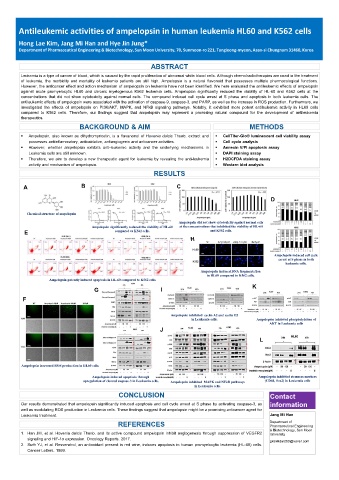
Chemical structure of ampelopsin
Ampelopsin did not show cytotoxicity against normal cells
Ampelopsin significantly reduced the viability of HL-60 at the concentrations that inhibited the viability of HL-60
E compared to K562 cells. and K562 cells.
H
Ampelopsin induced cell cycle
arrest at S phase in both
leukemia cells.
Ampelopsin induced DNA fragmentation
in HL60 compared to K562 cells.
Ampelopsin potently induced apoptosis in HL-60 compared to K562 cells.
K
G I
F
Ampelopsin inhibited cyclin A2 and cyclin E2
in Leukemia cells. Ampelopsin inhibited phospholylation of
AKT in Leukemia cells
J
L
Ampelopsin increased ROS production in HL60 cells.
Ampelopsin induced apoptosis through Ampelopsin inhibited stemness markers
upregulation of cleaved caspase-3 in Leukemia cells. Ampelopsin inhibited MAPK and NFkB pathways (CD44, Sox2) in Leukemia cells
in Leukemia cells.
CONCLUSION Contact
Our results demonstrated that ampelopsin significantly induced apoptosis and cell cycle arrest at S phase by activating caspase-3, as information
well as modulating ROS production in Leukemia cells. These findings suggest that ampelopsin might be a promising anticancer agent for
Leukemia treatment. Jang Mi Han
REFERENCES Department of
Pharmaceutical Engineering
& Biotechnology, Sun Moon
1. Han JM, et al. Hovenia dulcis Thunb. and its active compound ampelopsin inhibit angiogenesis through suppression of VEGFR2 University
signaling and HIF-1α expression. Oncology Reports. 2017. gkswkdal200@naver.com
2. Surh YJ, et al. Resveratrol, an antioxidant present in red wine, induces apoptosis in human promyelocytic leukemia (HL-60) cells.
Cancer Letters. 1999.

