


Page 29 - I. Chemical biology and drug discovery
P. 29
Exploration of anticancer agents showing chemical synthetic lethal interaction
with CaMKII inhibitors in glioblastoma stem-like cells
Jang Mi Han and Hye Jin Jung*
Department of Pharmaceutical Engineering & Biotechnology, Sun Moon University, 70, Sunmoon-ro 221, Tangieong-myeon, Asan-si Chungnam 31460, Korea
ABSTRACT
Glioblastoma stem cells (GSCs) drive tumor initiation, cancer invasion, immune evasion, and therapeutic resistance, and are thus a key therapeutic target for improving
glioblastoma multiforme treatment. We previously identified Ca2+/calmodulin‐dependent protein kinase II (CaMKII) as a novel molecular target to eliminate GSCs. In this
study, we aimed to explore the anticancer agents that act synergistically through synthetic lethal interaction with CaMKII inhibitors in GSCs. The high-throughput drug
combination screening based on luminescent cell viability assay was performed using CaMKII inhibitors (berbamine, HBC) and 1280 compounds, covering a range of
pharmacological targets. As a result, four different compounds (77, 521, 867, 1051) showed significant synthetic lethal interactions with berbamine or HBC in U87MG-
derived GSCs. Combination of CaMKII inhibitors and the compounds markedly reduced the viability, neurosphere formation, and migration of GSCs compared to each
compound alone. The synthetic lethal interactions were further validated using another CaMKII inhibitor KN93 and U373MG-derived GSCs. Therefore, the chemical
synthetic lethality screen may provide novel potential anticancer agents and interactive biomolecules to reinforce CaMKII-targeted therapy of GSCs.
BACKGROUND & AIM METHODS
CellTiter-Glo® luminescent
cell viability assay
Tumorsphere forming assay
Synthetic lethality arises when a combination of deficiencies in the expression of two or more genes leads to cell death, Migration assay
whereas a deficiency in only one of these genes does not. Synthetic lethality has utility for purposes of molecular targeted
cancer therapy. Therefore, we aim to discover compounds that interact through synthetic lethality with inhibitors of
Ca2+/CaM/CaMKII, a major marker of Glioblastoma, and develop them into new therapeutic agents.
RESULTS
A Screening System B
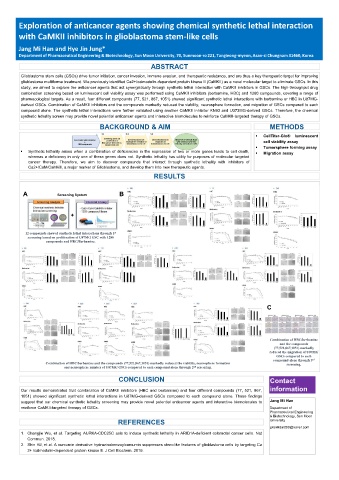
12 compounds showed synthetic lethal interactions through 1 st
screening based on proliferation of U87MG GSC with 1280
compounds and HBC/Berbamine.
C
Combination of HBC/berbamine
and the compounds
(77,521,867,1051) markedly
reduced the migration of U87MG
GSCs compared to each
compound alone through 3 rd
Combination of HBC/berbamine and the compounds (77,521,867,1051) markedly reduced the viability, neurosphere formation screening.
and neurosphere number of U87MG GSCs compared to each compound alone through 2 nd screening.
CONCLUSION Contact
Our results demonstrated that combination of CaMKII inhibitors (HBC and berbamine) and four different compounds (77, 521, 867, information
1051) showed significant synthetic lethal interactions in U87MG-derived GSCs compared to each compound alone. These findings
suggest that our chemical synthetic lethality screening may provide novel potential anticancer agents and interactive biomolecules to Jang Mi Han
reinforce CaMKII-targeted therapy of GSCs. Department of
Pharmaceutical Engineering
& Biotechnology, Sun Moon
REFERENCES University
gkswkdal200@naver.com
1. Changjie Wu, et al. Targeting AURKA-CDC25C axis to induce synthetic lethality in ARID1A-deficient colorectal cancer cells. Nat
Commun. 2018.
2. Shin HJ, et al. A curcumin derivative hydrazinobenzoylcurcumin suppresses stem-like features of glioblastoma cells by targeting Ca
2+ /calmodulin-dependent protein kinase II. J Cell Biochem. 2019.

