


Page 31 - H. Cell signaling
P. 31
Role of mTORC2 in NK cell‐mediated cytotoxicity

                                          against tumor cells


                     Jaeho Cho, Mirae Kim,Gyu Tae Park, and Sung Su Yea

            Dept. of Biochemistry, College of Medicine, Inje University, Korea

                        BACKGROUND                                                   AIM

         Phosphoinositide 3-kinase (PI3K)                      • To assess how different classes of PI3K inhibitors and mTORC
         • Lipid kinase family: 3'-hydroxy group of PtdIns and phosphoinositides  inhibitors affect  the function of NK cells, a key cell type for
         • Mammalian PI3K: Class I, II, III; class I PI3Ks: generation of   immunosurveillance and tumor immunotherapy
           PtdIns(3,4,5)P 3 (PIP 3 )                           • To assess how a promising new class of targeted agents impacts
         • PIP 3 production: recruitment of protein effectors containing  PH domain  NK cell function.
         • PI3K signaling is implicated in a variety of human diseases including
           cancer.
         Mechanistic target of rapamycin (mTOR)                                 METHODS
         • Complex and two type: mTORC1, mTORC2
         • mTORC1 consists of Raptor and other factors(mTOR, mLST8, deptor,   • Cells: Primary NK cells from C57BL/6 mice and NKL cell line were
           PRAS40), mTORC2 is complex of Rictor and others(mTOR, mLST8,   cultured in IL-2 and used.
           mSIN1).                                             • Cell-mediated cytotoxicity (CMC): CMC was determined by
         Natural Killer (NK) cells                               calcein release assay with the NK cells and calcein AM-labeled
         • Lymphocytes of the innate immune system that can kill tumor cells.   target cells at the indicated effector:target (E:T) ratios.
         • Critical role in eliminating tumors and virally infected cells by induction   • Gene knock-down: NKL cells were transfected with Rictor siRNA,
           of cytotoxicity and production of cytokines           AKT siRNA, or control siRNA.
         • Effector function is controlled by opposing signals from activating and   • Western blot analysis: The whole-cell lysates were prepared and
           inhibitory receptors                                  analyzed for phosphorylation of indicated kinases.
                                                      RESULTS

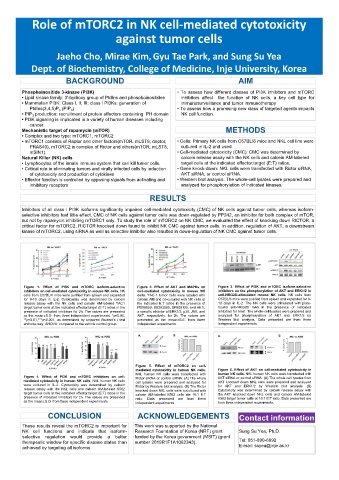
         Inhibitors of all class I PI3K isoforms significantly impaired cell-mediated cytotoxicity (CMC) of NK cells against tumor cells, whereas isoform-
         selective inhibitors had little effect. CMC of NK cells against tumor cells was down-regulated by PP242, an inhibitor for both complex of mTOR,
         but not by rapamycin inhibiting mTORC1 only. To study the role of mTORC2 on NK CMC, we evaluated the effect of knocking down RICTOR, a
         critical factor for mTORC2. RICTOR knocked down found to inhibit NK CMC against tumor cells. In addition, regulation of AKT, a downstream
         kinase of mTORC2, using siRNA as well as selective inhibitor also resulted in down-regulation of NK CMC against tumor cells.


         Figure 1. Effect of PI3K and mTORC isoform-selective  Figure 2. Effect of AKT and MAPKs on  Figure 3. Effect of PI3K and mTORC isoform-selective
         inhibitors on cell-mediated cytotoxicity in mouse NK cells. NK  cell-mediated cytotoxicity in mouse NK  inhibitors on the phosphorylation of AKT and ERK1/2 in
         cells from C57BL/6 mice were purified from spleen and expanded  cells. YAC-1 tumor cells were labeled with  anti-NKG2D-stimulated mouse NK cells. NK cells from
         for 8-10 days in IL-2. Cytotoxicity was determined by calcein  calcein AM and co-cultured with NK cells at  C57BL/6 mice were purified from spleen and expanded for 8-
         release assay with the NK cells and calcein AM-labeled YAC1  the indicated E:T ratios in the presence of  10 days in IL-2. The NK cells were stimulated with plate-
         target tumor cells at the indicated effector:target (E:T) ratios in the  PD98059, SB203580, SP600125, and AKTi,  bound anti-NKG2D mAb in the presence of indicated
         presence of indicated inhibitors for 2h. The values are presented  a specific inhibitor of ERK1/2, p38, JNK, and  inhibitors for 5min. The whole-cell lysates were prepared and
         as the mean±S.D. from three independent experiments. *p<0.05,  AKT, respectively, for 2h. The values are  analyzed for phosphorylation of AKT and ERK1/2 by
         **p<0.01,***p<0.001, as determined by unpaired Student’s t test  presented as the mean±S.E. from three  Western blot analysis. Data presented are from three
         and one-way ANOVA compared to the vehicle control group.  independent experiments.  independent experiments.
                                                  A.          B.              A.                   B.


                                                 Figure 5. Effect of mTORC2 on cell-
                                                 mediated cytotoxicity in human NK cells.  Figure 6. Effect of AKT on cell-mediated cytotoxicity in
                                                 NKL human NK cells were transfected with  human NK cells. NKL human NK cells were transfected with
         Figure 4. Effect of PI3K and mTORC inhibitors on cell-  Rictor siRNA or control siRNA. (A) The whole  AKT siRNA or control siRNA. (A) The whole cell lysates from
         mediated cytotoxicity in human NK cells. NKL human NK cells  cell lysates were prepared and analyzed for  AKT knocked down NKL cells were prepared and analyzed
         were cultured in IL-2. Cytotoxicity was determined by calcein  Rictor by Western blot analysis. (B) The Rictor  for AKT and ERK1/2 by Western blot analysis. (B)
         release assay with the NKL cells and calcein AM-labeled K562  knocked down NKL cells were cocultured with  Cytotoxicity was determined by calcein release assay with
         target tumor cells at the indicated effector:target (E:T) ratios in the  calcein AM-labeled K562 cells ate 10:1 E:T  the AKT knocked down NKL cells and calcein AM-labeled
         presence of indicated inhibitors for 2h. The values are presented  ratio.  Data  presented  are  from  three  K562 target tumor cells at 10:1 E:T ratio. Data presented are
         as the mean±S.D. from three independent experiments.  independent experiments.  from three independent experiments.
                  CONCLUSION                     ACKNOWLEDGEMENTS                    Contact information

         These results reveal the mTORC2 is important for  This work was supported by the National
         NK cell functions and indicate that isoform-  Research Foundation of Korea (NRF) grant   Sung Su Yea, Ph.D.
         selective  regulation  would  provide  a  better  funded by the Korea government (MSIT) (grant
         therapeutic window for specific disease states than  number 2019R1F1A1062343).  Tel: 051-890-6892
         achieved by targeting all isoforms.                                         E-mail: ssyea@inje.ac.kr

