


Page 1 - G. Cell differentiation. division. and death
P. 1
Mitochondrial reactive oxygen species in TNFα-induced necroptosis

  Ji Young Lee, and Sang Won Kang
  Department of Life Science, Ewha Womans University, Seoul 03760, Korea


                  BACKGROUND                                                   AIM

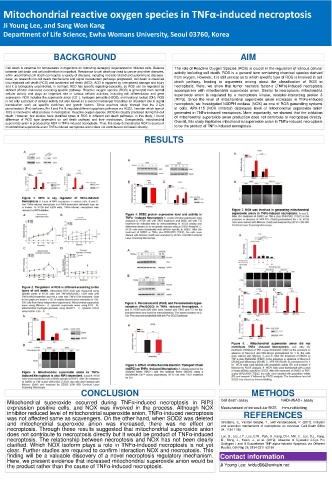
   Cell death is essential for homeostasis in organisms on removing damaged, degenerated or infected cells. Balance  The role of Reactive Oxygen Species (ROS) is crucial in the regulation of various cellular
   between cell death and cell proliferation is important. Resistance to cell death can lead to cancer and other diseases,  activity including cell death. ROS is a general term containing chemical species derived
   while uncontrolled cell death can lead to a variety of diseases, including necrotic-related and autoimmune diseases.  from oxygen. However, it is still unclear as to which specific type of ROS is involved in cell
   Later, as research into cell death mechanisms and signal transduction pathways progressed, cell death is classified
   into regulated cell death (RCD) and accidental cell death (ACD). ACD is triggered by unexpected damage and injury  death pathway, leading to arguments arising about the classification of ROS in
   and it is biologically uncontrolled. In contrast, RCD has specific signaling cascades, so RCD can be regulated by  necroptosis. Here, we show that tumor necrosis factor-α (TNFα)-induced necroptosis
   defined effector molecules executing specific pathway. Reactive oxygen species (ROS) is generated from normal  accompanies with mitochondrial superoxide anion. Similar to necroptosis, mitochondria
   cellular activity and plays an important role in various cellular activities, including cell differentiation and gene  superoxide anion is regulated by a necroptosis kinase, receptor-interacting protein 3
   expression. ROS includes the superoxide anion (O2˙ˉ), hydrogen peroxide (H2O2), and hydroxyl radical (OH). ROS  (RIP3). Since the level of mitochondrial superoxide anion increases in TNFα-induced
   is not only a product of cellular activity but also known as a second messenger that plays an important role in signal
   transduction such as specific cytokines and growth factors. Since previous study showed that the 2-Cys  necroptosis, we investigated NADPH oxidase (NOX) as one of ROS generating systems
   peroxiredoxin (Prx) isoforms, Prx I and Prx II, regulate different apoptosis pathways via H2O2, I wonder which type of  in cells. APX-115 (NOX inhibitor) decreases level of mitochondrial superoxide anion
   ROS is involved in what process in necroptosis. Reactive oxygen species (ROS) is robustly produced during the cell  generated in TNFα-induced necroptosis. More importantly, we showed that the inhibition
   death. However, few studies have identified types of ROS in different cell death pathways. In this study, I found  of mitochondrial superoxide anion production does not contribute to necroptosis directly.
   difference of ROS type dependent on cell death pathway and their mechanism. Unexpectedly, mitochondrial  Overall, this study implicates mitochondrial superoxide anion in TNFα-induced necroptosis
   superoxide anion is produced by NOX in TNFα-induced necroptosis. Thus, this study demonstrates NOX is source of
   mitochondrial superoxide anion TNFα-induced necroptosis and it does not contribute to cell death directly.  to be the product of TNFα-induced necroptosis.
                                                RESULTS


                           CONCLUSION                                              METHODS
   Mitochondrial superoxide occurred during TNFα-induced necroptosis in RIP3  Cell death assay  NADH/NAD+ assay
   expression positive cells, and NOX was involved in the process. Although NOX  Measurement of intracellular ROS  Immunoblotting
   inhibitor reduced level of mitochondrial superoxide anion, TNFα-induced necroptosis  REFERENCES
   was not affected same as scavengers. On the other hand, when SOD2 was deleted
   and mitochondrial superoxide anion was increased, there was no effect on  Grootjans, S., Vanden Berghe, T., and Vandenabeele, P. (2017). Initiation
                                                                         and execution mechanisms of necroptosis: an overview. Cell Death Differ
   necroptosis. Through these results suggested that mitochondrial superoxide anion  24, 1184-1195.
   does not contribute to necroptosis directly but it would be product of TNFα-induced  Lee, S., Lee, J.Y., Lee, E.W., Park, S., Kang, D.H., Min, C., Lee, D.J., Kang,
   necroptosis. The relationship between necroptosis and NOX has not been clearly  D., Song, J., Kwon, J., et al. (2019). Absence of Cytosolic 2-Cys Prx
   clarified. Which NOX isoform plays a role in TNFα-induced necroptosis is not yet  Subtypes I and II Exacerbates TNF-alpha-Induced Apoptosis via Different
   clear. Further studies are required to confirm interaction NOX and necroptosis. This  Routes. Cell Rep 26, 2194-2211 e2196
   finding will be a valuable discovery of a novel necroptosis regulatory mechanism.  Contact information
   Here, we present evidence that increased mitochondrial superoxide anion would be
   the product rather than the cause of TNFα-induced necroptosis.        Ji Young Lee: lwldud96@ewhain.net

