


Page 123 - D. Cancer biology
P. 123
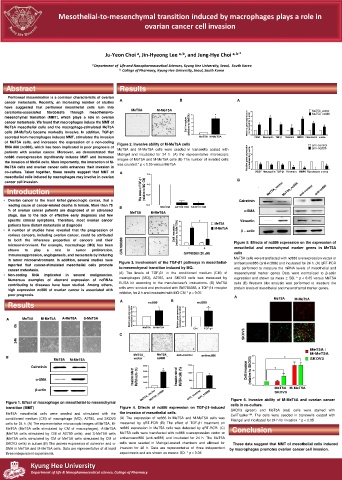
Mesothelial-to-mesenchymal transition induced by macrophages plays a role in
                                                   ovarian cancer cell invasion


                                      Ju-Yeon Choi  , Jin-Hyeong Lee  a, b , and Jung-Hye Choi  a, b *
                                                 a
                                 a  Department of  Life and Nanopharmaceutical Sciences, Kyung Hee University, Seoul,  South Korea
                                           b  College of Pharmacy, Kyung Hee University, Seoul, South Korea

   Abstract                                Results
                                            Conclusion
    Peritoneal dissemination is a common characteristic of ovarian
   cancer metastasis. Recently, an increasing number of studies  A  B               A
   have suggested that peritoneal mesothelial cells turn into
   carcinoma-associated  fibroblasts  through  mesothelial-to-  MeT5A  M-MeT5A          5                     MeT5A_vector
                                                                                                              MeT5A_nc886
   mesenchymal transition (MMT), which plays a role in ovarian     10 8     *           4      *          *
   cancer metastasis. We found that macrophages induce the MMT of   6                  Relative gene expression  normalized by β-actin  3  *  *  *
   MeT5A mesothelial cells and the macrophage-stimulated MeT5A    Cell invasion  (relative to MeT5A)  4  2  *     *
   cells (M-MeT5A) became markedly invasive. In addition, TGF-β1    2                   1
   secreted from macrophages induces MMT, stimulates the invasion   0  MeT5A M-MeT5A    0  VEGF  Neuropilin TGF-β   Vimentin  MMP2 Fibronectin α-sma
   of MeT5A cells, and increases the expression of a non-coding  Figure 2. Invasive ability of M-MeT5A cells
   RNA 886 (nc886), which has been implicated in poor prognosis of  MeT5A and M-MeT5A cells were seeded in transwells coated with  3  anti-control
                                                                                                              anti-nc886
   patients with ovarian cancer. Moreover, we demonstrated that  Matrigel and incubated for 24 h. (A) the representative microscopic
   nc886 overexpression significantly induces MMT and increases  images of MeT5A and M-MeT5A cells (B) The number of invaded cells  Relative gene expression  0 normalized by β-actin  2
   the invasion of Met5A cells. More importantly, the interaction of M-  was counted.* p < 0.05 versus MeT5A  1  *  *  *  *
   MeT5A cells and ovarian cancer cells enhances their invasion in                                     *   *   *
   co-culture. Taken together, these results suggest that MMT of  A  1.5                  VEGF Neuropilin TGF-β  Vimentin MMP2 Fibronectin α-sma
   mesothelial cells induced by macrophages may involve in ovarian
   cancer cell invasion.                            1.0                             B
   Introduction                                   The levels of TGF-β1  (relative to MQ  CM)
   Introduction
  • Ovarian cancer is the most lethal gynecologic cancer, that a  0.5               Calretinin
    leading cause of cancer-related deaths in female. More than 75  0.0  MQ CM  A2780 CM  SKOV3 CM
    % of ovarian cancer patients are diagnosed at an advanced  B  MeT5A  M-MeT5A      α-SMA
    stage, due to the lack of effective early diagnosis and few
    specific clinical symptoms. Therefore, most ovarian cancer  10    *              Vimentin
    patients have distant metastasis at diagnosis               8           MeT5A
  • A number of studies have revealed that the progression of   6           M-MeT5A  β – actin
    various cancers, including ovarian cancer, could be attributed  Cell invasion  (relative to MeT5A)  4
    to both the inherence properties of cancers and their       2                  Figure 5. Effects of nc886 expression on the expression of
    microenvironment. For example, macrophage (MQ) has been  GW788388  0  -  +     mesothelial and mesenchymal marker genes in MeT5A
    shown  to  play  a  role  in  tumor  proliferation,
    immunosuppression, angiogenesis, and metastasis by inducing  GW788388 (20 µM)  cells
    in tumor microenvironment. In addition, several studies have                   MeT5A cells were transfected with nc886 overexpression vector or
    reported that cancer-stimulated mesothelial cells promote  Figure 3. Involvement of the TGF-β1 pathways in mesothelial-  antisensenc886 (anti-nc886) and incubated for 24 h. (A) qRT-PCR
    cancer metastasis.                    to-mesenchymal transition induced by MQ.  was performed to measure the mRNA levels of mesothelial and
  • Non-coding  RNA  implicated  in  several  malignancies.  (A) The levels of TGF-β1 in the conditioned medium (CM) of  mesenchymal marker genes Data were normalized to β-actin
    Numerous examples of aberrant expression of ncRNAs  macrophages (MQ), A2780, and SKOV3 cells was measured by  expression and shown as mean ± SD. * p < 0.05 versus MeT5A
    contributing to diseases have been studied. Among others,  ELISA kit according to the manufacturer's instructions. (B) MeT5A  cells (B) Western blot analysis was performed to measure the
    high expression nc886 of ovarian cancer is associated with  cells were seeded and pretreated with GW788388, a TGF-β1 receptor  protein levels of mesothelial and mesenchymal marker genes.
    poor prognosis.                       inhibitor, for 2 h and incubated with MQ-CM * p < 0.05  A  MeT5A  M-MeT5A
    Results                                A   2.0   nc886  *  B  2.0  nc886  *


   A     MeT5A  M-MeT5A  A-MeT5A  S-MeT5A     Relative gene expression  normalized by 18s rRNA  1.5 1.0 0.5  Relative gene expression  normalized to 18s rRNA  1.5 1.0 0.5
       0h                                      0.0  MeT5A  M-MeT5A  0.0  Ctrl  TGF-β1
                                           C                                          SKOV3
       24h
                                                                                                             MeT5A /
                                                MeT5A_  MeT5A_  anti-control   anti-nc886   8                M-MeT5A
   B                MeT5A  M-MeT5A              vector   nc886                                      *        SKOV3
            Calretinin                             800    *       150                  Cell invasion  (relative to SKOV3)  6 4  *
                                               Invasion rate of  MeT5A cells  (%)  400  Invasion rate of  MeT5A cells  (%)  100  *
                                                   600
             α-SMA                                 200             50                    2
             β-actin                                0              0                     0       MeT5A  M-MeT5A
                                                  MeT5A_vector    anti_control anti_nc886
                                                     MeT5A_nc886
                                                                                                 SKOV3
   Figure 1. Effect of macrophage on mesothelial-to-mesenchymal                  Figure 6. Invasive ability of M-MeT5A and ovarian cancer
                                                                                 cells in co-culture.
   transition (MMT)                        Figure 4. Effects of nc886 expression on TGF-β1-induced  SKOV3 (green) and MeT5A (red) cells were stained with
   MeT5A mesothelial cells were seeded and stimulated with the  the invasion of mesothelial cells.  CellTracker TM . The cells were seeded in transwells coated with
   conditioned medium (CM) of macrophage (MQ), A2780, and SKOV3  (A) The expression of nc886 in MeT5A and M-MeT5A cells was  Matrigel and incubated for 24 h for invasion. * p < 0.05
   cells for 24 h. (A) The representative microscopic images of MeT5A, M-  measured by qRT-PCR (B) The effect of TGF-β1 treatment on
   MeT5A (MeT5A cells stimulated by CM of macrophages), A-MeT5A  nc886 expression in MeT5A cells was detected by qRT-RCR. (C)  Conclusion
   (MeT5A cells stimulated by CM of A2780 cells), and S-MeT5A cells  MeT5A cells were transfected with nc886 overexpression vector or
   (MeT5A cells stimulated by CM of MeT5A cells stimulated by CM of  antisensenc886 (anti-nc886) and incubated for 24 h. The MeT5A
   SKOV3 cells) in culture.(B) The protein expression of calretinin and α-  cells were seeded in Matrigel-coated chambers and allowed for  These data suggest that MMT of mesothelial cells induced
   SMA in MeT5A and M-MeT5A cells. Data are representative of at least  invasion for 48 h. Data are representative of three independent  by macrophages promotes ovarian cancer cell invasion.
   three independent experiments.          experiments and are shown as mean± SD. * p < 0.05
            Kyung Hee University
            Department of Life & Nanopharmaceutical science, College of Pharmacy

