


Page 121 - D. Cancer biology
P. 121
The role of senescent tumor cells in colorectal cancer progression
                                             1
                                                                        2,4
                                                                                       3
                                                            1,2
                                                                                                    4
                            1,2
               1,2
  Soon Sang Park , Ga-Yeon Lee , Young-Kyoung Lee , Young-Sam Kim , Tae-Gyu Kim , Yong Won Choi , Jang-Hee Kim and Tae
  Jun Park 1,2,5
                                                      2
   1 Department of Biochemistry and Molecular Biology, Ajou University School of Medicine; Department of Biomedical Sciences, Ajou University Graduate School of Medicine;
                                              4
   3 Department of Hematology-Oncology, Ajou University School of Medicine; Department of Pathology, Ajou University School of Medicine;
   5 Institute on Aging, Ajou University Medical Center, Suwon, 16499, Korea
   Corresponding author : Tae Jun Park, park64@ajou.ac.kr
                   BACKGROUND                                                  AIM
   Cellular senescence is historically considered to be an essential  These findings suggest senescent tumor cells generate a
   anticarcinogenic barrier in normal cells. Nonetheless, senescent  cytokine barrier protecting non-senescent tumor cells from
   tumor cells have been found not only in premalignant tumors but  immune attack and provide a new target for overcoming the
   also in developed malignant tumors. In a previous study,  immunotherapy resistance of CRC.
   senescent tumor cells play an important role in cancer
   progression. This observation led to the hypothesis that
   senescent tumor cells participate in immune cell infiltration.
                                                METHODS
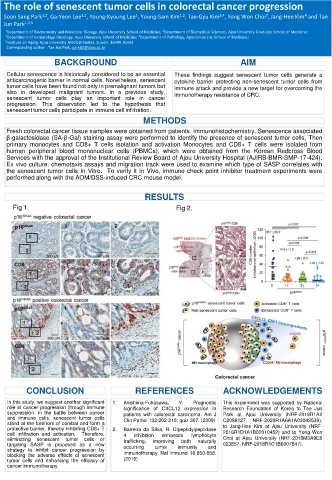
   Fresh colorectal cancer tissue samples were obtained from patients. Immunohistochemistry, Senescence associated
   β-galactosidase (SA-β-Gal) staining assay were performed to identify the presence of senescent tumor cells, Then
   primary monocytes and CD8+ T cells isolation and activation Monocytes and CD8+ T cells were isolated from
   human peripheral blood mononuclear cells (PBMCs), which were obtained from the Korean Redcross Blood
   Services with the approval of the Institutional Review Board of Ajou University Hospital (AJIRB-BMR-SMP-17-424).
   Ex vivo culture, chemotaxis assays and migration track were used to examine which type of SASP correlates with
   the senescent tumor cells In Vitro. To verify it In Vivo, immune check point inhibitor treatment experiments were
   performed along with the AOM/DSS-induced CRC mouse model.


                                                RESULTS
     Fig 1.                                               Fig 2.


          CONCLUSION                         REFERENCES                   ACKNOWLEDGEMENTS

   In this study, we suggest another significant  1.  Akishima-Fukasawa,  Y.  Prognostic  This experiment was supported by National
   role in cancer progression through immune  significance of CXCL12 expression in  Research Foundation of Korea to Tae Jun
   suppression. In the battle between cancer  patients with colorectal carcinoma. Am J  Park at Ajou University (NRF-2019R1A2
   and immune cells, senescent tumor cells  Clin Pathol 132:202-210; quiz 307. (2009)  C2086127,  NRF-2020R1A6A1A03043539),
   stand at the forefront of combat and form a
   protective barrier, thereby inhibiting CD8+ T  2.  Barreira da Silva, R. Dipeptidylpeptidase  to Jang-Hee Kim at Ajou University (NRF-
   cell infiltration and activation.  Therefore,  4  inhibition  enhances  lymphocyte  2016R1D1A1B02010452) and to Yong Won
   eliminating  senescent  tumor  cells  or  trafficking,  improving  both  naturally  Choi at Ajou University (NRF-2018M3A9E8
   targeting SASP is proposed as a new   occurring  tumor  immunity  and  023857, NRF-2018R1C1B6007847).
   strategy to inhibit cancer progression by
   blocking the adverse effects of senescent  immunotherapy. Nat Immunol 16:850-858.
   tumor cells and enhancing the efficacy of  (2015)
   cancer immunotherapy.

