


Page 117 - D. Cancer biology
P. 117
Activation of the Sympathetic Nerve System Weakens Anti-Tumoral Immunity
                via Beta 2 Adrenergic Receptors in Osteoblast and Myeloid-Derived Suppressor Cells,
                                     Contributing to Bone Metastasis Progression
                                                                  1
                                                      1
                                           Eun Jung Lee , Kyoung Jin Lee , Serk In Park 1
                     1 Department of Biochemistry and Molecular Biology, Korea University College of Medicine, Seoul, Korea
   Background & Aim
    Bone metastasis is the most significant factor affecting the patient survival of breast cancer patients, but no cure or preventive approaches are currently available. One factor that potentially affects
    metastatic bone microenvironment is the sympathetic nerve system (SNS). The SNS regulates bone homeostasis via β2 adrenergic receptor (AR) on osteoblasts, and subsequently chronic stress-
    induced SNS activation was shown to promote bone metastasis tumor growth, osteolysis, angiogenesis by osteoblastic cytokine expression in immunocompromised mouse models. On the other hand,
    we previously demonstrated that osteoblast activation could lead to myeloid-derived suppressor cells (MDSC) activation, contributing to orthotopic prostate tumor growth. Therefore, we further
    investigated the effects of SNS activation on immune cells via β2 AR on osteoblasts in the bone microenvironment using immune-competent mouse models of breast cancer bone metastasis.
   Methods
    A chronic immobilization stress (CIS) mouse model, one of the well-established models for the sympathetic nerve system activation in mice, was used. Mice were challenged with daily two-hour CIS
    and tumor cells were implanted in the tibia on day-15. To block the SNS activation, a chemical selective inhibitor of β2 AR was used. At the endpoint analysis, tumors measured by bioluminescence
    imaging. Tumor bearing tibia, tumor-naïve tibia or spleen were pulverized and performed flow cytometry. Additionally, to confirm the effects on MDSCs by β2 AR -stimulated osteoblast in vitro, we
    cocultured both bone marrow cells and osteoblasts containing with or without β2 AR agonist, isoproterenol and then performed RT-qPCR on bone marrow cells.
   Results
    A.                             B.                1  A.                        B.          C.         3
           CIS ± ICI or Vehicle Tx (25 d.)                                            P>0.05       P>0.05
                                         P<0.05                                           P>0.05      P>0.05
                                            P<0.05            CIS ± ICI or Vehicle  30           95
                          Bioluminescence
     Balb/c mice  14 d.  11 d.         30
                           (Tumor Size)  25              Balb/c   14 d.  Bioluminescence &  20   90
                                                                                    15
                                       15
               4T1 intra-tibial        20                mice             Flow Cytometry  ×10 4 Photon/S 25  % CD45 + cells  85
                tumor inj.            ×10 8 Photon/S  10   4T1 intra-tibial         10           80
        Chronic   Con                  5                    tumor inj.               5           75
      Immobilization                                                                 0  Con Veh ICI  70  Con Veh ICI
       Stress (CIS)                    0
      2 hours daily  Veh                 Con Veh ICI                                      CIS          CIS
                CIS                         CIS
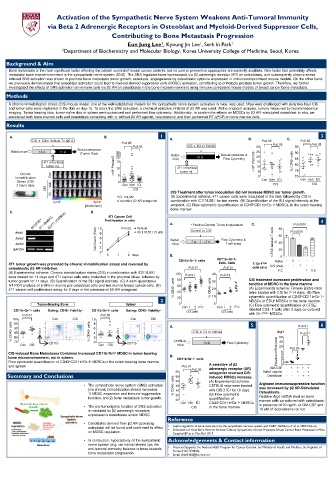
                  ICI                                    CIS Treatment after tumor inoculation did not increase MDSC nor tumor growth.
                                       *ICI 118,551      (A) Experimental scheme. 4T1 cancer cells were inoculated in the tibia followed by CIS in
                  1x10 6       5x10 7   A selective β2 AR antagonist  combination with ICI118,551 for two weeks. (B) Quantification of the BLI signal intensity at the
                             [photon/sec]                endpoint. (C) Flow cytometric quantification of CD45 + CD11b + Gr-1 + MDSCs, in the tumor bearing
                                                         bone marrow.
    C.                         D.
                                    4T1 Cancer Cell
                                   Proliferation in vitro                                                4
                                                        A.     * Positive Control: Tumor Implantation  C.  P<0.0001
                                              ICI 118,551 (5 μM)
      Adrb1                      10 8   P˃0.05  Vehicle        Control or CIS               80  P<0.0001
      Adrb2                     Cell Count (Fold)  6    Balb/c           Flow Cytometry &   60
      Adrb3                      4                       mice  7 d.  +7 d.  T cell assay  CFSE-labeled T cells  %  40
     GAPDH                       2                                                          20
                                 0
                                    0  1   2 days       B.                                  0
                                                           CD11b + Gr-1 +  cells  CD11b+Gr-1+  Naïve  -  1      -  -  -
    4T1 tumor growth was promoted by chronic immobilization stress and reversed by   EdU+ Cells  T/ Gr-1 high   CIS (2wk) -  -  1      -  -
    osteoblastic β2 AR inhibition.                            P<0.01      P<0.01   cells ratio  -  -  1     0.5
    (A) Experimental scheme. Chronic immobilization stress (CIS) in combination with ICI118,551   100  40  P.C -
    were treated for 14 days and 4T1 cancer cells were implanted in the proximal tibiae, followed by   P<0.01  P<0.01
    tumor growth for 11 days. (B) Quantification of the BLI signal intensity  (C) A semi-quantitative   80  30  CIS treatment increased proliferation and
    RT-PCR analysis of β-ARs in murine pre-osteoblast cells and two murine breast cancer cells. (D)   60  function of MDSC in the bone marrow
    4T1 cancer cell proliferation assay for 2 days in the presence of β2-AR antagonist.  % CD45 + cells  40  % CD45 + cells  20  (A) Experimental scheme. Female Balb/c mice
                                                                                  were treated with CIS for 7-14 days. (B) Flow
                                                     2     20         10          cytometric quantification of CD45 + CD11b + Gr-1 +
                                                                                  MDSCs or EDU + MDSCs in the bone marrow.
             Tumor-Bearing Bone           Spleen           0           0          (C) Flow cytometric quantification of CFSE-
                                                            Con 1  2 P.C  Con 1  2 P.C
     CD11b + Gr-1 +  cells  Gating: CD45 +  Viability +  CD11b + Gr-1 +  cells  Gating: CD45 +  Viability +  CIS (wk)  CIS (wk)  labelled CD3 + T cells after 3 days co-cultured
        P<0.01                    P>0.05                                          with Gr-1 high+  MDSCs.
     100          Con    CIS   10 8         Con   CIS                              5                     6
      95
     % CD45 + cells  90  Gr-1  % CD45 + cells  6 4 2  Gr-1  A.  CIS ± ICI or Vehicle       Arg1   P<0.01
      85
                                                                                                   P<0.01
      80
      75
        Con  CIS  CD11b         0  Con  CIS  CD11b        C57BL/6   10 d.  Flow Cytometry   40  P<0.05
                                                           mice
                                                                                            20
    CIS-induced Bone Metastases Contained Increased CD11b + Gr1 + MDSC in tumor-bearing    Relative mRNA level 60 5 4
    bone microenvironment, not in spleen.               B.  CD11b + Gr-1 +  cells           3 2
    Flow cytometric quantification of CD45 + CD11b + Gr-1 + MDSCs in the tumor bearing bone marrow   1
    and spleen.                                             P<0.01   A selective of β2   GM-CSF 0  -  +     +    +    +
                                                                     adrenergic receptor (AR)
                                                          60   P<0.05  antagonist reversed CIS-  Adrb2 agonist  -  -  +     -  +
   Summary and Conclusions                                55         induced MDSCs increase.  Osteoblast  -  -  -  +    +
                            • The sympathetic nerve system (SNS) activation   % CD45 + cells  50  (A) Experimental scheme.   Arginase immunosuppressive function
                                                                     C57BL/6 mice were treated
                                                          45
                              (via chronic immobilization stress) increases  40  with CIS±ICI for 10 days.   was increased by β2 AR-Stimulated
                              1) MDSC expansion and immuno-suppressive   35  (B) Flow cytometric   Osteoblasts.
                              function; and 2) bone metastasis tumor growth.  30  quantification of   Relative Arg1 mRNA level on bone
                                                            Con Veh ICI  CD45 + CD11b + Gr-1 + MDSCs   marrow cells co-cultured with osteoblasts
                            • The pro-tumorigenic function of SNS activation   CIS  in the bone marrow.   in presence of 20 ng/mL of GM-CSF and
                              is mediated by β2 adrenergic receptors                 10 uM of isoproterenol or not.
                              expressed in osteoblasts and/or MDSC.
                                                        Reference
                            • Candidates derived from β2 AR-activating
                              osteoblast will be found and confirmed its effect   • •  Leptin regulation of bone resorption by the sympathetic nervous system and CART. Elefteriou F et al. 2005 Nature.
                                                         Stimulation of Host Bone Marrow Stromal Cells by Sympathetic Nerves Promotes Breast Cancer Bone Metastasis in Mice.
                              on MDSC regulation.        Campbell JP et al. Plos Biol 2012
                            • In conclusion, hyperactivity of the sympathetic   Acknowledgements & Contact information
                              nerve system (e.g. via mental stress) tips the
                              anti-tumoral immunity balance in bone towards   •  Financial Supports: the National R&D Program for Cancer Control, the Ministry of Health and Welfare, the Republic of
                              bone metastasis progression.  •  Korea (HA17C0040).
                                                         Email: ejlee3365@korea.ac.kr

