


Page 5 - B.Bioinformatics and systems biology
P. 5
A bioinformatic approach to the identification of
    genetic markers for idiopathic pulmonary fibrosis (IPF)

                                   2
            1
                        1
    Sungmin Park , Seungmin Song , Junghyun Jung , Jong Wha J. Joo 1*
    1 Department of Computer Science and Engineering, Dongguk University-Seoul, 04620 Seoul, South Korea
    2 Department of Life Science, Dongguk University-Seoul, 04620 Seoul, South Korea
  Abstract
   Idiopathic pulmonary fibrosis is one of the chronic and fatal interstitial lung diseases. IPF generally shows poor prognosis, and their exact
   pathogenesis and casualties are not clearly revealed yet. RNA sequencing and microarray experiments enable the determination of genes
   whose expression levels are significantly different in IPF disease group compared with the healthy control group. Total 749 genes were
   identified as differentially expressed genes in both two data sets via (P-value < 0.05) via oligo, limma, and DESeq R packages. Among total
   DEGs, 453 genes were significantly up-regulated genes and 250 genes were down-regulated genes. In order to confirm the systemic functions
   of the obtained DEGs, we performed gene set enrichment analysis and functional annotation by database for Annotation, Visualization, and
   Integrated Discovery.
  Methods & Materials                                           Table 1. Table of dataset used in this study,.
   -Pre-processing and Meta analysis                               Type       Express ID   Source  IPF/Control
   Pre-processing of datasets were performed using oligo, limma, DESeq       E-GEOD-24206            17/6
   Bioconductor  package,  and  the  robust  multiarray  average  (RMA)
   normalization method was used -for normalizing each microarray dataset    E-GEOD-21369            23/6
   separately.                                                   Microarray                Lung
                                                                             E-GEOD-71351            8/4
   -Gene Set Enrichment Analysis                                                           tissue
   Gene set enrichment analysis (GSEA) is a computational method that        E-GEOD-44723            10/4
   determines whether an a priori defined set of genes shows statistically
   significant.                                                   RNA-Seq     GSE134692             54/26
                                                                   Total          -          -      112/46
   RESULTS
                                                                  -Data Collection and identifying Differentially Expressed
                                                                  Genes by Meta-Analysis
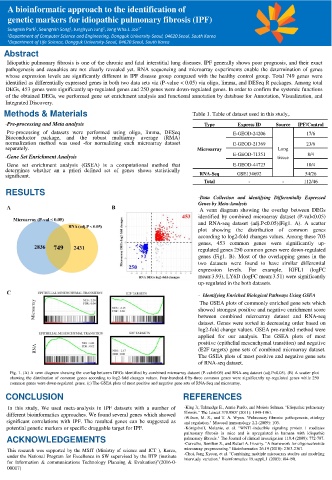
                                                                  A venn diagram showing the overlap between DEGs
                                                                  identified by combined microarray dataset (P-val<0.05)
                                                                  and RNA-seq dataset (adj.P<0.05)(Fig1. A). A scatter
                                                                  plot showing the distribution of common genes
                                                                  according to log2-fold changes values. Among these 703
                                                                  genes, 453 common genes were significantly up-
                                                                  regulated genes 250 common genes were down-regulated
                                                                  genes (Fig1. B). Most of the overlapping genes in the
                                                                  two datasets were found to have similar differential
                                                                  expression  levels.  For  example,  IGFL1  (logFC
                                                                  mean:3.93), LY6D (logFC mean:3.51) were significantly
                                                                  up-regulated in the both datasets.
                                                                  - Identifying Enriched Biological Pathways Using GSEA
                                                                  The GSEA plots of commonly enriched gene sets which
                                                                  showed strongest positive and negative enrichment score
                                                                  between combined microarray dataset and RNA-seq
                                                                  dataset. Genes were sorted in decreasing order based on
                                                                  log2-fold change values. GSEA pre-ranked method were
                                                                  applied for our analysis. The GSEA plots of most
                                                                  positive (epithelial mesenchymal transition) and negative
                                                                  (E2F targets) gene sets of combined microarray dataset.
                                                                  The GSEA plots of most positive and negative gene sets
                                                                  of RNA-seq dataset.
    Fig. 1. (A) A venn diagram showing the overlap between DEGs identified by combined microarray dataset (P-val<0.05) and RNA-seq dataset (adj.P<0.05). (B) A scatter plot
    showing the distribution of common genes according to log2-fold changes values. Four-hundred-fifty-three common genes were significantly up-regulated genes while 250
    common genes were down-regulated genes. (c) The GSEA plots of most positive and negative gene sets of RNA-Seq and microarray.

   CONCLUSION                                                REFERENCES
    In this study, We used meta-analysis in IPF datasets with a number of  -King Jr, Talmadge E., Annie Pardo, and Moisés Selman. "Idiopathic pulmonary
   different bioinformatics approaches. We found several genes which showed  fibrosis." The Lancet 378.9807 (2011): 1949-1961.
                                                             -Wilson, M. S., and T. A. Wynn. "Pulmonary fibrosis: pathogenesis, etiology
   significant correlations with IPF. The resulted genes can be suggested as  and regulation." Mucosal immunology 2.2 (2009): 103.
   potential genetic markers or specific druggable target for IPF.  -Königshoff, Melanie, et al. "WNT1-inducible signaling protein–1 mediates
                                                             pulmonary fibrosis in mice and is upregulated in humans with idiopathic
   ACKNOWLEDGEMENTS                                          pulmonary fibrosis." The Journal of clinical investigation 119.4 (2009): 772-787.
                                                             -Carvalho, Benilton S., and Rafael A. Irizarry. "A framework for oligonucleotide
   This research was supported by the MSIT (Ministry of science and ICT ), Korea,  microarray preprocessing." Bioinformatics 26.19 (2010): 2363-2367.
   under the National Program for Excellence in SW supervised by the IITP (institute  -Choi, Jung Kyoon, et al. "Combining multiple microarray studies and modeling
                                                             interstudy variation." Bioinformatics 19.suppl_1 (2003): i84-i90.
   for Information & communications Technology Planning & Evaluation)”(2016-0-
   00017)

