


Page 5 - A. Aging
P. 5
Protective Effect of Capsicum annuum L. (Paprika) Extract Fermented by L. plantarum
                        on Sodium Iodate-Induced Acute Retinal Degeneration in Mice
                                                                       1
                                                            2
                                                                                             1
                                                                                 1
                             1
                Ha-Rim Kim , Sol Kim , Sang-Jun Kim , Sang-Wang Lee , Hong-Sig Sin ,  Seung-Il Jeong , Kang-Yeol Yu , Seon-Young Kim *
                       1
                                                   2
                                       1
                                 1 Jeonju Agro-Biomaterials Institute, Jeonju, 54810, Republic of Korea
                                      2 Chebigen Co. Ltd, Jeonju, 54853, Republic of Korea
              BACKGROUND & AIM                                            METHODS
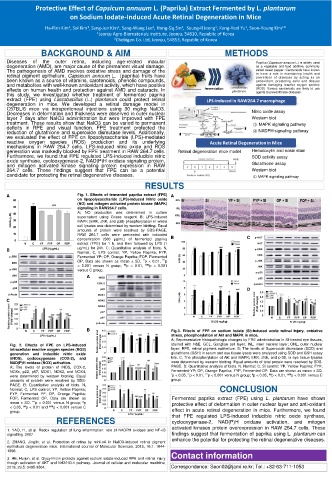
   Diseases  of  the  outer  retina,  including  age-related  macular               Paprika (Capsicum annuum L.) is widely used
   degeneration (AMD), are major cause of the permanent visual damage.              as a vegetable and food additive, commonly
   The pathogenesis of AMD involves oxidative stress and damage of the              called sweet pepper. Carotenoids have known
                                                                                    to have a role in maintaining health and
   retinal pigment epithelium. Capsicum annuum L. (paprika) fruits have             prevention of diseases by acting as an
   been known as a source of vitamins, carotenoids, phenolic compounds,             antioxidant, protecting cells and tissues
   and metabolites with well-known antioxidant activity, which have positive  Lactobacillus   against damaging reactive oxygen species
   effects on human health and protection against AMD and cataracts. In  fermentation  plantarum  (ROS). Various carotenoids are likely to use
                                                                                    agents to prevent these diseases.
   this study, we investigated whether treatment of fermented paprika
   extract (FPE) using Lactobacillus (L.) plantarum could protect retinal  LPS-induced in RAW264.7 macrophage
   degeneration in mice. We developed a retinal damage model in
   C57BL/6 mice via intraperitoneal injections using 30 mg/kg NaIO3.               Nitric oxide assay
   Decreases in deformation and thickness were observed in outer nuclear
   layer 7 days after NaIO3 administration but were improved with FPE              Western blot
   treatment. These results show that NaIO3 can be varied to permanent             ① MAPK signaling pathway
   deficits in RPE and visual function. FPE treatment protected the
   reduction of glutathione and superoxide dismutase levels. Additionally,         ② NADPH signaling pathway
   we evaluated the effect of FPE on lipopolysaccharide (LPS)-mediated
   reactive  oxygen  species  (ROS)  production  and  its  underlying  Acute Retinal Degeneration in Mice
   mechanisms in RAW 264.7 cells. LPS-induced nitric oxide and ROS
   generation was markedly blocked by FPE treatment in RAW 264.7 cells.  Retinal degeneration mice model  Hematoxylin and eosin stain
   Furthermore, we found that FPE regulated LPS-induced inducible nitric           SOD activity assay
   oxide synthase, cyclooxygenase-2, NAD(P)H oxidase signaling protein,
   and mitogen activated kinase signaling protein expression in RAW                Glutathione assay
   264.7 cells. These findings suggest that FPE can be a potential                 Western blot
   candidate for protecting the retinal degenerative diseases.                     ① MAPK signaling pathway
                                                RESULTS
   A                      Fig. 1. Effects of fermented paprika extract (FPE)  A
                          on lipopolysaccharide (LPS)-induced Nitric oxide
                          (NO) and mitogen activated protein kinase (MAPK)
                          signaling in RAW264.7 cells.
                          A;  NO  production  was  determined  in  culture
                          supernatant using Griess reagent. B; LPS-induced
                          MAPK (ERK, JNK, and p38) phosphorylation in whole
                          cell lysates was determined by western blotting. Equal
                          amounts of protein were resolved by SDS-PAGE.
                          RAW 264.7 cells were pretreated with indicated
                          concentration (500 μg/mL) of fermented paprika  B      C
                          extract (FPE) for 1 h, and then followed by LPS (1
                          μg/mL) for 24h. C; Quantitative analysis of blots. N,
   B
                          Normal; C, LPS control; YP, Yellow Paprika; FYP,
                          Fermented YP; OP, Orange Paprika; FOP, Fermented
                          OP. Data are shown as mean ± SD. ** p < 0.01, *** p
                          < 0.001 versus N group; ## p < 0.01, ### p < 0.001
                          versus C group.
                             A
                                                                                 D
   C
                             B                           Fig.3. Effects of FPE on sodium iodate (SI)-induced acute retinal injury, oxidative
                                                         stress, phosphorylation of Akt and MAPK in mice.
                                                         A; Representative histopathologic changes by FRE administration in SI-treated eye tissues,
    Fig. 2. Effects of FPE on LPS-induced                stained with H&E. GCL, Ganglion cell layer; INL, inner nuclear layer; ONL, outer nuclear
    intracellular reactive oxygen species (ROS)          layer; RPE, retinal pigment epithelium. B; The levels of Superoxide dismutase (SOD) and
    generation  and  inducible  nitric  oxide            glutathione (GSH) in serum and eye tissue lysate were analyzed using SOD and GSH assay
    (iNOS),  cyclooxygenase  (COX-2),  and               kits. C; The phosphorylation of Akt and MAPK; ERK, JNK, and p-38, in eye tissue lysates
    NAD(P)H oxidase (NOX) activation.                    were determined by western blotting. Equal amounts of total protein were resolved by SDS-
    A; The levels of protein of iNOS, COX-2,             PAGE. D; Quantitative analysis of blots. N, Normal; C, SI control; YP, Yellow Paprika; FYP,
    NOXs; p22, p67, MOX1, NOX2, and NOX4,                Fermented-YP; OP, Orange Paprika; FYP, Fermented-OP. Data are shown as mean ± SD.
    were determined by western blotting. Equal           * p < 0.05, ** p < 0.01, *** p < 0.001 versus N group; # p < 0.05, ## p < 0.01, ### p < 0.001 versus C
    amounts of protein were resolved by SDS-             group.
    PAGE. B; Quantitative analysis of blots. N,
    Normal; C, LPS control; YP, Yellow Paprika;                         CONCLUSION
    FYP, Fermented YP; OP, Orange Paprika;
    FOP, Fermented OP. Data are shown as                 Fermented paprika extract (FPE) using L. plantarum have shown
    mean ± SD. *** p < 0.001 versus N group; # p         protective effect of deformation in outer nuclear layer and anti-oxidant
    < 0.05, ## p < 0.01 and ### p < 0.001 versus C
    group.                                               effect in acute retinal degeneration in mice. Furthermore, we found
                                                         that FPE regulated LPS-induced inducible nitric oxide synthase,
                   REFERENCES                            cyclooxygenase-2,  NAD(P)H  oxidase  activation,  and  mitogen
                                                         activated kinases protein overexpression in RAW 264.7 cells. These
   1. YAO, H., et al. Redox regulation of lung inflammation: role of NADPH oxidase and NF-κB
   signalling. 2007.                                     findings suggest that fermentation of paprika using L. plantarum can
                                                         enhance the potential for protecting the retinal degenerative diseases.
   2. ZHANG, Jinglin, et al. Protection of retina by mini-αA in NaIO3-induced retinal pigment
   epithelium degeneration mice. International Journal of Molecular Sciences, 2015, 16.1: 1644-
   1656.
   3. HE, Huijun, et al. Glycyrrhizin protects against sodium iodate‐induced RPE and retinal injury Contact information
   though activation of AKT and Nrf2/HO‐1 pathway. Journal of cellular and molecular medicine,
   2019, 23.5: 3495-3504.                                Correspondence: Seon02@jami.re.kr; Tel.: +82-63-711-1053

