


Page 1 - A. Aging
P. 1
Ultrasound selectively stimulates senescent cells,
          promoting their removal by macrophage recruitment


                 In Woo Kim  1,2,# , Su Hyun Lee , Hyung Min Kim , Ki Joo Pahk , So Yeon Kim         1,2,*
                                                1,#
                                                                                     3
                                                                    2,3
                          ¹Center for Theragnosis, Biomedical Research Institute, Korea Institute of Science and Technology, Seoul 02792, Republic of Korea,
                      2 Division of Bio-Medical Science and Technology, KIST school, Korea University of Science and Technology (UST), Seoul 02792, Republic of Korea,
                            ³Center for Bionics, Biomedical Research Institute, Korea Institute of Science and Technology, Seoul 02792, Republic of Korea
                                                   # These authors contributed equally.
                   * Correspondence to: So Yeon Kim (e-mail: soyeonkim@kist.re.kr; telephone 82-2-958-5914; fax 82-2-958-5909),
                                    Hwarangno 14-gil 5, Seongbuk-gu, Seoul, Republic of Korea 02792
                 Abstract                                  Aim

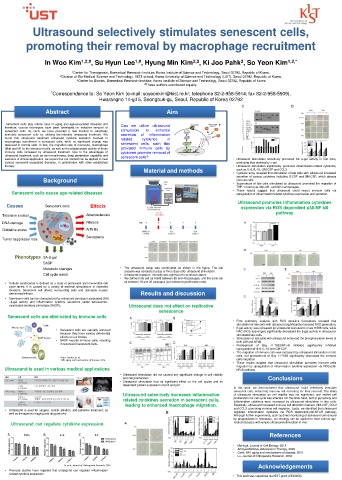
   Senescent cells play critical roles in aging and age-associated diseases and  Can we utilize ultrasound
   therefore, various techniques have been developed for selective removal of
   senescent cells. As such, we have provided a new method to selectively  stimulation  to  enhance
   stimulate senescent cells by utilizing low-intensity ultrasound treatment. We  secretion  of  inflammation
   found that ultrasound treatment enhanced cytokine secretion involved in  related  cytokines  in
   macrophage recruitment in senescent cells, while no significant change was
   observed in normal cells. In fact, the migration rate of monocyte, macrophage  senescent cells, such that
   (Mφ) and M1 to the senescent cells, as well as the phagocytosis activity of these  activated immune cells by
   immune cells increased by ultrasound treatment. Due to the advantages of  cytokines promote removal of
   ultrasound treatment, such as non-invasiveness, deep penetration capability and  senescent cells?
   easiness of clinical application, we expect that our method can be applied to treat  • Ultrasound stimulation selectively promoted SA β-gal activity in late cells,
   various senescent-associated diseases, in combination with other established    producing blue staining by x-gal.
   therapy.                                                                       • Ultrasound stimulation significantly promoted inflammation-related cytokines,
                                                   Material and methods           • Cytokine array revealed that stimulation of late cells with ultrasound increased
                                                                                   such as IL-6, IL-1β, GM-CSF and CCL3.
                                                                                   secretion of various cytokines including G-CSF and GM-CSF, which attracts
                Background                                                         immune cells.
                                                                                  • Supernatant of late cells stimulated by ultrasound promoted the migration of
                                                                                   THP-1 monocyte, Mφ, M1, and M2 macrophages.
                                                                                  • These results suggest that ultrasound could recruit immune cells via
     Senescent cells cause age-related diseases                                    upregulation of inflammation related cytokines expression and secretion.
                                                                                    Ultrasound promotes inflammation cytokines
   Causes        Senescent cells  Effects                                            expression via ROS dependent p38-NF-kB
                                                                                                 pathway
  Telomere erosion             Atherosclerosis
  DNA damage                   Fibrosis
  Oxidative stress             Arthritis
                               Sarcopenia
  Tumor suppressor loss
      Phenotypes SA-β-gal
                SASP
                Metabolic changes          •  The ultrasound setup was constructed as shown in the figure. The cell
                                            analysis was conducted a day or three days after ultrasound stimulation.
                Cell cycle arrest          •  Ultrasound exposure intensity was optimized to as shown above.
                                           •  We defined late cell as HS68 between 38 and 43 passages, and the early cell
                                            as between 16 and 20 passages (see below for proliferation rate).
   •  Cellular senescence is defined as a state of permanent and irreversible cell
    cycle arrest. It is caused by a variety of external stimulations or repeated
    divisions. Senescent cell affects surrounding cells and ultimately causes
    detrimental effects.                          Results and discussion
   •  Senescent cells can be characterized by enhanced senescent associated (SA)
    –β-gal activity and inflammation cytokine secretions called senescence-
    associated secretory phenotype (SASP).    Ultrasound does not affect on replicative
                                                        senescence
    Senescent cells are eliminated by immune cells
                                                                                  • Flow cytometry analysis with ROS sensitive fluorophore revealed that
                                                                                   stimulation of late cells with ultrasound significantly increased ROS generation.
                                                                                  • β-gal activity was increased by ultrasound stimulation in late HS68 cells, while
                    •  Senescent cells are naturally removed                       NAC (ROS scavenger) significantly decreased the β-gal activity in ultrasound-
                      because they have various detrimental                        stimulated late cells.
                      effects on our bodies.
                    •  SASP recruits immune cells, resulting                      • Stimulation of late cells with ultrasound enhanced the phosphorylation levels of
                                                                                   both p38 and NFκB.
                      in removal of senescent cells.                              • Pretreatment  of  Bay  11-7802(NF-κB  inhibitor)  significantly  inhibited
                                                                                   upregulation of IL-6, IL-1β and GM-CSF.
                                                                                  • The migration of immune cells was increased by ultrasound stimulation in late
                                                                                   cells, but pretreatment of Bay 11-7082 significantly decreased the immune
                      Oishi, Yumiko, et al,
                      NPJ aging and mechanisms of disease, 2016                    cells migration.
                                                                                  • These results suggest that ultrasound stimulation promotes immune cells
                                                                                   migration by upregulation of inflammation cytokine expression via ROS-p38-
   Ultrasound is used in various medical applications                              NFκB pathway.
                                           • Ultrasound stimulation did not caused any significant change in cell viability
                                            and cell proliferation.                           Conclusions
                                           • Ultrasound stimulation had no significant effect on the cell cycles and its
                                            dependent protein expression of p16 and p21.
                                                                                  In this work, we demonstrated that ultrasound could selectively stimulate
                                                                                  senescent cells, enhancing immune cell recruiting for their removal. The effect
                                            Ultrasound selectively increases inflammation   of ultrasound stimulation on cell viability was not significant, and neither cell
                                            related cytokines secretion in senescent cells,   proliferation nor cell cycle was affected. On the other hand, both β-gal activity and
                                                                                  inflammation cytokines were increased by ultrasound stimulation in late cells.
                                             leading to enhanced macrophage migration.  Especially, ultrasound increased immune cell attraction markers, GM-CSF, CCL2
   •  Ultrasound is used for surgery, cancer ablation, and palliative treatment, as  and CCL3, promoting immune cell migration. Lastly, we identified that ultrasound
                                                                                  regulates inflammation cytokines via ROS dependent-p38-NF-kB pathway.
    well as therapeutic imaging and drug delivery.
                                                                                  Although further experiments, such as direct monitoring of senescent cell removal
                                                                                  by phagocytosis is necessary, our strategy can be applied to treat various age-
     Ultrasound can regulate cytokine expression                                  related diseases with simple ultrasound stimulation in vivo.
                                                                                               References
                                                                                  •  McHugh, Journal of Cell Biology, 2018
                                                                                  •  Amaya-Montoya, Advances in Therapy, 2020
                                                                                  •  Oishi, NPJ aging and mechanisms of disease, 2016
                                                                                  •  Lu, Journal of Orthopaedic Research, 2016
                                                                                           Acknowledgements
                       Lu et al, Journal of Orthopaedic Research, 2016
   •  Previous studies have reported that ultrasound can regulate inflammation
    related cytokine expression.
                                                                                  • This work was supported the KIST grant (2E30350).

