


Page 3 - A. Aging
P. 3
ATM mediated-p53 signaling pathway forms a novel axis
for senescence control
Su Young Hwang and Joon Tae Park*
Division of Life Sciences, College of Life Sciences and Bioengineering, Incheon National University, Incheon, Korea
Previously, we uncovered a novel mechanism in which senescence is controlled by mitochondrial
functional recovery upon Ataxia-telangiectasia mutated (ATM) inhibition. However, it remains elusive
how ATM controls signaling pathways to achieve restorative effect. In this study, we performed
microarray and found that p53 pathway was differentially expressed upon ATM inhibition. We found
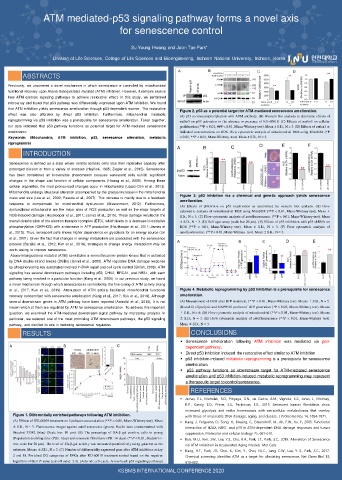
that ATM inhibition yields senescence amelioration through p53-dependent manner. The restorative Figure 2. p53 as a potential target for ATM-mediated senescence amelioration.
effect was also afforded by direct p53 inhibition. Furthermore, mitochondrial metabolic (A) p53 co-immunoprecipitation with ATM antibody. (B) Western blot analysis to determine effects of
reprogramming via p53 inhibition was a prerequisite for senescence amelioration. Taken together, nutlin3 on p53 activation in the absence or presence of KU-60019. (C) Effects of nutlin3 on cellular
our data indicated that p53 pathway functions as potential target for ATM-mediated senescence proliferation (**P < 0.01, ##P < 0.01, Mann-Whitney test). Mean ± S.D., N = 3. (D) Effects of nutlin3 at
amelioration. indicated concentrations on ROS. Flow cytometric analysis of mitochondrial ROS using MitoSOX (*P
Keywords: Mitochondria, ATM inhibition, p53, senescence alleviation, metabolic < 0.05, **P < 0.01, Mann-Whitney test). Mean ± S.D., N = 3.
reprogrammer
Senescence is defined as a state where normal somatic cells lose their replicative capacity after
prolonged division or from a variety of stresses (Hayflick, 1965; Ziegler et al., 2015). Senescence
has been considered an irreversible phenomenon because senescent cells exhibit significant
changes in the shape and function of cellular components (Hwang et al., 2009). Among these
cellular organelles, the most pronounced changes occur in mitochondria (López-Otín et al., 2013).
Mitochondria undergo structural alteration accompanied by the gradual increase in the mitochondrial
mass and size (Lee et al., 2002; Passos et al., 2007). This increase is mainly due to a feedback Figure 3. p53 inhibition via a chemical and genetic approach yields senescence
amelioration.
response to compensate for mitochondrial dysfunction (Westermann, 2012). Furthermore, (A) Effects of pifithrin-α on p53 inactivation as determined by western blot analysis. (B) Flow
dysfunctional mitochondria are the major sites of ROS production as well as the major targets of cytometric analysis of mitochondrial ROS using MitoSOX (**P < 0.01, Mann-Whitney test). Mean ±
ROS-induced damage (Houtkooper et al., 2011; James et al., 2015). These damage resulted in the S.D., N = 3. (C) Flow cytometric analysis of autofluorescence. (**P < 0.01, Mann-Whitney test). Mean
overall deterioration of the electron transport complex (ETC), which leads to a decrease in oxidative ± S.D., N = 3. (D) Soft agar assay (scale bar 20 μm). (E) Effects of p53 inhibition with p53 shRNA on
phosphorylation (OXPHOS) with a decrease in ATP production (Houtkooper et al., 2011; James et ROS (**P < 0.01, Mann-Whitney test). Mean ± S.D., N = 3. (F) Flow cytometric analysis of
al., 2015). Thus, senescent cells shows higher dependence on glycolysis for an energy source (Lin autofluorescence. (**P < 0.01, Mann-Whitney test). Mean ± S.D., N = 3.
et al., 2001). Given the fact that changes in energy metabolism are associated with the senescence
process (Barzilai et al., 2012; Kim et al., 2019), strategies to change energy metabolism may be
worth testing to improve senescence.
Ataxia-telangiectasia mutated (ATM) constitutes a serine/threonine protein kinase that is activated
by DNA double-strand breaks (DSBs) (Ismail et al., 2005). ATM regulates DNA damage response
by phosphorylating key substrates involved in DNA repair and cell cycle control (Shiloh, 2006). ATM
signaling has several downstream pathways including p53, CHK2, BRCA1, and NBS1, with each
pathway being involved in a particular function (Kang et al., 2005). In our previous study, we found
a novel mechanism through which senescence is controlled by the fine-tuning of ATM activity (Kang
et al., 2017; Kuk et al., 2019). Attenuation of ATM activity facilitated mitochondrial functional Figure 4. Metabolic reprogramming by p53 inhibition is a prerequisite for senescence
recovery concomitant with senescence amelioration (Kang et al., 2017; Kuk et al., 2019). Although amelioration.
several downstream genes in ATM pathway have been reported (Awasthi et al., 2015), it is not (A) Measurement of OCR after DFP treatment. (**P < 0.01, Mann-Whitney test). Means ± S.D., N = 5.
known which of them are regulated by ATM for senescence amelioration. To address this important (B and C) Glycolytic and OXPHOS portion of ATP generation (*P < 0.05, Mann-Whitney test). Means
question, we examined the ATM-mediated downstream signal pathway by microarray analysis. In ± S.D., N = 6. (D) Flow cytometric analysis of mitochondrial (**P < 0.01, Mann-Whitney test). Means
particular, we selected one of the most promising ATM downstream pathways, the p53 signaling ± S.D., N = 3. (E) Flow cytometric analysis of autofluorescence (**P < 0.01, Mann-Whitney test).
pathway, and clarified its role in mediating senescence regulation. Mean ± S.D., N = 3.
Senescence amelioration following ATM inhibition was mediated via p53-
dependent pathway.
Direct p53 inhibition induced the restorative effect similar to ATM inhibition
p53 inhibition-induced metabolic reprogramming is a prerequisite for senescence
amelioration.
p53 pathway functions as downstream target for ATM-mediated senescence
amelioration and p53 inhibition-induced metabolic reprogramming may represent
a therapeutic target to control senescence.
James, E.L., Michalek, R.D., Pitiyage, G.N., de Castro, A.M., Vignola, K.S., Jones, J., Mohney,
R.P., Karoly, E.D., Prime, S.S., Parkinson, E.K., 2015. Senescent human fibroblasts show
increased glycolysis and redox homeostasis with extracellular metabolomes that overlap
Figure 1. Differentially enriched pathways following ATM inhibition. with those of irreparable DNA damage, aging, and disease. J Proteome Res 14, 1854-1871.
(A) Effects of KU-60019 treatment on lipofuscin accumulation (**P < 0.01, Mann-Whitney test). Mean Kang, J., Ferguson, D., Song, H., Bassing, C., Eckersdorff, M., Alt, F.W., Xu, Y., 2005. Functional
± S.D., N = 3. Fluorescence images against autofluorescence (green). Nuclei were counterstained with interaction of H2AX, NBS1, and p53 in ATM-dependent DNA damage responses and tumor
Hoechst 33342 (blue) (Scale bar: 10 μm). (B) The percentage of SA-β gal positive cells in young suppression. Molecular and cellular biology 25, 661-670.
(Population doubling time (PD): 1day) and senescent fibroblasts (PD: 14 days) (**P < 0.01, Student’s t- Kuk, M.U., Kim, J.W., Lee, Y.S., Cho, K.A., Park, J.T., Park, S.C., 2019. Alleviation of Senescence
test; scale bar 20 μm). The level of SA-β-gal activity was measured quantitatively using galacton as the via ATM Inhibition in Accelerated Aging Models. Mol Cells.
substrate. Means ± S.D., N = 3. (C) Number of differentially expressed gene after ATM inhibition at day Kang, H.T., Park, J.T., Choi, K., Kim, Y., Choi, H.J.C., Jung, C.W., Lee, Y.-S., Park, S.C., 2017.
2 and 18. Enriched GO categories of DEGs after KU-60019 treatment ranked based on the negative Chemical screening identifies ATM as a target for alleviating senescence. Nat Chem Biol 13,
logarithm of their P-value (cut-off value: 2.3). (Asterisk: cell cycle, Arrow head: p53 signaling pathway). 616-623.

