


Page 13 - A. Aging
P. 13
CD9 induces cellular senescence and aggravates atherosclerotic plaque formation
3
1,2
Eok-Cheon Kim 1,2# , Youlim Son 1,2# , Jung Hee Cho 1,2# , Da-Woon Lee , Yong Seop Park , Jun-Hyuk Choi , Kyung-Hyun Cho , Ki-Sun Kwon , Jae-Ryong Kim 1,2*
4
1,2
5
1 Department of Biochemistry and Molecular Biology, Smart-aging Convergence Research Center, Department of Pathology, College of Medicine, Yeungnam
3
2
University, Daegu, 42415, Republic of Korea. School of Biotechnology, Yeungnam University, Gyeongsan, 38541, Republic of Korea. Aging Research Institute,
4
5
Korea Research Institute of Bioscience and Biotechnology, Daejeon, 34141, Republic of Korea.
#These authors contributed equally to this manuscript.
ABSTRACT INTRODUCTION
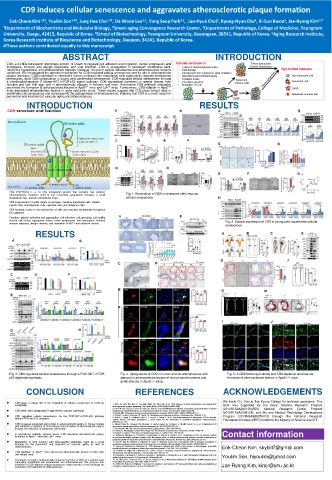
CD9, a 24 kDa tetraspanin membrane protein, is known to regulate cell adhesion and migration, cancer progression and Cellular senescence Tissue dysfunction
metastasis, immune and allergic responses, and viral infection. CD9 is upregulated in senescent endothelial cells, • Telomere shortening/dysfunction Chronic inflammation
neointima hyperplasia, and atherosclerotic plaques. However, its role in cellular senescence and atherosclerosis remains • DNA damage Age-related diseases
undefined. We investigated the potential mechanism for CD9-mediated cellular senescence and its role in atherosclerotic • Oncogene/Tumor suppressor gene activation
plaque formation. CD9 knockdown in senescent human umbilical vein endothelial cells significantly rescued senescence • Senoinflammation/Inflammaging Non-senescent cell
phenotypes, while CD9 upregulation in young cells accelerated senescence. CD9 regulated cellular senescence through • Oxidative stress
a phosphatidylinositide 3 kinase-AKT-mTOR-p53 signal pathway. CD9 expression increased in arterial tissues from • Chemotherapeutics Senescent Senescent cell
humans and rats with age, and in atherosclerotic plaques in humans and mice. Anti-mouse CD9 antibody noticeably • Irradiation, UV etc immune cells
prevented the formation of atherosclerotic lesions in ApoE −/− mice and Ldlr −/− mice. Furthermore, CD9 ablation in ApoE −/−
mice decreased atherosclerotic lesions in aorta and aortic sinus. These results suggest that CD9 plays critical roles in SASP
endothelial cell senescence and consequently the pathogenesis of atherosclerosis, implying that CD9 is a novel target for Senescent immune cell
prevention and treatment of vascular aging and atherosclerosis.
SASP
INTRODUCTION RESULTS
CD9 (TSPAN29) is a 24 kDa tetraspanin protein that contains four putative Fig. 1. Knockdown of CD9 in senescent cells rescues
transmembrane domains, short N and C-terminal cytoplasmic domains, a small
intracellular loop, and two extracellular loops. cellular senescence.
CD9 is expressed in a wide variety of cell types, including endothelial cells, smooth
muscle cells, hematopoietic cells, epithelial cells, and malignant cells.
CD9 localizes mainly in the membranes of cells and may also be detected throughout
the cytoplasm.
Function : platelet activation and aggregation, cell adhesion, cell spreading, cell motility,
muscle cell fusion, egg-sperm fusion, tumor progression and metastasis, humoral Fig. 2. Ectopic expression of CD9 in young cells accelerates cellular
immune response, allergic reaction, and replication of HIV-1 and influenza viruses.
senescence.
RESULTS
Fig. 3. CD9 regulates cellular senescence through a PI3K-AKT-mTOR- Fig. 4. Upregulation of CD9 in human and rat arterial tissues with Fig. 5. A CD9 blocking antibody and CD9 depletion alleviate the
p53 dependent pathway. age and in atherosclerotic lesions of human carotid arteries and formation of atherosclerotic lesions in ApoE−/− mice.
aortic sinuses in ApoE−/− mice.
CONCLUSION REFERENCES ACKNOWLEDGEMENTS
CD9 plays a critical role in the regulation of cellular senescence in HUVECs We thank G.J. Kim at Tae Kyung College for technical assistance. This
specifically. 1. Cho JH, Kim EC, Son Y, Lee DW, Park YS, Choi JH, et al. CD9 induces cellular senescence and aggravates work was supported by the Basic Science Research Program
atherosclerotic plaque formation. Cell Death Differ. 2020 Sep;27(9):2681-2696.
2. Kim TW, Kim HJ, Lee C, Kim HY, Baek SH, Kim JH, et al. Identification of replicative senescence-associated genes in human (2014R1A2A2A01004559), Medical Research Center Program
CD9 levels were upregulated in age-related vascular pathology. umbilicalvein endothelialcells by an annealing control primer system. Exp Gerontol. 2008;43:286–95.
3. Hemler ME. Tetraspanin functions and associated microdomains. Nat Rev Mol Cell Biol. 2005;6:801–11 (2015R1A5A2009124), and Bio and Medical Technology Development
CD9 regulates cellular senescence via the PI3K-AKT-mTOR-p53 pathway 4. Zhang F, Kotha J, Jennings LK, Zhang XA. Tetraspanins and vascular functions. Cardiovasc Res. 2009;83:7–15. Program (2013M3A9B6076413) through the National Research
5. Kotha J, Zhang C, Longhurst CM, Lu Y, Jacobs J, Cheng Y, et al. Functional relevance of tetraspanin CD9 in vascular
without DDR and p16 activation.
smooth muscle cell injury phenotypes: a novel target for the prevention of neointimal hyperplasia. Atherosclerosis. Foundation of Korea (NRF) funded by the Ministry of Science and ICT.
2009;203:377–86.
CD9 increases senescent cell burden in atherosclerotic lesions in mouse models 6. Munoz-Espin D, Canamero M, Maraver A, Gomez-Lopez G, Contreras J, Murillo-Cuesta S, et al. Programmed cell
and inhibition or ablation of CD9 reduces the formation of atherosclerotic plaque senescence during mammalian embryonic development. Cell. 2013;155:1104–18.
through the reduction of senescent cell burden. 7. van Deursen JM. The role of senescent cells in ageing. Nature. 2014;509:439–46.
8. Kuilman T, Michaloglou C, Mooi WJ, Peeper DS. The essence of senescence. Genes Dev. 2010;24:2463–79.
9. Rodier F, CampisiJ. Four faces of cellular senescence. J Cell Biol. 2011;192:547–56.
A neutralizing antibody against mouse CD9 alleviated atherosclerotic plaque for proheparin-binding epidermal growth factor-like growth factor, in human atherosclerotic plaques: possible involvement of Contact information
10. Nishida M, Miyagawa J, Yamashita S, Higashiyama S, Nakata A, Ouchi N, et al. Localization of CD9, an enhancer protein
formation in ApoE −/− mice and Ldlr −/− mice.
juxtacrine growth mechanism on smooth musclecell proliferation. ArteriosclerThromb Vasc Biol. 2000;20:1236–43.
Modulation of CD9 function with CD9-specific antibodies might be a novel 11. Iwai K, Ishii M, Ohshima S, Miyatake K, Saeki Y. Abundant expression of tetraspanin CD9 in activated osteoclasts in
strategy for the prevention and treatment of vascular aging, as well as ovariectomy-inducedosteoporosis and in bone erosions of collagen-inducedarthritis. RheumatolInt. 2008;28:225–31.
atherosclerosis. 12. Huang W, Febbraio M, Silverstein RL. CD9 tetraspanin interacts with CD36 on the surface of macrophages: a possible Eok-Cheon Kim, skybill7@gmail.com
regulatory influence on uptake of oxidized low density lipoprotein. PLoS ONE. 2011;6:e29092.
CD9 depletion in ApoE −/− mice decreased atherosclerotic lesions in both male 13. Febbraio M, Hajjar DP, Silverstein RL. CD36: a class B scavenger receptor involved in angiogenesis, atherosclerosis,
inflammation, and lipid metabolism. J Clin Investig. 2001;108:785–91.
and female mice. 14. Nakamoto T, Murayama Y, Oritani K, Boucheix C, Rubinstein E, Nishida M, et al. A novel therapeutic strategy with anti-CD9
antibody in gastric cancers. J Gastroenterol. 2009;44:889–96. Youlim Son, hiyoulim@gmail.com
Our study revealed a fundamentally important function of CD9 as a potent factor 15. Ko EM, Lee IY, Cheon IS, Kim J, Choi JS, Hwang JY, et al. Monoclonal antibody to CD9 inhibits platelet-induced human
controlling endothelial cell senescence and atherosclerosis. We propose that endothelial cell proliferation. Mol Cells. 2006;22:70–77.
inhibition of CD9-induced cellular senescence might provide a novel strategy for 16. Childs BG, Baker DJ, Wijshake T, Conover CA, Campisi J, van Deursen JM. Senescent intimal foam cells are deleterious at Jae-Ryong Kim, kimjr@ynu.ac.kr
prevention and treatment of atherosclerosis. all stages of atherosclerosis. Science. 2016;354:472–7.

