


Page 118 - Homes & Interiors Scotland
P. 118
Constructing a mezzanine can be carried out in one of two
              ways, explains Brown + Brown’s Andrew Brown, both of which   LISTED BUILDINGS
              will affect the look and feel of the new and existing levels: “The   Period buildings require an entirely different
              first uses a structure relatively independent of the building, and   approach, to protect their heritage and meet
              essentially ‘slots in’ the mezzanine. This has the benefit of not   stricter building regulations. The process is
              interfering with the existing structure, but will probably not   worthwhile, however, asserts Purcell’s Chris
              be suitable if the property is not on the ground floor, as it will   Betts: “Whether it’s a converted church or a
              potentially require its own foundations.”                  warehouse, the introduction of a mezzanine
                 The other, more common, method sees the mezzanine       floor can transform a building’s use and value.
                                                                         Architecturally, it creates vibrant, dynamic
              attached to the existing building, says Brown, as in the case of   spaces in areas otherwise le  redundant or
              upper-level properties such as that pictured top right, whose   under-utilised. It allows inaccessible areas
              minimal mezzanine tops off a sleek Mereway Modern Classic   to be brought into habitable use and, where
              kitchen, and period buildings such as that pictured below right,   costs per square foot are high, this can make
              anchored by Neville Johnson’s dark oak staircase, which respects   a considerable difference on development
                                                                         costs. When historic or listed buildings are
              the traditional features of the room and introduces glass
                                                                         converted, a mezzanine can make all the
                                                                         difference between simply rescuing the
                                                                         deteriorating building and achieving a viable
                                                                         solution for its reuse. Historic buildings
                                                                         particularly lend themselves to the insertion
                                                                         of mezzanines as the existing spaces are
                                                                         o en large and open. You find this especially
                                                                         in civic buildings.”


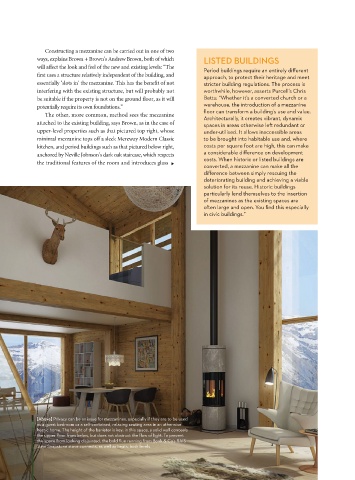
              [Above] Privacy can be an issue for mezzanines, especially if they are to be used
              as a guest bedroom or a self-contained, relaxing seating area in an otherwise
              hectic home. The height of the banister is key: in this space, a solid wall conceals
              the upper floor from below, but does not obstruct the flow of light. To prevent
              the space from looking disjointed, the bold flue running from Bonk & Co’s RAIS
              Juno Soapstone stove connects, as well as heats, both levels

