


Page 117 - Homes & Interiors Scotland
P. 117
PLANNING PERMISSION

                 Avoid stress and ensure you are fully aware
                 of the legalities and limitations involved with
                 building a mezzanine – these can make or
                 break your project and, in some cases, could
                 even require you to scrap it altogether. Nest’s
                 Debbie Happell offers her advice:
                 “If the mezzanine is internal and the building
                 is not listed, planning permission is not
                 required to build an extra level.
                   “If the mezzanine is within an existing
                 bedroom and is being constructed to sleep
                 on or be used as a small office etc, it is not
                 necessary to obtain a building warrant.
                   “On the other hand, if the mezzanine is
                 being constructed to create another room or
                 another floor, a building warrant should be
                 applied for. A structural engineer should be
                 enlisted to ensure the loadings and integrity
                 of the mezzanine are correct. Daylight,
                 ventilation and fire-escape requirements
                 must also be considered.
                   “Above all else, always contact the local
                 authority before carrying out any alterations.
                 You don’t want to build something that has to
                 be removed at a later stage.”


                 The stripped-back bare bones of the building should
              dictate the size and positioning of the mezzanine, but
              not necessarily the function. Consider what an extra level
              might add to your lifestyle and how can it change the
              way you use the room for the better. Desjardins Bherer’s
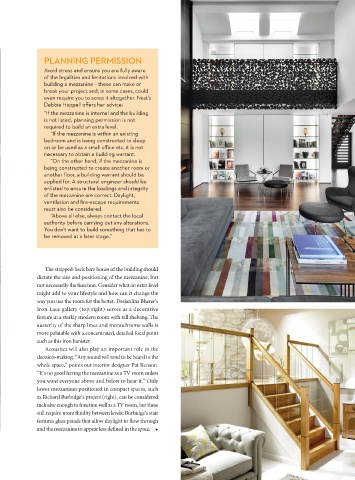
              Iron Lace gallery (top right) serves as a decorative
              feature in a starkly modern room with tall shelving. The
              austerity of the sharp lines and monochrome walls is
              more palatable with a concentrated, detailed focal point
              such as this iron banister.
                 Acoustics will also play an important role in the
              decision-making. “Any sound will tend to be heard in the
              whole space,” points out interior designer Pat Renson.
              “It’s no good having the mezzanine as a TV room unless
              you want everyone above and below to hear it.” Only
              lower mezzanines positioned in compact spaces, such
              as Richard Burbidge’s project (right), can be con sidered
              inclusive enough to function well as a TV room, but these
              still require more fluidity between levels: Burbidge’s stair
              features glass panels that allow daylight to flow through
              and the mezzanine to appear less defined in the space.

