


Page 9 - ebook
P. 9
Inactivation Mechanism for Viruses and Bacteria


            ▣ How does the inactivation system work against viruses?
            ▶ There are many viruses that are still not identified but most of identified viruses
            have an envelope. Such viruses are inactivated by the enzyme dissolving the envelope.
            Without the envelope, Viruses cannot invade host cells because no spikes remain.

            ▶ Influenza is an envelope virus, thus the inactivation system is also effective against
            swine or avian flu.

            ▣ Lytic Enzyme

            ▶ dissolves cell wall of bacteria and fungi hyphae; decomposes to a molecular level
            ▶ 6 Major classes of enzymes oxidoreductase / transferase / lyase / isomerase /
            synthetase(ligase) / hydrolase → Lytic enzyme belongs to the hydrolase enzyme class.


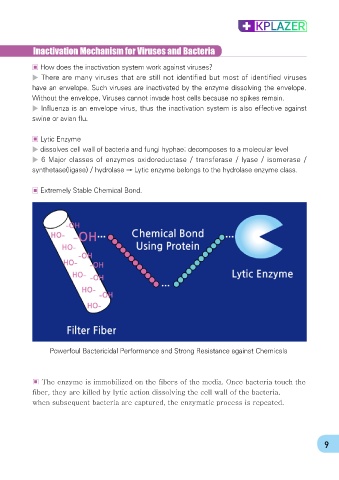
            ▣ Extremely Stable Chemical Bond.


                   Powerfoul Bactericidal Performance and Strong Resistance against Chemicals


            ▣ The enzyme is immobilized on the fibers of the media. Once bacteria touch the
            fiber, they are killed by lytic action dissolving the cell wall of the bacteria.
            when subsequent bacteria are captured, the enzymatic process is repeated.


                                                                                                                   9

