


Page 255 - ebook
P. 255
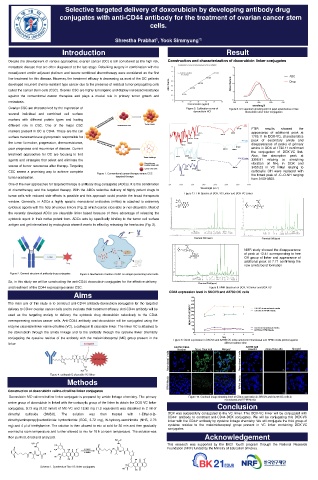
Selective targeted delivery of doxorubicin by developing antibody drug
conjugates with anti-CD44 antibody for the treatment of ovarian cancer stem
cells.
Shrestha Prabhat , Yook Simmyung *1
1
College of Pharmacy, Keimyung University, Daegu, 42601, Republic of Korea
1
Introduction Result
Despite the development of various approaches, ovarian cancer (OC) is still considered as the high risk, Construction and characterization of doxorubicin linker conjugates
Calibration Curve of Doxorubicin HCl in DMSO
metastatic disease that are often diagnosed at the late stage. Debulking surgery in combination with the 1.4 4
neoadjuvant and/or adjuvant platinum and taxane combined chemotherapy were considered as the first 1.2 y = 0.0222x + 0.0444 1.143
R² = 0.9982 3
1 ADC
line treatment for this disease. However, the treatment efficacy is decreasing as most of the OC patients 0.8 0.939
developed recurrent chemo-resistant type cancer due to the presence of residual tumor-propagating cells Absorbance 0.6 0.705 Absorbance 2 Drug
called the cancer stem cells (CSC). Ovarian CSC are highly tumorigenic and display increased resistance 0.4 0.509
1
against the conventional cancer therapies and plays a crucial role in primary tumor growth and 0.2 0.25
metastasis. 0 0 10 20 30 40 50 60 0 300 400 500 600 700
Concentration (μg/ml) wavelength
Ovarian CSC are characterized by the expression of Figure 5. Calibration curve of Figure 6. UV-spectrum showing shift in peak absorbance of free
doxorubicin HCl doxorubicin after inker conjugation
several individual and combined cell surface
markers with different protein types and having
different role in CSC. One of the major CSC Persistence of CSC Tumor relapse DOX
3525.83 FTIR results showed the
markers present in OC is CD44. These are the cell
1733.11 2895.87 3306.91 appearance of additional peak at
surface transmembrane glycoprotein responsible for 1614.81 1705.11 in DOX-VC, characteristics
1412.85 1579.95 peak of secondary amide and
the tumor formation, progression, chemoresistance, 1070.21 1282.09 VC Linker
988.18 disappearance of peaks of primary
3450.23
poor prognoses and recurrence of disease. Current 2939.38 3324.81 amine in DOX at 1730.11 confirmed
the conjugation of DOX-VC link.
treatment approaches for OC are focusing to find Also, the absorption peak at
Tumor shrinkage 828.36 1208.65 1698.31 DOX-VC Linker
1698.31
agents and strategies that select and eliminate the 1541.75 3306.91 relating to stretching
Chemotherapy vibration of NH 2 in DOX and
source of tumor recurrence after therapy. Targeting sensitive tumor cells 3450.23 in VC linker relating to
Cancer stem cells 1212.29 1644.25 3369.88
CSC seems a promising way to achieve complete 1705.11 carboxylic OH were replaced with
Figure 1. Conventional cancer therapy versus CSC the broad peak of -C=O-NH ranging
tumor eradication. targeted therapy 1013.34 from 3100-3500.
One of the new approaches for targeted therapy is antibody drug conjugates (ADCs). It is the combination 500 1000 1500 2000 2500 3000 3500 4000
-1
of chemotherapy and the targeted therapy. With the ADCs selective delivery of highly potent drugs to Wavelength (cm )
Figure 7. FTIR Spectra of DOX, VC Linker and DOX-VC Linker
tumor cells with reduced side effects is possible and this approach could provide the broad therapeutic
window. Generally, in ADCs a highly specific monoclonal antibodies (mAbs) is attached to extremely H 2 N O O OH O O O H 2 N HN O
HO
HO N NH O
cytotoxic agents with the help of various linkers (Fig. 2) which can be cleavable or non-cleavable. Most of HO O OH O O O NH O OH
the recently developed ADCs are cleavable linker based because of there advantage of releasing the
cytotoxic agent in their native potent form. ADCs acts by specifically binding to the tumor cell surface
antigen and get internalized by endocytosis where it exerts its effect by releasing the free toxins (Fig. 3).
Chemical Shift (ppm) Chemical Shift (ppm)
H 2 N O
HN
O
O
N NH H N NMR study showed the disappearance
NH
O O O
O
O OH O O of peak at 12.41 corresponding to free
HO
HO OH group of linker and appearance of
O OH O
additional peak at 7.71 confirming the
new amide bond formation
Figure 2. General structure of antibody drug conjugates Figure 3. Mechanism of action of ADC on antigen presenting tumor cells
So, in this study we will be constructing the anti-CD44 doxorubicin conjugates for the effective delivery
Chemical Shift (ppm)
and treatment of the CD44 expressing ovarian CSC. Figure 8. NMR Spectrum of DOX, VC linker and DOX-VC
Aims CD44 expression level in SKOV3 and A2780 OC cells
500
450
The main aim of this study is to construct anti-CD44 antibody-doxorubicin conjugates for the targeted 400
delivery to CD44 ovarian cancer cells and to evaluate their treatment efficacy. Anti-CD44 antibody will be 350 SKOV3 in neurobasal media
+
SKOV3 in RPMI media
300
used as the targeting moiety to delivery the cytotoxic drug doxorubicin selectively to the CD44 MEAN FITC INTENSITY 250
overexpressing ovarian cancer cells. Anti-CD44 antibody and doxorubicin will be conjugated using the 200
150
enzyme cleavable linker valine-citrulline (VC), a cathepsin B cleavable linker. The linker VC is attached to 100
50 A2780 in neurobasal media
A2780in RPMI Media
the doxorubicin through the amide linkage and to the antibody through the cysteine linker chemistry 0
0 1 2 3 4 5 6
conjugating the cysteine residue of the antibody with the maleimidocaproyl (MC) group present in the Day
Figure 9. CD44 Expression in SKOV3 and A2780 OC cells cultured in Neurobasal and RPMI media plotted against
linker. different culture time
SKOV3 CELL A2780 Cell
Hoechst Alexa Flour 488 Merged Hoechst Alexa Flour 488 Merged
Neurobasal Media Neurobasal Media
Figure 4. cathepsin B cleavable VC linker
Methods RPMI Media RPMI Media
Construction of doxorubicin valine-citrulline linker conjugates
Doxorubicin MC-valine-citrulline linker conjugate is prepared by amide linkage chemistry. The primary Figure 10. Confocal image showing level of CD44 expression in SKOV3 and A2780 OC cells in
neurobasal and RPMI Media
amine group of doxorubicin is linked with the carboxylic group of the linker to obtain the DOX-VC linker
conjugates. 9.13 mg (0.02 mmol) of MC-VC and 13.92 mg (1.2 equivalent) was dissolved in 2 ml of Conclusion
dimethyl sulfoxide (DMSO). The solution was then treated with 1-Ethyl-3-[3- DOX was successfully conjugated to the VC linker. This DOX-VC linker will be conjugated with
CD44 antibody to construct anti-CD44-DOX conjugates. We will be conjugating this DOX-VC
+
dimethylaminopropyl]carbodiimide hydrochloride (EDC, 3.72 mg), N-hydroxy-succinimide (NHS, 2.76 linker with the CD44 antibody by cysteine linkage chemistry. We will conjugate the thiol group of
+
mg) and 4 μl of triethylamine. The solution is then allowed to mix at cold for 30 min and then gradually cysteine residue to the maleimidocaproyl group present in VC linker containing DOX-VC
conjugates.
warmed to room temperature and further allowed to mix for 16 h at room temperature. The solution was
then purified, dried and analyzed. Acknowledgement
H N O
2
H N O HN This research was supported by the BK21 fourth program through the National Research
2
HO O
O HN O EDC/NHS N NH O H Foundation (NRF) funded by the Ministry of Education of Korea.
2
O + H N O OH O O NH N
N NH In DMSO O O O
NH OH HO O
O O HO
O
O OH O O OH O O
HO
Scheme 1. Synthesis of Dox-VC linker conjugates
HO
O OH O

