


Page 229 - ebook
P. 229
Autophagy context-based drug repurposing
approach with Parkinson's disease-specific network
1,2
1,2
1,2
1,2
Seunghwan Jung , Junseok Park , Jaywook Han , Doheon Lee *
1 Department of Bio and Brain Engineering, Korea Advanced Institute of Science and Technology (KAIST)
2 Bio-Synergy Research Center, KOREA
Summary
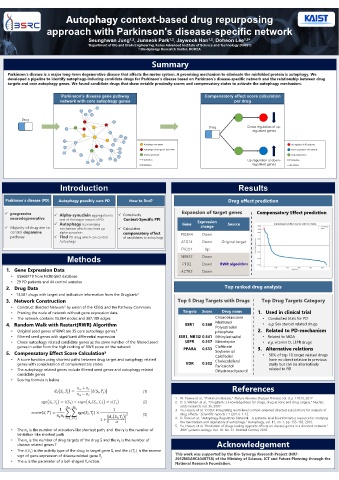
Parkinson's disease is a major long-term degenerative disease that affects the motor system. A promising mechanism to eliminate the misfolded protein is autophagy. We
developed a pipeline to identify autophagy-inducing candidate drugs for Parkinson's disease based on Parkinson's disease-specific network and the relationship between drug
targets and core autophagy genes. We found candidate drugs that show notable proximity scores and compensatory states to activate the autophagy mechanism.
Parkinson’s disease gene pathway Compensatory effect score calculation
network with core autophagy genes per drug
Drug
Drug Down regulation of up-
regulated genes
Autophagy core genes Up-regulated in PD patients
Autophagy related genes from RWR Down-regulated in PD patients
Drug target genes Drug target genes
Activation Up regulation of down- Activation
regulated genes
Inhibition Inhibition
Introduction Results
Parkinson’s disease (PD) Autophagy possibly cure PD How to find? Drug effect prediction
progressive Alpha-synuclein aggregation is Constructs Expansion of target genes Compensatory Effect prediction
neurodegenerative one of the major reason of PD Context-Specific PPI
Autophagy is promising Gene Expression Source
Majority of drug aim to mechanism which can clean up Calculates change
control dopamine alpha-synuclein compensatory effect PIK3R4 Down
pathway Find PD drug which can control of candidates to autophagy
Autophagy ATG14 Down Original target
FYCO1 Up
Methods NRBF2 Down
PTD2 Down RWR algorithm
1. Gene Expression Data ACTR2 Down
• GSE68719 from NCBI GEO database
• 29 PD patients and 44 control samples
2. Drug Data Top ranked drug analysis
• 13,581 drugs with target and indication information from the Drugbank 2
3. Network Construction Top 5 Drug Targets with Drugs Top Drug Targets Category
3
• Construct directed Network by union of the KEGG and the Pathway Commons
• Pruning the node of network without gene expression data Targets Score Drug name 1. Used in clinical trial
• The network contains 15,364 nodes and 397,189 edges Chlorotrianisene • Conducted trials for PD
4. Random Walk with Restart(RWR) Algorithm ESR1 0.568 Mestranol • e.g. Sex steroid related drugs
Polyestradiol
• Original seed genes of RWR are 35 core autophagy genes. 4 phosphate 2. Related to PD-mechanism
• Filtered seed genes with significant differential expression ESR1, NR1I2 0.541 Ethinylestradiol • Related to MOA
• Chose autophagy related candidate genes as the same number of the filtered seed LEPR 0.537 Metreleptin • e.g. vitamin D, LEPR drugs
genes in order from the high ranking of RWR score on the network PPARA 0.533 Clofibrate 3. Alternative relations
5. Compensatory Effect Score Calculation 5 Soybean oil • 50% of top 10 target related drugs
Calcifediol
• A score function using shortest paths between drug target and autophagy related Cholecalciferol have no direct relation in previous
genes with consideration of complementary states VDR 0.532 Paricalcitol study but can be alternatively
• The autophagy related genes include filtered seed genes and autophagy related Dihydrotachysterol related to PD
candidate genes
• Scoring formula is below
, , (1) References
1. W. Poewe et al., "Parkinson disease," Nature Reviews Disease Primers, vol. 3, p. 17013, 2017
(2) 2. D. S. Wishart et al., "DrugBank: a knowledgebase for drugs, drug actions and drug targets," Nucleic
sgn , ,
acids research, vol. 36, 2007
1 1 3. Yu, Hasun, et al. "CODA: Integrating multi-level context-oriented directed associations for analysis of
, sgn , (3) drug effects." Scientific reports 7.1 (2017): 1-12.
1 , 4. D. Türei et al., "Autophagy Regulatory Network—A systems-level bioinformatics resource for studying
the mechanism and regulation of autophagy," Autophagy, vol. 11, no. 1, pp. 155-165, 2015.
5. Yu, Hasun, et al. "Prediction of drugs having opposite effects on disease genes in a directed network."
• The n a is the number of actvation-like shortest path, and the n i is the number of BMC systems biology. Vol. 10. No. S1. BioMed Central, 2016.
inhibition-like shortest path
• The n s is the number of drug targets of the drug S and the n t is the number of
disease related genes T Acknowledgement
• The is the activity type of the drug to target gene S i and the is the reverse
This work was supported by the Bio-Synergy Research Project (NRF-
sign of gene expression of disease related gene T j
• The α is the parameter of a bell-shaped function. 2012M3A9C4048758) of the Ministry of Science, ICT and Future Planning through the
National Research Foundation.

