Page 5 - ebook
P. 5

관관 ID관 rId5관 관관관 관관관 관관관관 관관 관 관관관관.


                                                                   Expression of c-Jun and KROX-20 on facial nerve


                                                                                    degeneration and regeneration in a rat model


                                                                                                                                                                                               1                                                            1                                                     1                                                                            2

                                                                                                                               Seung Geun Yeo , In Hyeok Kim , Jae Min Lee , Dong Choon Park


                                                                1  Department of Otorhinolaryngology - Head & Neck Surgery, School of Medicine, Kyung Hee University, Seoul, Korea


                                                               2  Department of Obstetrics and Gynecology, St. Vincent’s Hospital, The Catholic University of Korea, Suwon, Korea


            Introduction


           • Facial paralysis, although not a life-threatening condition, is one of the most important


                  conditions requiring a complete cure because it has devastating effects on patients’


                  emotional and social lives. Various treatments have been tested to cure facial paralysis,


                  and considerable research has attempted to identify the mechanisms underlying damage


                  to and regeneration of facial nerves.


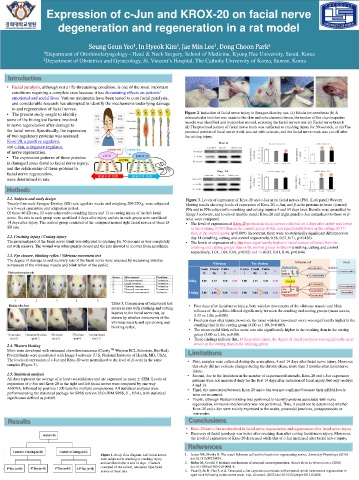
           • The present study sought to identify                                                                                                                                                                                                                       Figure 2. Induction of facial nerve injury in Sprague-Dawley rats. (a) Ihhalation anesthesia (b) A


           some of the biological factors involved                                                                                                                                                                                                                      retroauricular incision was made in the skin and subcutaneous tissue, the tendon of the clavotrapezius

                                                                                                                                                                                                                                                                        muscle was identified and its position moved, exposing the facial nerve trunk (c) Facial nerve branch
           in nerve regeneration after damage to                                                                                                                                                                                                                        (d) The proximal portion of facial nerve trunk was subjected to crushing injury for 30 seconds, or (e) The


           the facial nerve. Specifically, the expression                                                                                                                                                                                                               proximal portion of facial nerve trunk was cut with scissors, and the facial nerve trunk was cut off after


           of two regulatory proteins was assessed:                                                                                                                                                                                                                     the cutting injury.


           Krox-20, a positive regulator,


           and c-Jun, a negative regulator,


           of nerve regeneration.


           • The expression patterns of these proteins


           in damaged areas distal to facial nerve injury,


           and the relationship of these proteins to


           facial nerve regeneration,


           were determined in rats.


          Methods


           2.1. Subjects and study design                                                                                                                                                                                                                                Figure 3. Levels of expression of Krox-20 and c-Jun in rat facial nerves (FN). (Left panel) Western


           Twenty-four male Sprague-Dawley (SD) rats, aged six weeks and weighing 200-250 g, were subjected                                                                                                                                                              blotting results showing levels of expression of Krox-20, c-Jun, and     -actin proteins in intact (control)


           to a 1-week quarantine and adaptation period.                                                                                                                                                                                                                 FNs and in FNs subjected to crushing and cutting injuries 4 and 14 days later. Results were quantified by


           Of these 40 SD rats, 12 were subjected to crushing injury and 12 to cutting injury of the left facial                                                                                                                                                         Image J software, and levels of (middle panel) Krox-20 and (right panel) c-Jun normalized to those of     -


           nerve. Six rats in each group were sacrificed 4 days after injury and six in each group were sacrificed                                                                                                                                                       actin were compared.


           14 days after injury. The control group consisted of the uninjured normal right facial nerves of these 24                                                                                                                                                     • The level of expression of Krox-20 proteins in facial nerves collected on 4 days after injury was lower


           SD rats.                                                                                                                                                                                                                                                             in the crushing (0.70) than in the control group (0.82), and significantly lower in the cutting (0.57)


                                                                                                                                                                                                                                                                                than in the control group (p=0.009). In contrast, there were no statistically significant differences on

           2.2. Crushing injury / Cutting injury                                                                                                                                                                                                                                day 14 (crushing, cutting and control respectively, 0.58, 0.67, 0.71, p=0.436).


           The proximal part of the facial nerve trunk was subjected to crushing for 30 seconds or was completely                                                                                                                                                        • The levels of expression of c-Jun were significantly higher in facial nerves collected from the


           cut with scissors. The wound was subsequently closed and the rats allowed to recover from anesthesia.                                                                                                                                                                crushing and cutting groups than in the normal group on days 4 (crushing, cutting and control


                                                                                                                                                                                                                                                                                respectively, 1.01, 1.04, 0.68, p=0.02) and 14 (0.83, 0.81, 0.48, p=0.046)

           2.3. Eye closure, blinking reflex / Vibrissae movement test


           The degree of damage to and recovery rate of the facial nerve were assessed by measuring whisker


           movement of the vibrissae muscle and blink reflex of the eyelid.                                                                                                                                                                                                                                     Vibrissae                                              Eye closing


                                                                                                                                                                                                                                                                                              Contr Crushi Cuttin                            p        Contro Crushi Cuttin                             p

                                                                                                                                                                                                                                                                                                  ol            ng              g                           l            ng               g


                                                                                                                                                                                                                                                                             4day               5.00          1.33           1.00          0.00          5.00           1.33           1.00          0.00


                                                                                                                                                                                                                                                                                                                   *                                                           *

                                                                                                                                                                                                                                                                             14day              5.00          4.00           1.00         0.003          5.00           5.00           1.66          0.00


                                                                                                                                                                Table 3. Comparison of behavioral test


                                                                                                                                                                scores in rats with crushing and cutting                                                                      • Four days after facial nerve injury, both whisker movements of the vibrissae muscle and blink


                                                                                                                                                                injuries to the facial nerve rats, as                                                                                reflexes of the eyelids differed significantly between the crushing and cutting groups (mean scores,


                                                                                                                                                                shown by whisker movements of the                                                                                    1.33 vs 1.00, p=0.00).


                                                                                                                                                                vibrissae muscle and eye closing and                                                                          • Fourteen days after injury, however, the mean whisker movement score was significantly higher in the


                                                                                                                                                                blinking reflex.                                                                                                     crushing than in the cutting group (4.00 vs 1.00, 0=0.003).

                                                                                                                                                                                                                                                                              • The mean eyelid blink reflex score was also significantly higher in the crushing than in the cutting


                                                                                                                                                                                                                                                                                     group (5.00 vs 1.66, p=0.00).


                                                                                                                                                                                                                                                                              • These findings indicate that, 14 days after injury, the degree of facial paralysis was significantly more


           2.4. Western blotting                                                                                                                                                                                                                                                     severe in the cutting than in the crushing group


           Blots were developed with enhanced chemiluminescence (Clarity™ Western ECL Substrate, Bio-Rad).                                                                                                                                                                  Limitations


           Protein bands were quantitated with Image J software (U.S. National Institutes of Health, MD, USA).


           The levels of expression of c-Jun and Krox-20 were normalized to the level of     -actin in the same                                                                                                                                                             • First, samples were collected during the acute phase, 4 and 14 days after facial nerve injury. However,


           samples (Figure 3).                                                                                                                                                                                                                                                     this study did not evaluate changes during the chronic phase, more than 3 months after facial nerve


                                                                                                                                                                                                                                                                                   injury.

           2.5. Statistical analysis                                                                                                                                                                                                                                        • Second, due to the limitation in the number of experimental animals, Krox-20 and c-Jun expression


           All data represent the average of at least two replicates and are expressed as mean ± SEM. Levels of                                                                                                                                                                    patterns were not measured daily for the first 14 days after induction of facial injury, but only on days


           expression of c-Jun and Krox-20 in the right and left facial nerves were compared by one-way                                                                                                                                                                            4 and 14.


           ANOVA, followed by post hoc LSD tests for multiple comparisons. All statistical analyses were                                                                                                                                                                    • Third, the association between Krox-20 and c-Jun was not confirmed because their mRNA levels


           performed using the statistical package for SPSS version 25.0 (IBM SPSS, IL, USA), with statistical                                                                                                                                                                     were not measured.


           significance defined as p<0.05.                                                                                                                                                                                                                                  • Fourth, although Western blotting was performed to identify proteins associated with nerve


                                                                                                                                                                                                                                                                                   regeneration, immunohistochemistry was not performed. Thus, it could not be determined whether


                                                                                                                                                                                                                                                                                   Krox-20 and c-Jun were mainly expressed in the nodes, paranodal junctions, juxtaparanodes or


                                                                                                                                                                                                                                                                                   internodes.


            Results                                                                                                                                                                                                                                                          Conclusions


                                                                                                                                                                                                                                                                          • Krox-20 and c-Jun are involved in facial nerve degeneration and regeneration after facial nerve injury


                                                                                                                                                                                                                                                                          • Recovery of facial paralysis was better after crushing than after cutting facial nerve injury, Moreover,


                                                                                                                                                                                                                                                                                 the level of expression of Krox-20 decreased while that of c-Jun increased after facial nerve injury.


                                                                                                                                                                                                                                                                            References


                                                                                                                                                Figure 1. Study flow diagram. Left facial nerves                                                                        1. Jessen KR, Mirsky R. The repair Schwann cell and its function in regenerating nerves. Journal of Physiology (2016)

                                                                                                                                                were subjected to crushing or crushing injury                                                                                   doi:10.1113/JP270874.


                                                                                                                                                and sacrificed after 4 and 14 days.  Controls                                                                           2. Mahar M, Cavalli V. Intrinsic mechanisms of neuronal axon regeneration. Nature Reviews Neuroscience (2018)


                                                                                                                                                consisted of the normal, uninjured right facial                                                                                 doi:10.1038/s41583-018-0001-8

                                                                                                                                                nerves of these rats.                                                                                                   3. Yuan Q, Su H, Guo J, et al. Decreased c-Jun expression correlates with impaired spinal motoneuron regeneration in

                                                                                                                                                                                                                                                                                aged mice following sciatic nerve crush. Exp. Gerontol. (2012) doi:10.1016/j.exger.2012.02.006
   1   2   3   4   5   6   7   8   9   10